
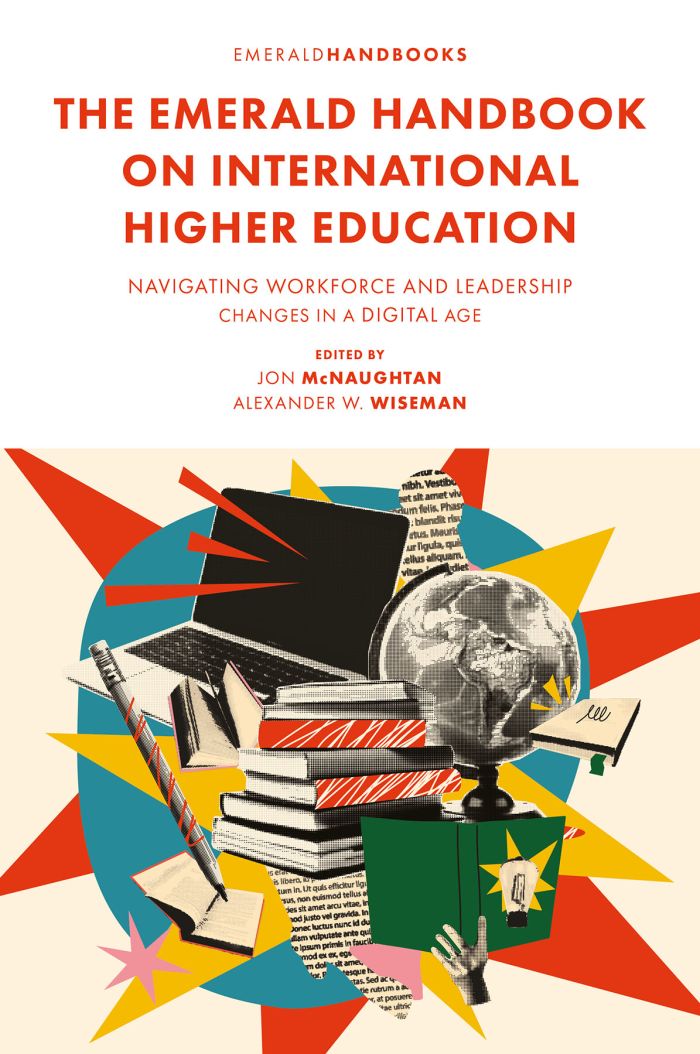

The Emerald Handbook on International Higher Education
Navigating Workforce and Leadership Changes in a Digital Age

This book can be opened with

Note on our eBooks and Audiobooks: you can read our eBooks (ePUB or PDF) and listen to audiobooks on the free Emerald Books app on iOS, Android, and desktop. Or read and listen on Emerald's online reader (ePUB eBooks and audiobooks only). To purchase a digital book you will need to create an account if you don’t already have one. After purchasing you will receive instructions on how to get started.
- Description
- Contents
- About
The Emerald Handbook on International Higher Education is a comprehensive and structured exploration of the challenges and opportunities arising from the digital age's impact on workforce and leadership in higher education institutions. Chapters provide evidence-based guidance, real-world examples, and valuable resources to equip educational leaders, administrators, faculty and all stakeholders with the knowledge and strategies necessary to excel in this transformative era of international higher education.
Contributing international scholars and experts from various disciplines delve into the challenges and opportunities associated with a globally dispersed and increasingly diverse pool of employees. They examine how universities harness talent from around the world and how this workforce diversity can lead to innovation and cross-cultural collaboration. Featuring an extensive collection of new and diverse case studies from higher education institutions and systems worldwide, these real-world scenarios offer practical, on-the-ground insights into the challenges and successes of global education. Readers can draw from these case studies to inform their own strategies and decision-making processes, allowing for immediate application and relevance in their respective contexts.
The Emerald Handbook on International Higher Education is a new and significant contribution to the research in a new era of education, with remote work and online learning becoming more prevalent than ever before. It will be of special interest to international higher education researchers, leaders, administrators, faculty members and policy makers.
Introduction to the Handbook; Jon McNaughtan and Alexander W. Wiseman
- Part I. The Changing Landscape of International Higher Education
- Chapter 1. Disability and Employability in Higher Education Research - A Comprehensive Review; Paul Othusitse Dipitso and Fadzayi M. Maruza
- Chapter 2. Adapting to Change: Navigating International Student Academic and Career Needs in a New Era; Lixing Li and Andrea Yuan Zhou
- Chapter 3. Review of the Effect of COVID-19 on Online Learning in International Higher Education; Simge Engelkiran
- Chapter 4. Navigating Digital Transformation in International Higher Education: An EdTech Mapping of the Emerging Global Educational Ecosystem; Annie Snelson-Powell, Daniela Defazio, and Dimo Dimov
- Part II. Workforce Diversity and Talent Management
- Chapter 5. Academic Mobility and Workforce Diversity in Higher Education; MD Bayezid Islam and Brian P. An
- Chapter 6. Alternative Educational Pathways: Stackable and Micro-Credentials to Bridge Education and Employment; Justin R Louder
- Chapter 7. The Role of Workforce Diversity in Driving Talent Management and Institutional Performance in Higher Education; Mallak Rashid Al Maqarshi and Salim Bakhit Al Daraai
- Part III. Remote Work in Higher Education
- Chapter 8. The Tension of Digital Transformation & Flexible Work Arrangements; Catherine Shepard and Jon McNaughtan
- Chapter 9. Navigating the Horizon: Remote Work in Higher Education Management; Diana Cvita, Juani Swart, and John L. Davies
- Chapter 10. University Policies on Employee Remote/Hybrid Work: Would Converging Policies Entail Any Sustainable Change in Institutional Operations?; Ya Xuan Wang and Qiang Zha
- Chapter 11. Gender Dimensions of Precarity in the Academic Job Market - A Comparative View of the United States and Austria; Sarah Schiffecker, Franziska Lessky, and Corinna Geppert
- Part IV. Online Learning in the Digital Age
- Chapter 12. What’s AI for Academics: Making Sense of Change in the Academic World of Work; Fahdia Khalid
- Chapter 13. How AI, the Metaverse, and NFTs could Challenge U.S. Immigration Regulations and Reshape International Education; Hanna Lee
- Chapter 14. Investigating the Online Education Market: A Comparative Analysis of Public and Private Ed-tech; Sneha Bhasin and Nooria Rehman
- Chapter 15. Sticky Campuses or Hybrid Hubs? Getting (Un)stuck in the Academic Workplace; Amy Scott Metcalfe
- Part V. Understanding and Engaging Artificial Intelligence in Leadership and Learning
- Chapter 16. Response of International Higher Education to AI Challenge: Educational Policies and Precautions; Evgeniy Terentev, Anna Grigoreva, Ekaterina Minaeva, Guang Yang, and Na Li
- Chapter 17. Digital Dislocation during times of Universities in Managerial Crisis; Anita Louise Wheeldon
- Chapter 18. Africanizing the Artificial Intelligence Education in South African Universities; Yilun Jiang
- Part VI. Leadership in International Higher Education
- Chapter 19. Research Integrity and Research Security in International Research Collaborations: Engaged Higher Education Leadership Addressing Emerging Challenges in a Digital Age; Takehito Kamata
- Chapter 20. Educators in the Post Covid Digital Era: An Enquiry through the Transformational Leadership Lens; Anupama Sadasivan, Divya Dosaya, and Athira M.
- Chapter 21. Servant Teachers and Online Learning in Higher Education: A narrative Enquiry into experiences of teachers during COVID-19 outbreak; Divya Dosaya, Anupama Sadasivan, Sonia David, Athira M., and Palak Pipalia
- Chapter 22. On the Importance of Cultural Intelligence in Higher Education Leadership: Through the lens of Neo-Institutionalism; Linda du Plessis, Nkosinathi Tom, and Yvonne du Plessis
- Chapter 23. Making Virtual Internationalization Work Across Disciplines: The Role of University Leaders; Eveke de Louw and Pouneh Eftekhari
- Chapter 24. Navigating leadership roles: Native English-speaking teachers in English language teaching in China; Zhidan Zhou, Stephen M. Croucher, Mingsheng Li, and Georgeta Hodis
- Part VII. Case Studies from around the World
- Chapter 25. Internationalization of The Curriculum: How to Assess in the Era of ChatGPT - A Mexican Perspective; María Cruz Cuevas Álvarez and Marcos Pérez Mendoza
- Chapter 26. Private Sector Partnerships for the Public Good: A Toolkit for Supporting University Students’ Career Development in Kosovo; Chris Kromphardt, Cassie Barnhardt, Mark Anthoney, and Zoie Schares
- Chapter 27. Unpacking the Impact of Collaborative Online International Learning on Educators and Students: A reflective case study; Gabriella Rodolico, Mark Breslin, Rhona Brown, Ashley Lewis-Cole, Abimbola Abodunrin, Neeraja Dashaputre, Annamaria Mariani, and Casey Dinger
- Chapter 28. UGC and its Transformative Role in Higher Education in India: A Glimpse into NEP 2020 and Digital Initiatives; Sonal Mobar Roy
- Part VIII. Practical Tools and Resources
- Chapter 29. A Policy Guide for Education Leaders On Ways to Establish a Co-Understanding Of 'Human Work' And Originality Integrated With the Positive Use Of AI In Students And Academic Staff; Fawad Khaleel, Patrick Harte, and Alija Avdukic
- Chapter 30. Conclusion - Navigating Forward: Global Workforce and Leadership Futures in Higher Education; Alexander W. Wiseman and Jon McNaughtan
Jon McNaughtan is an Associate Professor of Higher Education at Texas Tech University where his research focuses on leadership and organizational behavior in higher education from multiple perspectives.
Alexander W. Wiseman is Professor of Educational Leadership and Policy and Associate Dean for Research, Outreach and Engagement in the College of Education at Texas Tech University.