
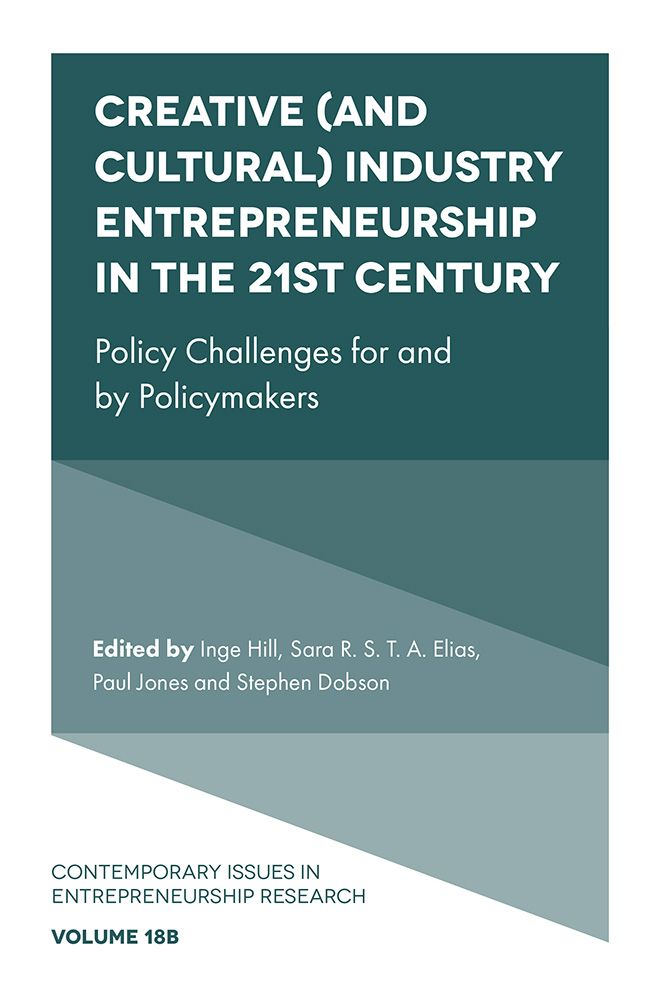

Creative (and Cultural) Industry Entrepreneurship in the 21st Century
Policy Challenges for and by Policymakers

This book can be opened with

Note on our eBooks and Audiobooks: you can read our eBooks (ePUB or PDF) and listen to audiobooks on the free Emerald Books app on iOS, Android, and desktop. Or read and listen on Emerald's online reader (ePUB eBooks and audiobooks only). To purchase a digital book you will need to create an account if you don’t already have one. After purchasing you will receive instructions on how to get started.
- Description
- Contents
- About
Creative and cultural industries are growing in almost every nation around the world and over the last two decades have contributed to global, national, and local economies significantly. More recently, policy makers and those who start these creative businesses have demonstrated a greater interest in how creative entrepreneurs create, sustain and market their services and products. And how contexts influence their ‘doing business’ is of increasing importance.
Both volumes of Creative (and Cultural) Industry Entrepreneurship in the 21st Century map and elucidate the adaptations and challenges faced by the creative professionals and the entrepreneurial solutions they have co-developed. Illuminating how contexts and recent socio-economic disruptive challenges influence how value is created and maintained from start-up to growth and exit, the chapter authors take a fresh look at creative micro-businesses and SMEs, the processes leading to their formation, developments and their founders. This volume 2 adds a focus on how creative ventures could contribute to economic development and the challenges policy makers face.
Contemporary Issues in Entrepreneurship Research is an official book series of the Institute for Small Business and Entrepreneurship (ISBE). Each volume is designed around a specific theme of importance to the entrepreneurship and small business community with articles collectively exploring and developing theory and practice in the field.
Chapter 1. Creative and cultural industry entrepreneurship in the 21st century: Challenges by and for policymakers; Inge Hill, Sara R. S. T. A. Elias, Paul Jones, and Stephen Dobson
- Unusual and temporary places for CCI entrepreneurship
- Chapter 2. Temporary art spaces: A conceptual framework; Hayley Reid, Andreana Drencheva, and Malcolm Patterson
- Chapter 3. Cultural entrepreneurship at the Aardklop Arts festival: An ecosystem perspective; Saskia de Klerk and Nada Endrissat
- Chapter 4. Out of the studio and into the street: A case study of street art opportunities during COVID-19; Leigh Morland and Ekaterina Sheath
- Economic perspectives on CCI entrepreneurship
- Chapter 5. Essential puzzle piece for CCI entrepreneurship: CCI managers Mental models concerning collaborative processes with non CCI; Kristiina Urb
- Chapter 6. Entrepreneurial performance and competition within the creative and cultural industries: Challenges for cultural entrepreneurs in a developing country; Tafadzwa Masiye, Alison Lawson, and Kuldeep Banwait
- Chapter 7. Make it work; Strategies of creative entrepreneurs for coping with the tension from artistic and economic logics; Nanne Migchels and Milou van der Linden
- Organising clustering of CCI entrepreneur
- Chapter 8. Play, experimentation, and proximity in the Creative Industries; Stephen Dobson, Lorena Raquel Serrano Tamayo, and Sue Hayton
- Chapter 9. Building Online Communities to Support Women Creative Entrepreneurs During Lockdown; Beki Gowing
- Chapter 10. The ‘Creative Village’: A creative entrepreneurship framework for catalysing Africa’s creative and cultural industries; Adeyinka Adewale, Jean-Pierre Choulet, Chike Maduegbuna, Barry Van Zyl, and Stephen Budd
- Cognitive aspects of doing CCI entrepreneurship
- Chapter 11. Exploration of Entrepreneurship Education and Innovative Talent Training Model: New Normal Perspective; Lei Jian Qiang, Oo Yu Hock, and Osaro Aigbogun
- Chapter 12. Neuroentrepreneurship: Pierce the veil of creativity in workplaces; Rajat Sharma and Rita Devi
- Social spaces and placemaking for CCI entrepreneurs
- Chapter 13. Community and creative entrepreneurship: The dynamic relationship between social workspaces and creative entrepreneurs; Annette Naudin
- Chapter 14. Creative Placemaking in the Scottish Rurality: Comparing two small towns; David Rae
- Chapter 15. Heritage craft entrepreneuring in ‘the wild’: The role of entrepreneurial placemaking for rural development; Birgit Helene Jevnaker and Inge Hill
Inge Hill is Lecturer in Entrepreneurship, The Faculty of Business & Law, The Open University Business School, UK, and a Fellow of the Royal Society of the Arts, Manufacture and Commerce.
Sara R. S. T. A. Elias is Associate Professor at the University of Victoria’s Peter B. Gustavson School of Business, Canada, and a Research Associate of the Center for Psychosocial Organization Studies.
Paul Jones is Professor of Entrepreneurship and Innovation at the School of Management, Swansea University, UK.
Stephen Dobson is Associate Profession in Creativity and Enterprise at the School of Performance and Cultural Industries, University of Leeds, UK.