
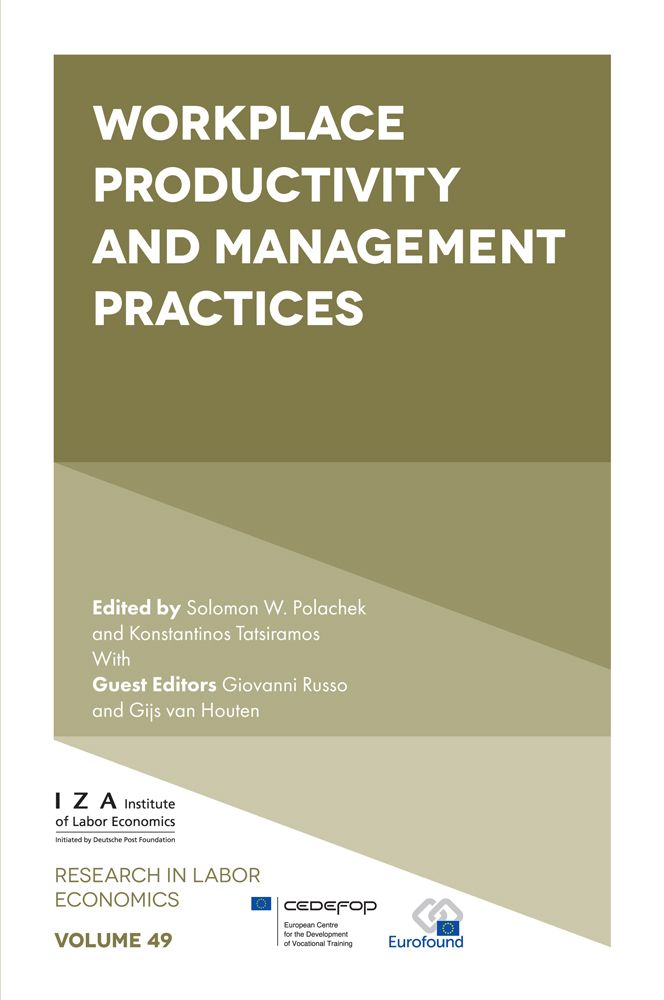

Workplace Productivity and Management Practices

This book can be opened with

Note on our eBooks and Audiobooks: you can read our eBooks (ePUB or PDF) and listen to audiobooks on the free Emerald Books app on iOS, Android, and desktop. Or read and listen on Emerald's online reader (ePUB eBooks and audiobooks only). To purchase a digital book you will need to create an account if you don’t already have one. After purchasing you will receive instructions on how to get started.
- Description
- Contents
- About
Chapter 1. What Do Workers Want? The Representation Gap at The Eu Establishment as Perceived by Their Workplace Representatives; John T. Addison and Paulino Teixeira
- Chapter 2. Union Effects on Product and Technological Innovation; Alex Bryson and Harald Dale-Olsen
- Chapter 3. A Simple Model of Hold-Up, Union Voice and Firm Investments; Fabio Berton, Stefano Dughera, and Andrea Ricci
- Chapter 4. Complex Job Designs and Layers of Hierarchy; Giovanni Russo and Gijs van Houten
- Chapter 5. Internal Labor Market Dimensions and Labour Productivity; Pedro S. Martins
- Chapter 6. Incentivizing Learning-By-Doing: The Role of Compensation Schemes; Joshua Graff Zivin, Lisa B. Kahn, and Matthew Neidell
- Chapter 7. Downsizing Announcements, Job Security Perceptions, and Worksite Performance; Guido Friebel, Matthias Heinz, Ingo Weller, and Nick Zubanov
- Chapter 8. The Returns to Enterpreneurship: Evidence from Matched Person-Firm Data; Mirjam van Praag and Arvid Raknerud
- Chapter 9. The Impact of Private Tutoring on Higher Education Outcomes: Evidence from South Korea; Tiloka de Silva
- Chapter 10. Job Finding and Separation Rates in an Economy with High Labor Informality; Nikita Céspedes Reynaga and N.R. Ramírez-Rondán
Solomon W. Polachek, State University of New York at Binghamton and IZA
Giovanni Russo, The European Centre for the Development of Vocational Training (Cedefop)
Konstantinos Tatsiramos, University of Luxembourg, LISER and IZA
Gijs van Houten, The European Foundation for the Improvement of Living and Working Conditions (Eurofound)