
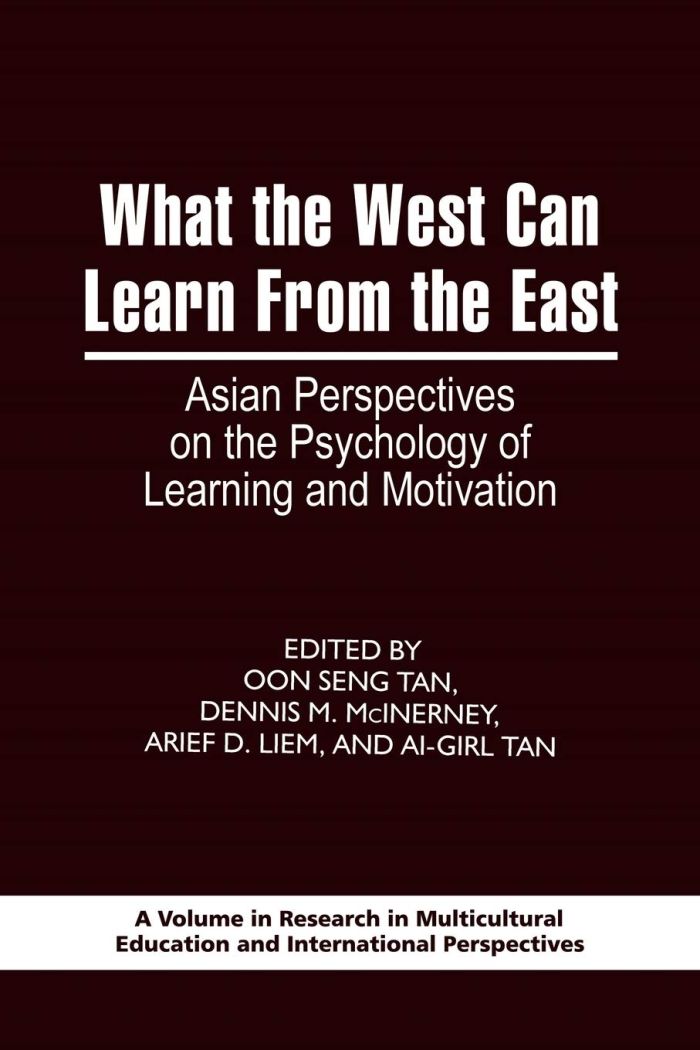
What the West Can Learn from the East
Asian Perspectives on the Psychology of Learning and Motivation

This book can be opened with

Note on our eBooks and Audiobooks: you can read our eBooks (ePUB or PDF) and listen to audiobooks on the free Emerald Books app on iOS, Android, and desktop. Or read and listen on Emerald's online reader (ePUB eBooks and audiobooks only). To purchase a digital book you will need to create an account if you don’t already have one. After purchasing you will receive instructions on how to get started.
- Description
- Contents
Education, East and West, is today mostly Western in orientation. Asian perspectives remain relatively unrepresented in curricula, pedagogy and administrative structures. This volume has brought together authors researching in Asia who redress this imbalance and describe what the West can learn from the East. Topics covered include conceptions of and approaches to effective learning and teaching, self-regulated learning, perceived causes of success and failure, valuing of education, peer influences and classroom behavior, creativity, teacher commitment, class size, motivation, future goals, and other influences on effective learning. Shared insights from the research and theorizing presented should provide a fascinating perspectives for educators and administrators charged with providing cutting-edge, research-based educational best practices in diverse cultural and social environments internationally.
West-East and East-West Learning: Some Psychological and Cultural Insights; Oon Seng Tan, Dennis M. McInerney, Arief D. Liem, Ai-Girl Tan
- Chapter 1. Teaching Creativity as a Demand-Led Competency; Elena L. Grigorenko and Mei Tan
- Chapter 2. Western Influences on the East, Eastern Influences on the West: Lessons for the East and West; Julian G. Elliott and Nguyen Phuong-Mai
- Chapter 3. Western Educational Research: A Basic for Educational Reforms in Asia? David A. Watkins
- Chapter 4. Ability Versus Effort: Perceptions of Students From the East and from the West; Alexander S. Yeung and Anton Yeung
- Chapter 5. Cross-Cultural Views of Teacher Commitment in Malaysia: Their Nature and Their Effects; Nordin Abd Razak, I Gusti Ngurah Darmawan, and John P. Keeves
- Chapter 6. In the Students' Own Words: Etic and Emic Conceptual Analyses of Why and How Students Learn; Arief D. Liem, Elizabeth Nair, Allan B. I. Bernardo, and Paulus H. Prasetya
- Chapter 7. Filipino Adolescent Students' Conceptions of Learning Goals; Allan B. I. Bernardo, Maria Guadalupe C. Salanga, and Karla Marie C. Aguas
- Chapter 8. Motivational and Self-Goals of Female Students in Contemporary Japan; Dexter Da Silva and Dennis M. McInerney
- Chapter 9. Motivation, Attribution of Academic Experiences, and Achievement Among Arab Students Within a Sociocultural Context; Maher M. Abu-Hilal
- Chapter 10. Cross-Cultural Validation of Self-Regulated Learning in Singapore; Jerome I. Rotgans and Henk G. Schmidt
- Chapter 11. Future Goals and Self-Regulated Learning Among Singaporean Chinese Students: The Mediating Role of the Utility Values of Schooling; Dennis M. McInerney, Arief D. Liem, Yasmin P. Y. Ortiga, Jie Qi Lee, and Adelaine S. Manzano
- Chapter 12. Role of Fieldwork in Humanities and Social Studies Education; Chew Hung Chang and Giok Ling Ooi