
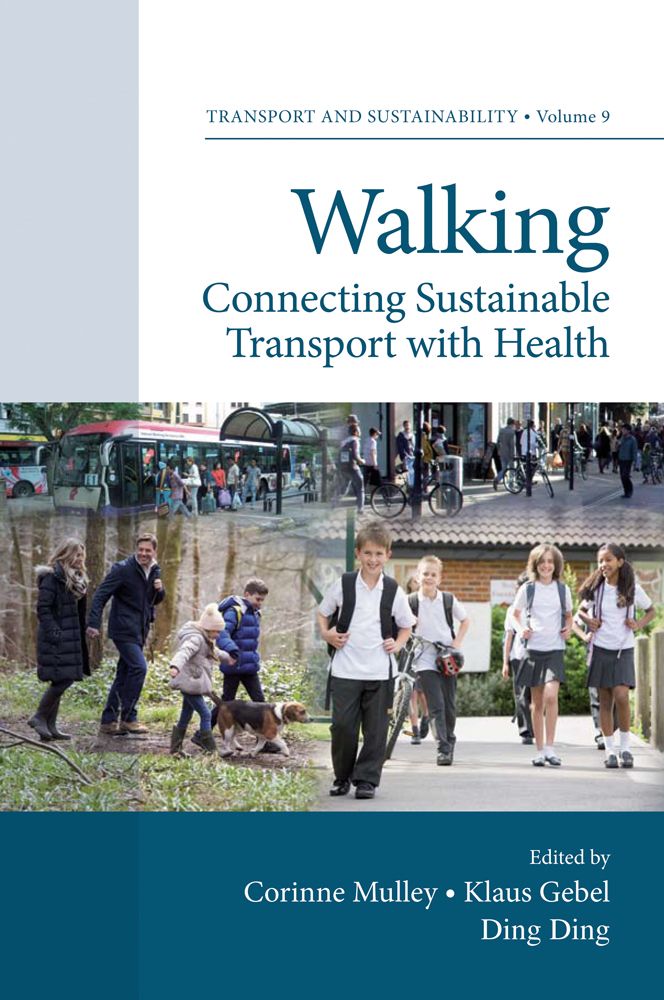
Walking
Connecting Sustainable Transport with Health

This book can be opened with

Note on our eBooks and Audiobooks: you can read our eBooks (ePUB or PDF) and listen to audiobooks on the free Emerald Books app on iOS, Android, and desktop. Or read and listen on Emerald's online reader (ePUB eBooks and audiobooks only). To purchase a digital book you will need to create an account if you don’t already have one. After purchasing you will receive instructions on how to get started.
- Description
- Contents
- Reviews
- About
CHAPTER 1 INTRODUCTION; Corinne Mulley, Klaus Gebel and Ding Ding SECTION 1: WALKING. ITS PREVALENCE, ITS BENEFITS AND ITS VARIETY CHAPTER 2 - MEASUREMENT OF WALKING; Dafna Merom and Robert Korycinski CHAPTER 3 - UNDERSTANDING THE DETERMINANTS OF WALKING AS THE BASIS FOR SOCIAL MARKETING PUBLIC HEALTH MESSAGING; Corinne Mulley and Chinh Ho CHAPTER 4 - THE HEALTH BENEFITS OF WALKING; Paul Kelly, Marie Murphy and Nanette Mutrie CHAPTER 5 - ECONOMIC VALUE OF WALKING; Todd Litman CHAPTER 6 - WALKING TO AND FROM SCHOOL; Jacky Kennedy and George Mammen CHAPTER 7 - DOG WALKING; Hayley E. Christian, Gavin R. McCormack, Kelly E. Evenson and Clover Maitland SECTION 2: ENVIRONMENTS AND WALKING CHAPTER 8 - THE BUILT ENVIRONMENT AND WALKING; William Riggs and Ruth L. Steiner CHAPTER 9 - PUBLIC TRANSPORT INFRASTRUCTURE AND WALKING: GEARING TOWARDS THE MULTIMODAL CITY; Sonia Lavadinho CHAPTER 10 - PLANNING WALKING ENVIRONMENTS FOR PEOPLE WITH DISABILITIES AND OLDER ADULTS; Yochai Eisenberg, Erin D. Bouldin, Nancy Gell and Dori Rosenberg CHAPTER 11 - PEDESTRIAN SAFETY AND PUBLIC HEALTH; Philip Stoker, Arlie Adkins and Reid Ewing SECTION 3: PUBLIC POLICY FOR WALKING CHAPTER 12 - WALKING POLICY STEPS - THE POLICY DEVELOPMENT PROCESS FOR THE FIRST STATE WALKING TARGET IN NEW SOUTH WALES, AUSTRALIA; Peter McCue CHAPTER 13 - DEVELOPING SUSTAINABLE WALKING INTERVENTIONS: INTEGRATING BEHAVIOURAL, ECOLOGICAL, AND SYSTEMS SCIENCE TO PROMOTE POPULATION HEALTH; Liza S. Rovniak and Abby C. King CHAPTER 14 - PROMOTION OF RECREATIONAL WALKING: CASE STUDY OF THE CICLOVIA-RECREATIVA OF BOGOTA; Olga L. Sarmiento, Carlos Pedraza, Camilo A. Triana, Diana P. Díaz, Silvia González and Sergio Montero SECTION 4: CASE STUDIES CHAPTER 15 - VANCOUVER AND THE WALKER: THE EVOLUTION OF THE WALKABLE CITY; Sandy James CHAPTER 16 - WALKING IN VIENNA: SMOOTHING THE WAY FOR CREATING A NEW URBAN LIFESTYLE; Wiebke Unbehaun, Mailin Gaupp-Berghausen and Petra Jens CHAPTER 17 - WALKING FOR TRANSPORTATION AND TRANSMILENIO IN BOGOTA: STRENGTHS AND SHORTCOMINGS; Diana C. Parra and Pablo D. Lemoine CHAPTER 18 - RETROFITTING TRADITIONAL STREETS FOR SHARED USES: THE ‘PEDESTRIAN PRIORITY STREET’ IN SEOUL; Sunghoon Oh and Jennifer L. Kent SECTION 5: INTO THE FUTURE CHAPTER 19 - THE FUTURE OF WALKING?; Miles Tight
Public health, transport, planning, and other researchers from the US, Europe, Australia, Colombia, Canada, and Korea provide 19 chapters on walking and health, sustainable transportation, and urban planning, many based on papers presented at Walk 21 in Sydney, Australia, in October 2014. They discuss the prevalence and trends in walking, including health benefits, the economic value of walking, walking to and from school, and dog walking; connections to the built environment, public transport infrastructure, planning walking environments for people with disabilities and older adults, and pedestrian safety; how walking can be promoted; and case studies of Vancouver, Vienna, Bogotá, and Seoul.