
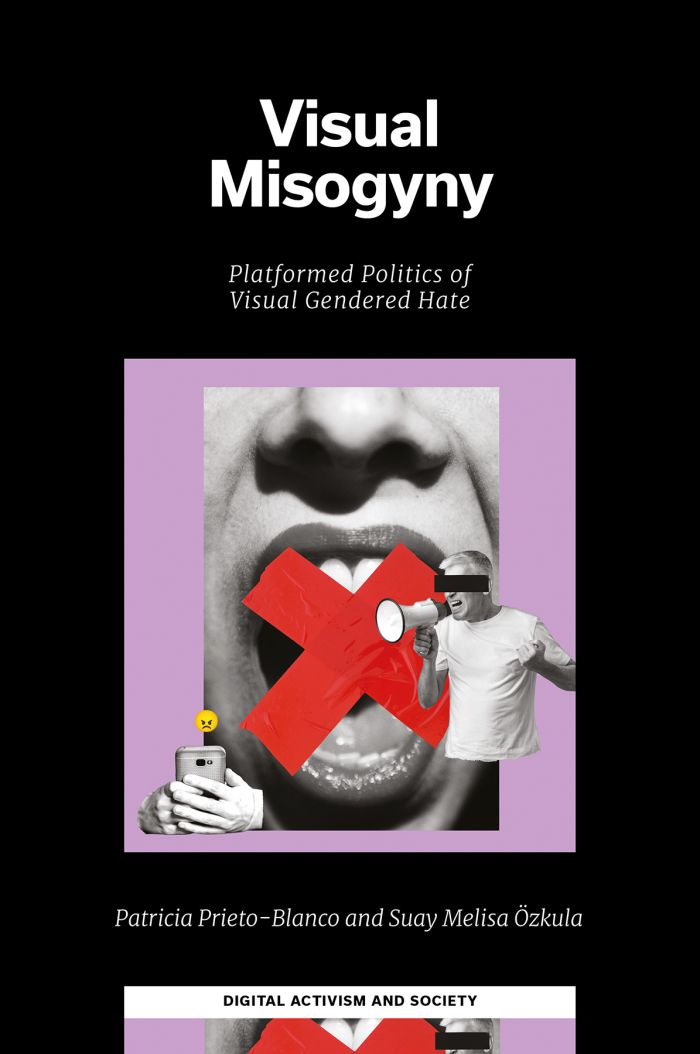
Visual Misogyny
Platformed Politics of Visual Gendered Hate

This book can be opened with

Note on our eBooks and Audiobooks: you can read our eBooks (ePUB or PDF) and listen to audiobooks on the free Emerald Books app on iOS, Android, and desktop. Or read and listen on Emerald's online reader (ePUB eBooks and audiobooks only). To purchase a digital book you will need to create an account if you don’t already have one. After purchasing you will receive instructions on how to get started.
- Description
- Contents
- Reviews
- About
This volume contains two Open Access chapters.
Visual Misogyny is an important contribution to media and cultural and gender studies that investigates the disturbing prevalence of visual gendered hate (images that contribute to and propagate hatred of women) in digital spaces and explores the dehumanising force of the circulation of such images on social media platforms.
While misogyny itself is not a new social phenomenon, the forms of visual hate that Prieto-Blanco and Özkula consider are new and remain under-researched. Bringing together three areas that have never before been explored in one comprehensive volume - misogyny, regimes of visualities, and platform studies - chapters focus on the widespread phenomenon of visual gendered hate and expose how this is bound to the anti-gender politics that has taken hold across Europe as a result of the rise of the right.
Presenting a transnational perspective through the inclusion of cases from Spain, Zimbabwe, and the UK, Visual Misogyny maps out the technological, social, and political dimensions of visual misogyny and will be of interest to a wide range of scholars interested in contemporary politics, activism, feminist visual studies and the relationship between state repression and right-wing ideology.
Part I. Platformed Politics of Visual Gendered Hate
- Chapter 1. Gendered Power and Regimes of Visibility; Patricia Prieto-Blanco and Suay Melisa Özkula OPEN ACCESS
- Chapter 2. Affordances and Platformed Visual Misogyny; Patricia Prieto-Blanco and Suay Melisa Özkula OPEN ACCESS
- Part II. Case Studies of Visual Misogyny
- Chapter 3. “No Heart, Just Games”: Online Visual Misogyny in Zimbabwe; Norita Mdege
- Chapter 4. Gendered Hate in Social Media: A Grey Area; Carla Barrio and Patricia Prieto-Blanco
- Chapter 5. Creepshots of a Maruxaina: From Slow Violence to Nude Economy; Elisa García-Mingo and Jacinto G. Lorca
- Chapter 6. Platforms Versus Patrick: Is it Activism, Harassment, or Doxxing?; Suay Melisa Özkula
- Chapter 7. Outlook: Reflections from the 2025 CAIS Working Group on Critical Interventions into Platformed Visual Misogyny; Suay Melisa Özkula, Patricia Prieto Blanco, Héctor Puente Bienvenido, Brianna L. Wiens, Shana MacDonald, Norita Mdege, and Elisa García-Mingo
- Conclusion: Gendered Politics and Techno-Patriarchy
Over 30 years since Neil Postman provocatively asked what technology does to a culture, scholars continue to work to address the question. Here, some of the shocking statistics around active visual online misogyny signal an acute need to attentively outline and analyze its digital manifestations. The careful nuancing of the concept, as organized and/or ambient forms of misogyny is demonstrated using case studies provides a fresh explanatory springboard for unpacking the “patriarchal bargain”, (recalling Lisa Wade’s famous 2011 blog post in Sociological Images). Developing such language gives us more powerful and sophisticated access to understanding how “patriarchy has no gender” (hooks 2014) and is an issue that impacts us all.
This book is much needed in our time. Prieto-Blanco and Özkula offer an in-depth account of visual misogyny, combining rigorous theoretical grounding with rich empirical insights. Featuring case studies from diverse cultural and political contexts by leading scholars in the field, Visual Misogyny is essential reading for researchers and graduate students engaged with the intersections of digital media, visual culture, and gender politics.
Visual Misogyny gathers a dynamic team of leading scholars to track the global rise of new digital forms of gendered hate in some of its myriad forms, from the blatant and outrageous to the nuanced and subdued. By linking key theoretical insights to detailed case studies from Spain, Britain, and Zimbabwe, the book advances our knowledge of this urgent problem while serving as an accessible introduction to readers new to it. I was particularly impressed by the book’s clear arguments and conceptual richness around visual misogyny, featuring powerful conceptual tools like ambient misogyny, techno-patriarchy, and participatory cultures of hate. It will be of great interest to students and lecturers in gender studies, visual studies, political communication, and online subcultures.
Visual Misogyny: Platformed Politics of Visual Gendered Hate is an important and much-needed contribution to feminist media and internet studies. The book synthesises an ever-expanding body of scholarship on (visual) online misogyny, while advancing our understanding through new concepts such as platformed visual misogyny, which incisively reveal how gender hate manifests within contemporary technopatriarchal systems.
What stands out is the book’s genuinely collaborative spirit. Bringing together the work of its two main authors with case studies from across continents, and culminating in jointly written reflections, the book exemplifies how academic research can be both rigorous and relational. In addition to its scholarly achievements, Visual Misogyny actively intervenes in urgent public and political debates, offering insights with the potential to shape real-world change.
Patricia Prieto-Blanco is a Lecturer in Digital Media Practice in the Department of Sociology at Lancaster University, UK.
Suay Melisa Özkula is Post-Doctoral Researcher at the University of Salzburg, Austria.