
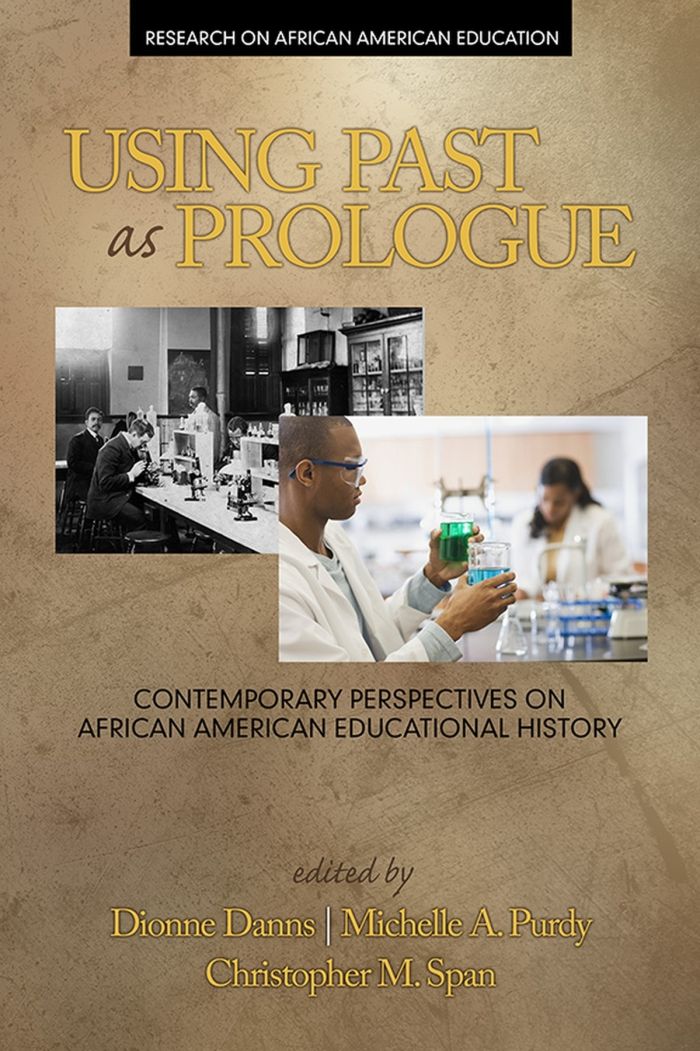
Using Past as Prologue
Contemporary Perspectives on African American Educational History

This book can be opened with

Note on our eBooks and Audiobooks: you can read our eBooks (ePUB or PDF) and listen to audiobooks on the free Emerald Books app on iOS, Android, and desktop. Or read and listen on Emerald's online reader (ePUB eBooks and audiobooks only). To purchase a digital book you will need to create an account if you don’t already have one. After purchasing you will receive instructions on how to get started.
- Description
- Contents
In 1978, V. P. Franklin and James D. Anderson co-edited New Perspectives on Black Educational History. For Franklin, Anderson, and their contributors, there were glaring gaps in the historiography of Black education that each of the essays began to fill with new information or fresh perspectives. There have been a number of important studies on the history of African American education in the more than three decades since Franklin and Anderson published their volume that has pushed the field forward. Scholars have redefined the views of Black southern schools as simply inferior, demonstrated the active role Blacks had in creating and sustaining their schools, sharpened our understanding of Black teachers’ and educational leaders’ role in educating Black students and themselves with professional development, provided a better understanding and recognition of the struggles in the North (particularly in urban and metropolitan areas), expanded our thinking about school desegregation and community control, and broadened our understanding of Black experiences and activism in higher education and private schools.
Our volume will highlight and expand upon the changes to the field over the last three and a half decades. In the shadow of 60th anniversary of Brown v. Board of Education and the 50th anniversary of the 1964 Civil Rights Act, contributors expand on the way African Americans viewed and experienced a variety of educational policies including segregation and desegregation, and the varied options they chose beyond desegregation. The volume covers both the North and South in the 19th and 20th centuries. Contributors explore how educators, administrators, students, and communities responded to educational policies in various settings including K-12 public and private schooling and higher education. A significant contribution of the book is showcasing the growing and concentrated work in the era immediately following the Brown decision. Finally, scholars consider the historian’s engagement with recent history, contemporary issues, future directions, methodology, and teaching.
Foreword, James D. Anderson.
- Preface.
- Acknowledgments.
- Introduction: Towards a New History of African American Education, Dionne Danns, Michelle A. Purdy, and Christopher M. Span.
- Part I: Education in the Nineteenth and Early Twentieth Century.
- Chapter 1. Why the Nineteenth Century Still Matters, Christopher M. Span.
- Chapter 2. A Class All Their Own: Economic and Educational Independence of Free People of Color in Antebellum Louisiana, Alisha D. Johnson.
- Chapter 3. Forgotten or Simply Ignored: A Historiography of African Americans and Catholic Education, Katrina M. Sanders.
- Part II: Education in the Twentieth Century.
- Chapter 4. New Perspectives on Progressive Education: HBCU Lab High Schools during Jim Crow, Sharon G. Pierson.
- Chapter 5. Graduate Study and Jim Crow: The Circular Migration of Southern Black Educators, 1945–1970, Donna Jordan-Taylor.
- Chapter 6. Words of Action: The Speeches of President Alfonso Elder and the North Carolina Student Movement, Eddie Rice Cole.
- Chapter 7. We Declare Independence from the Unjust Laws of Mississippi: The Freedom Schools, Head Start and the Reconstruction of Education during the Civil Rights Movement, Jon N. Hale.
- Chapter 8. The Rise and Fall of a Black Private School: Holy Name of Mary and the Golden Age of Black Private Education in Chicago, 1940–1990, Worth Kamili Hayes.
- Chapter 9. Why Are You Going All the Way Up There to That White School? Oral History, Desegregation, and Chicago Experiences, Dionne Danns.
- Part III: Contemporary History and Future Directions.
- Chapter 10. Control and Independence: Black Alternatives for Urban Education, Elizabeth S. Todd-Breland.
- Chapter 11. African American Education in the Age of Accountability, 1975–2005, R. Scott Baker.
- Chapter 12. Reassessing the Achievement Gap: An Intergenerational Comparison of African American Student Achievement before and after Compensatory Education and the Elementary and Secondary Education Act (ESEA), Christopher M. Span and Ishwanzya D. Rivers.
- Chapter 13. Future Directions of Historically Black Colleges and Universities, Marybeth Gasman and Felecia Commodore.
- Chapter 14. Connecting the Dots: Reflecting on Pedagogy and African American Educational History, Michelle A. Purdy.
- Epilogue: From Freedom Schools to Freedom Schooling? V. P. Franklin.
- About the Editors.
- About the Contributors.