
Using Mobiles in Early Childhood and Elementary Settings

This book can be opened with

Note on our eBooks and Audiobooks: you can read our eBooks (ePUB or PDF) and listen to audiobooks on the free Emerald Books app on iOS, Android, and desktop. Or read and listen on Emerald's online reader (ePUB eBooks and audiobooks only). To purchase a digital book you will need to create an account if you don’t already have one. After purchasing you will receive instructions on how to get started.
- Description
- Contents
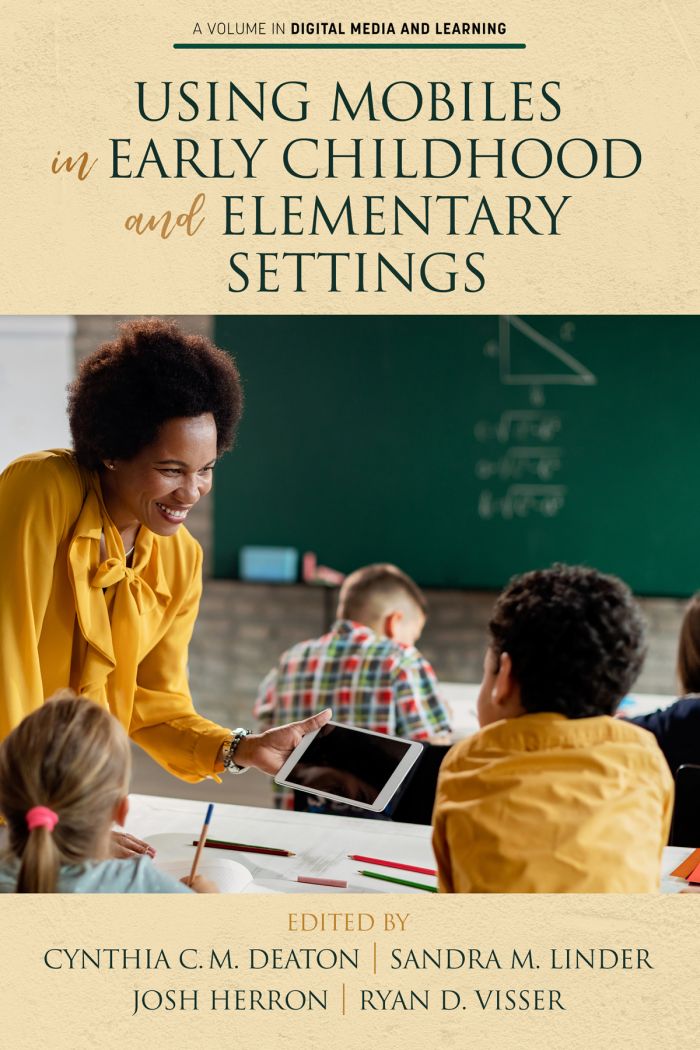
Mobile learning is a primary learning format in the education of young children from birth through 6th grade. This format has been found to have a positive impact on the academic achievement, self-efficacy, motivation, and learning attitudes of students, including those with special needs (Ciampa, 2014; Hwang, 2014; Nikou & Economides, 2018; Xie, Basham, Marino & Rice, 2018). In both formal and informal learning contexts, mobile learning affords opportunities to innovate and explore new forms of authentic experiences, meaning-making, and creativity with untethered technology (Choi, Land, & Zimmerman, 2018; Schuck, Kearney & Burden, 2017). This edited book acts as a springboard to expand discussions surrounding how mobiles might best be situated in contexts relating to young children. With a focus on early childhood and elementary settings, this book both expands the definition of mobiles to encompass digital-physical tools (e.g. Osmo, probeware) and wearables. It also provides insight into how intentional integration of mobiles supports the development and practice of both in-service and preservice teachers working with students in early childhood and elementary settings.
Foreword.
- Preface.
- Section I. Supporting Preservice And Inservice Teacher Development.
- Chapter 1. Preservice Teachers' Conceptions of Mobile Technology in the Elementary Mathematics Classroom; Angela Barlow and Victoria Groves-Scott.
- Chapter 2. The Role of Mobile Technology Within Elementary Project-Based Learning Classrooms; Michael Svec and Dawn Mitchell.
- Chapter 3. Mobile Devices and Their Impact on Teacher Professional Development; Amanda Bennett and Georgia McKown.
- Chapter 4. Timely and Relevant: Twitter Professional Development; Koti L. Hubbard and Lindsay Yearta.
- Section II. Reaching Students And Families Outside Of The Classroom.
- Chapter 5. Mobile Applications to Teach, Build Mindfulness, and Empower Children; Matthew Dombrowski and Jaime Dombrowski.
- Chapter 6. Supporting Home Environments Through Mobiles; Amaris Cordero and Qianyi Gao.
- Section III. Exploring Innovative And Effective Classroom Integration.
- Chapter 7. A Case for Implementation of Extended Reality in Early Childhood Education; Luke Bennett and Rohan Jowallah.
- Chapter 8. Elementary Teacher-Created Mobile Technology Projects With a Data-Based Research Approach; Joanna B. Stegall, Margaret Walworth, Jacquelynn A. Malloy, and Gary Mosley.
- Chapter 9. When Mobile Learning Intersects With Social Class: Computational Thinking in a Low Socioeconomic Status School; Brandon Dickson and Donna Kotsopoulos.
- Chapter 10. Using Mobiles in the Early Childhood Classroom; Kathryn A. Wolfe and Kaitlyn M. Biedenbender.
- About the Contributors.