
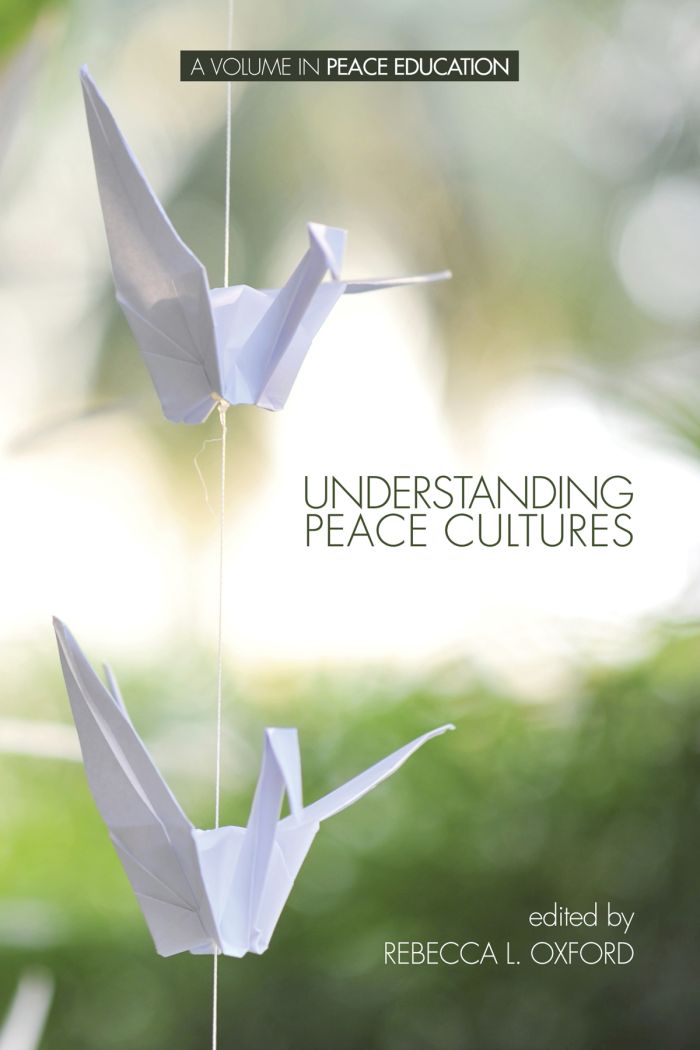
Understanding Peace Cultures

This book can be opened with

Note on our eBooks and Audiobooks: you can read our eBooks (ePUB or PDF) and listen to audiobooks on the free Emerald Books app on iOS, Android, and desktop. Or read and listen on Emerald's online reader (ePUB eBooks and audiobooks only). To purchase a digital book you will need to create an account if you don’t already have one. After purchasing you will receive instructions on how to get started.
- Description
- Contents
Understanding Peace Cultures is exceptionally practical as well as theoretically grounded. As Elise Boulding tells us, culture consists of the shared values, ideas, practices, and artifacts of a group united by a common history. Rebecca Oxford explains that peace cultures are cultures, large or small, which foster any of the dimensions of peace – inner, interpersonal, intergroup, international, intercultural, or ecological – and thus help transform the world. As in her earlier book, The Language of Peace: Communicating to Create Harmony, Oxford contends here that peace is a serious and desirable option.
Excellent educators help build peace cultures. In this book, Shelley Wong and Rachel Grant reveal how highly diverse public school classrooms serve as peace cultures, using activities and themes founded on womanist and critical race theories. Yingji Wang portrays a peace culture in a university classroom. Rui Ma’s model reaches out interculturally to Abraham’s children: Jewish, Christian, and Muslim youth, who share an ancient heritage. Children’s literature (Rebecca Oxford et al.) and students’ own writing (Tina Wei) spread cultures of peace.
Deep traditions, such as African performance art, Buddhism, Daoism, Confucianism and Islam, give rise to peace cultures, as shown here by John Grayzel, Sister Jewel (a colleague of Thich Nhat Hanh), Yingji Wang et al., and Dian Marissa et al. Peace cultures also emerge in completely unexpected venues, such as gangsta rap, unveiled by Charles Blake et al., and a prison where inmates learn Lois Liggett’s “spiritual semantics.” Finally, the book includes perspectives from Jerusalem (by Lawrence Berlin) and North Korea and South Korea (by Carol Griffiths) to help us envision – and hope for – new, transformative peace cultures where now there is strife.
List of Figures.
- List of Tables.
- Acknowledgments.
- Part A: Looking at Peace Cultures.
- Chapter 2. Using This Book to Discover Peace Cultures, Rebecca L. Oxford.
- Chapter 3. Better Than a Thousand Hollow Words: Speaking the Language of Peace Across Contexts and Cultures, Rebecca L. Oxford and Rebecca M. Boggs.
- Part B: Peace Education: Creating Small and Large Peace Cultures.
- Chapter 4. Womanist and Critical Race Theory for Peacemaking in Multilingual, Multicultural Classrooms, Shelley D. Wong and Rachel A. Grant.
- Chapter 5. The National Peace Essay Context: An Exploration in Peacebuilding through Transformative Peace Education, Jiemin (Tina) Wei.
- Chapter 6. Peace Language for Abraham's Children: A Peace Education Curriculum for Middle Eastern Youth Based on the Christian Bible, Rui Ma.
- Chapter 7. A Teacher's Journey: Integrating Peace Education into Language Classes, Yingji Wang.
- Part C: Creating Peace Cultures: Spiritual, Philosophical, Linguistic, and Literary Insights.
- Chapter 8. Creating Peace, Speaking Interbeing: A Buddhist Perspective, Sister Jewel (Chan Chau Nghiem).
- Chapter 9. Islamic Wisdom for Peace, Dian Nasrah Marissa, Rebecca L. Oxford, J. Edward Dotherow IV, and Lauren Mackenzie.
- Chapter 10. Chinese Language, Philosophy, and Wisdom of Peace, Yingji Wang, Ai Zhang, Ruifang Xu, and Jing Lin.
- Chapter 11. Peace Talk: Learning Peace through Spiritual Semantics, Lois P. Liggett.
- Chapter 12. Peace Lessons in Multicultural Literature for Children, Rebecca L. Oxford, Rebecca M. Boggs, Jennifer D. Turner, Rui Ma, and Chien-Yu Lin.
- Part D: Performing Art for Peace: Cultural Understandings for Peace Educators.
- Chapter 13. African Performing Art: Language of Social Connectivity, Reconstruction, and Harmony, John A. Grayzel.
- Chapter 14. Making Peace With Gangsta Rap: Themes and Paradoxes, Charles C. Blake III, Nathanael J. Rudolph, Rebecca L. Oxford, and Rebecca M. Boggs.
- Part E: Social and Political Perspectives: Challenges for Peace Educators and Peacebuilders.
- Chapter 15. Sunset Over Jerusalem, Lawrence N. Berlin.
- Chapter 16. Both Sides Now: Reflections on Korea, Carol Griffiths.