
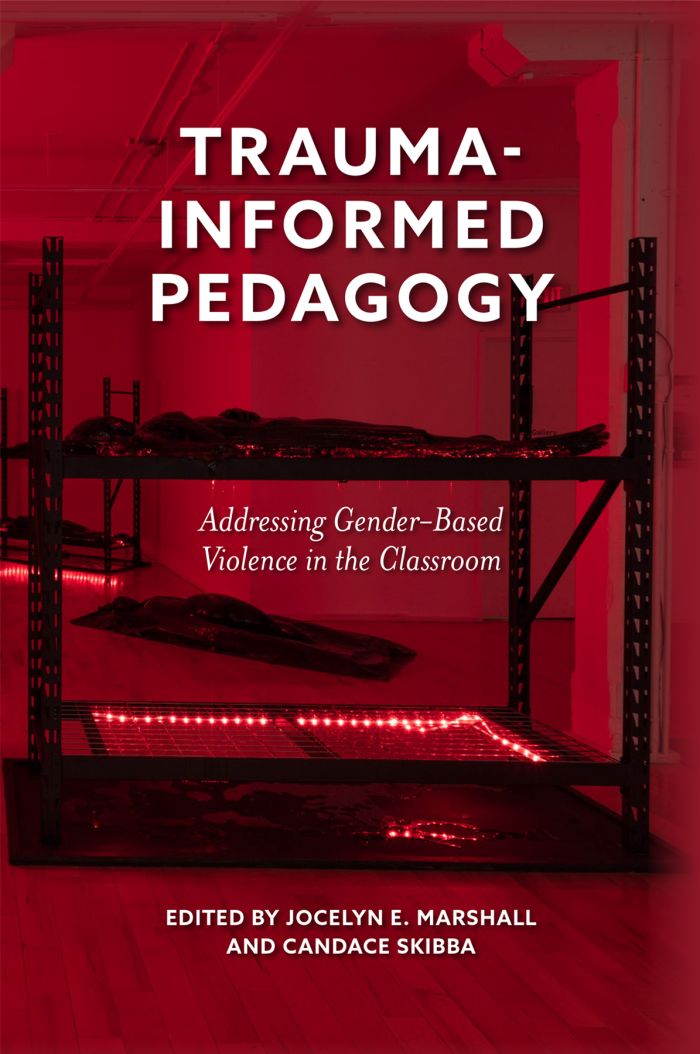

Trauma-Informed Pedagogy
Addressing Gender-Based Violence in the Classroom

This book can be opened with

Note on our eBooks and Audiobooks: you can read our eBooks (ePUB or PDF) and listen to audiobooks on the free Emerald Books app on iOS, Android, and desktop. Or read and listen on Emerald's online reader (ePUB eBooks and audiobooks only). To purchase a digital book you will need to create an account if you don’t already have one. After purchasing you will receive instructions on how to get started.
- Description
- Contents
- About
Gender-based violence is an issue often met with silence, unempathetic discourse, and troublesome visual representation. As educators, mentors, and public facilitators, how can we address this subject in our teaching spaces, curricula, texts, and conversations with greater care and understanding? And, what do we need as resources to cultivate these deeper insights and new roads to increased awareness and dynamic healing?
Building decentered and empowering spaces is vital to addressing gender-based violence. In an educational setting, this must take into consideration instructors’, students’, and other professionals’ own histories of and relationships to traumatic experience. The authors provide a cross-disciplinary dialogue involving spaces ranging from first-year writing programs to international classrooms to public art installation. What holds the conversation together is a collective emphasis on transnational feminist pedagogy and pedagogy of the oppressed while also prioritizing affective discourse. This combination of approaches is used to not only open the conversation itself, but to also pointedly deconstruct standard patriarchal practices found in academia and other institutional settings.
With contributions from scholars and practitioners from a variety of disciplines, cultures and educational backgrounds, Trauma-Informed Pedagogy brings visibility to perpetuated violence and silence through a range of genres, including poetry, syllabi, and critical reflections, offering an invaluable resource for instructors and workshop facilitators interested in approaches that decentralize learning spaces and empowers all participants.
Section One. Chaotic Spaces, Kairotic Classrooms
- Disasterology; Meaghan Ford
- Chapter 1. Teaching Trauma: Sexual Violence and the Kairotic Space of the First-Year Writing Classroom; Dr. Kellie Sharp
- Chapter 2. What Comes First – The Topic or The Method?: Why Pedagogy Must Take Center Stage; Dr. Candace Skibba
- Chapter 3. “Using Rhetorical Analysis and Trauma-Informed Pedagogy to Disrupt the Lie of ‘Love the Way You Lie’; Dr. Elizabeth Johnston
- Chapter 4. The New Spectators: Facilitating Conversations between Early British Women Writers and Twenty-First Century Studies; Dr. Ann Pleiss Morris
- Section Two. Reclaiming & (Re)Presenting: Pleasure, Pain, and Power
- What Lives in the Muscle After the Bruise is Gone; Meaghan Ford
- Chapter 5. A Pleasure Syllabus; or, Countering Trauma with Pleasure in the Classroom; Dr. Gabrielle Civil
- Chapter 6. Filling the Void in Contemporary Women’s Art History; Monika Fabijanska and Dineke van der Walt
- Chapter 7. Npuinu (ên-pu-i-nu) Corpse; Julia Rose Sutherland
- Chapter 8. Trauma-Informed Feminist Practices with Indigenous Artist Julia Rose Sutherland; Jocelyn E. Marshall
- Section Three. Affect & Empathy: Stretching Across Bodies and Disciplines, Languages and Nations
- My Mother Makes My Rapist a Meatloaf; Meaghan Ford
- Chapter 9. Consuming and Producing Trauma Narratives: Multiple Paths to Healing; Dr. Sarita Canon
- Chapter 10. Not Letting It Go: Anger, Empathy, and Interdisciplinarity as Trauma-Informed Approach; Jocelyn E. Marshall
- Chapter 11. Teaching from the Heart: Trauma and Affective Pedagogies at the Asian University for Women; Dr. Tiffany Cone
Jocelyn E. Marshall is Affiliated Faculty in the Writing, Literature, and Publishing Department at Emerson College and a Dissertation Scholar at Brandeis University’s Women’s Studies Research Center. Her work focuses on contemporary U.S.-based women and queer artists and writers, researching the relationships between intertextual practice, displaced positionality, and traumatic experience.
Candace Skibba is an Associate Teaching Professor of Contemporary Spanish Literature at Carnegie Mellon University, USA. The convergence of her literary and cultural studies interests and pedagogical foci have led her to investigate agency and empathy in both artistic expression and classroom practices.