
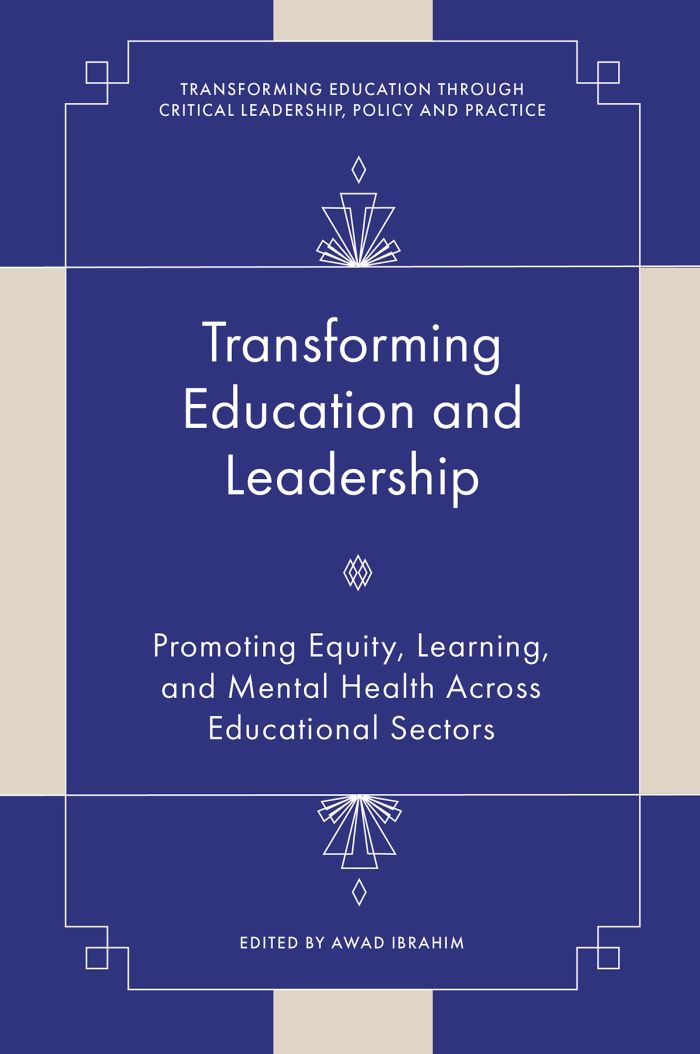
Transforming Education and Leadership
Promoting Equity, Learning, and Mental Health Across Educational Sectors

This book can be opened with

Note on our eBooks and Audiobooks: you can read our eBooks (ePUB or PDF) and listen to audiobooks on the free Emerald Books app on iOS, Android, and desktop. Or read and listen on Emerald's online reader (ePUB eBooks and audiobooks only). To purchase a digital book you will need to create an account if you don’t already have one. After purchasing you will receive instructions on how to get started.
- Description
- Contents
- About
In a world where equity is increasingly contested,Transforming Education and Leadership offers a bold and timely intervention. This groundbreaking volume brings together voices from across continents and disciplines to illuminate how equity is not just an ideal, but a lived, practiced, and transformative force.
Spanning diverse contexts, from classrooms in Asia and healthcare systems in Africa to digital spaces in North America, this volume explores how equity is enacted in real-world educational settings. Chapters delve into urgent issues such as gender justice, the ethical use of AI, language and identity, violence, and inclusive education. Through qualitative, narrative, ethnographic, digital, and quantitative methodologies, contributors reveal how equity can serve as both a conceptual lens and a methodological tool for reimagining leadership and education.
Drawing from education, sociology, psychology, gender studies, economics, applied linguistics, and special education, this is a vital resource for scholars, practitioners, and policymakers, offering concrete examples of how equity is being advanced globally.
Chapter 1. Introduction: Leading in a Time of Precarity: EDI, Access(Ability), Mental Health, AI and the Praxis of Critically Sustaining Leadership; Awad Ibrahim
- Chapter 2. Access to Quality Education: A Study on How the Tertiary Education System of Mauritius and South Africa Reflects this Goal; Roshni Karishma Ramnarain
- Chapter 3. "I Felt Like I Was Under Siege”: Women Academic Leaders’ Journeys Through a Crisis; Linda Ronnie and Marieta Du Plessis
- Chapter 4. Amplifying Student Voices: Understanding Gender-Based Violence through Digital Storytelling at the University of the Western Cape; Selina Palm and Naythan Kayser
- I am Everything They Say I am Not… a poem by Aishah Salim
- Chapter 5. Exploring the Potential of AI Chatbots in the Promotion of Mental Health at South African Universities; Matete Madiba, Faeza Khan, and Naythan Kayser
- Chapter 6. Language Use as a Tool for the Recognition of Diversity and Inclusion in Higher Education in Africa; Russell H Kaschula and Sunrise Dhlamini
- Chapter 7. A Corpus-Based Study of Cultural Content in Reading and Writing 1-4 of New Horizon College English (4th Edition); Yongzhi Liu and Yuchen Xie
- Chapter 8. Empowering Inclusiveness of SEN Support Systems for Young SEN Learners Through Digital Skills at Higher Education; Simi Sonatun-Seegoolam and Diroubinee Mauree-Narrainen
- Chapter 9. Instructional Coaching: Experiences, Challenges and Perspectives from One Ontario School District; Kien Nam Luu
- Chapter 10. Economic Growth and Human Capital: The Role of Education in an Island Economy; Vilesh Ray Seebaruth, Boopendra Seetanah, and Oomesh Gukhool
- New York Times Bestseller… a poem by Aisha Salim
Awad Ibrahim is Full Professor, Vice-Provost, Equity, Diversity and Inclusive Excellence and holder of the Air Canada Professorship on Anti-Racism at the University of Ottawa, Canada. He is a curriculum theorist with special interest in Black thought, social justice, ethnography, Hip-Hop and youth culture, and continental and diasporic African identities.