
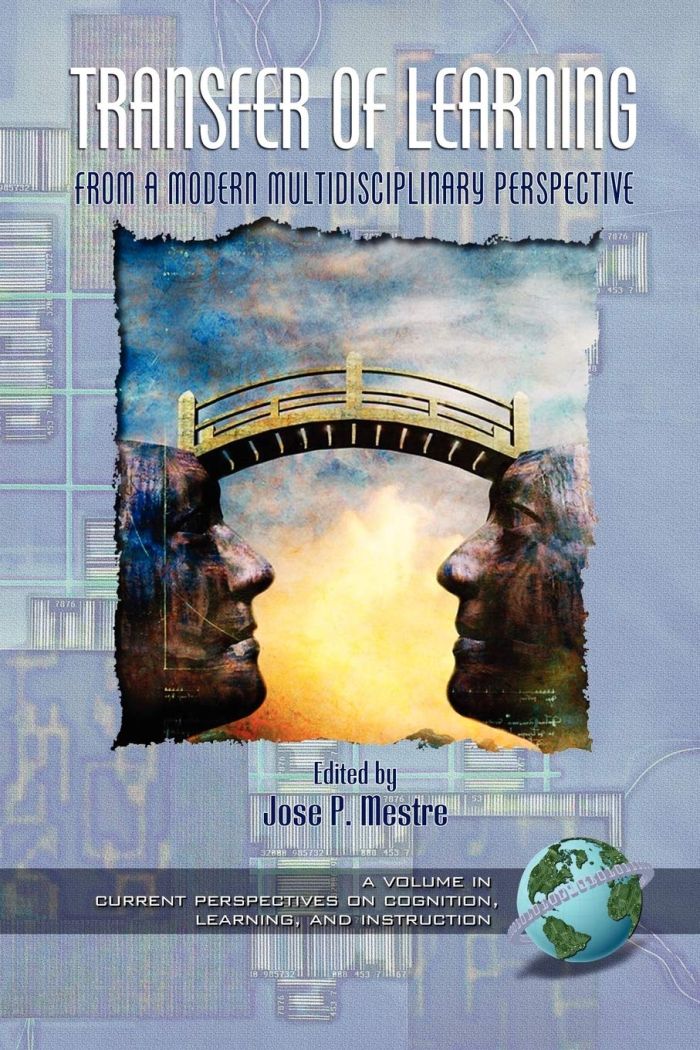
Transfer of Learning from a Modern Multidisciplinary Perspective

This book can be opened with

Note on our eBooks and Audiobooks: you can read our eBooks (ePUB or PDF) and listen to audiobooks on the free Emerald Books app on iOS, Android, and desktop. Or read and listen on Emerald's online reader (ePUB eBooks and audiobooks only). To purchase a digital book you will need to create an account if you don’t already have one. After purchasing you will receive instructions on how to get started.
- Description
- Contents
The chapters contained in the book present a new and exciting set of conceptual tools that will not only allow us to think about transfer in more productive ways, but will also enable the development of educational and measurement tools that will greatly facilitate our ability to educate the children in our schools. This volume is eclectic in bringing together researchers from psychology and science education (especially physics)—who would not normally present their ideas under the same forum—to share their views and perspectives on transfer. What we believe has emerged is a fresh look at transfer issues from a multidisciplinary perspective.
Foreword; Robert Dufresne, Jose Mestre and James M. Royer.
- Chapter 1. Re-Framing the Evaluation of Education: Assessing Whether Learning Transfers Beyond the Classroom; Susan M. Barnett and Stephen J. Ceci.
- Chapter 2. How Far Can Transfer Go? Making Transfer Happen Across Physical, Temporal, and Conceptual Space; Diane Halpern and Milt Hakel.
- Chapter 3. Fuzzy-Trace Theory: Implications for Transfer in Teaching and Learning; Valerie F. Reyna, Christopher Wolfe and Charles J. Brainerd.
- Chapter 4. Transfer of Learning in Informal Education: The Case of Television; Shalom Fisch, Heather Kirkorian and Daniel Anderson.
- Chapter 5. Efficiency and Innovation in Transfer; Daniel Schwartz, John Bransford, and David Sears.
- Chapter 6. When Transfer Fails: Effect of Knowledge, Expectations, and Observations on Transfer in Physics; Thomas Thaden-Koch, Jose Mestre, Bob Dufresne, Bill Gerace and Bill Leonard.
- Chapter 7. What Coordination Has to Say About Transfer; Andrea diSessa and Joseph Wagner.
- Chapter 8. Dynamic Transfer: A Perspective from Physics Education Research; Sanjay Rebello and Dean Zollman.
- Chapter 9. Resources, Framing, and Transfer; David Hammer, Andrew Elby, Rachel Scherr and Edward F. Redish.
- Chapter 10. Transfer of Mathematical Problem Solving Procedures Acquired Through Physical Science Instruction: When You Don't See it, Why Not?; Zbigniew Dziembowski and Nora Newcombe.
- Chapter 11. Transfer Between Variants of Mathematics Test Questions; Mary E. Morley, Rene R. Lawless and Brent Brideman.
- Chapter 12. Theory, Level, and Function: Three Dimensions for Understanding the Connections Between Transfer and Student Assessment; Daniel Kickey, Mary Ann Horne and James Pellegrino.