
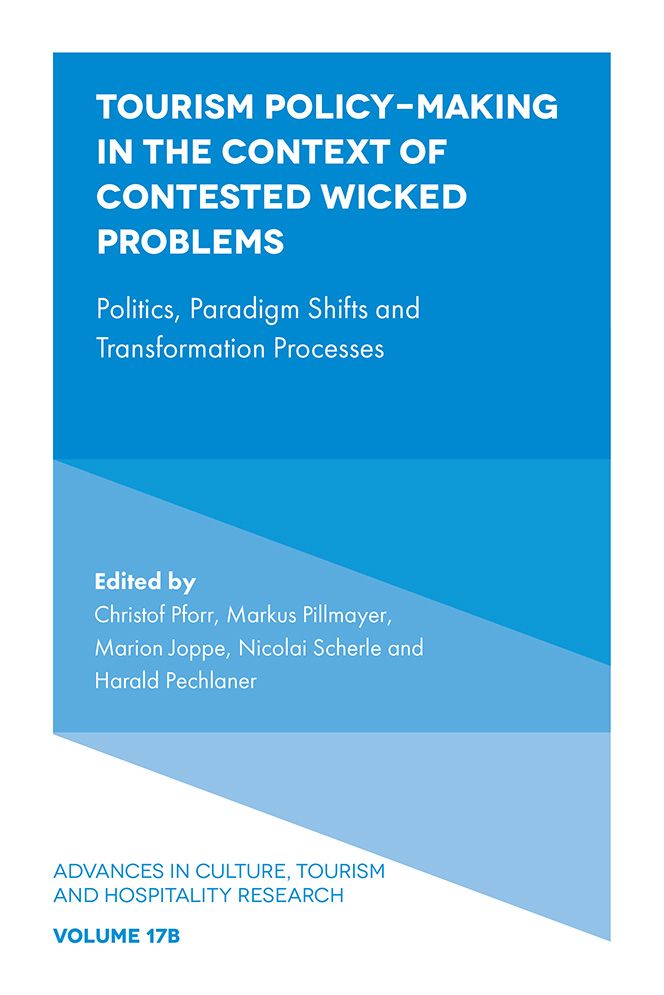

Tourism Policy-Making in the Context of Contested Wicked Problems
Politics, Paradigm Shifts and Transformation Processes

This book can be opened with

Note on our eBooks and Audiobooks: you can read our eBooks (ePUB or PDF) and listen to audiobooks on the free Emerald Books app on iOS, Android, and desktop. Or read and listen on Emerald's online reader (ePUB eBooks and audiobooks only). To purchase a digital book you will need to create an account if you don’t already have one. After purchasing you will receive instructions on how to get started.
- Description
- Contents
- About
Embedded in and interrelated with its broader socio-economic and political context, the tourism system currently faces profound challenges. Against this backdrop, the book Tourism Policy-Making in the Context of Contested Wicked Problems offers a contemporary and interdisciplinary perspective on tourism public policy to aid the description, analysis, and explanation of these wicked and interconnected, complex policy problems. Current problem-solving capabilities and competences of governments to deal with specific tourism policy issues (or wicked problems) such as the climate emergency, tourism mobility, indigenous disadvantages, the COVID-19 pandemic, or the P2P economy are critically analysed and some interesting insights are offered into transition pathways towards tourism sustainability.
The book is part of the Advances in Culture, Tourism and Hospitality Research series which seeks to advance knowledge and sense-making skills in interpreting cultural, organisational, and personal influences relating to tourism and hospitality behaviours. This broad objective includes examining unconscious and conscious thinking processes of tourists, guests, and/or service providers in contexts that relate to tourism and hospitality.
Chapter 1. Interrogating Tourism and Hospitality’s Wicked Employment Issues Through the Lens of Paradox Theory; Tom Baum, Deirdre Curran, Anastasios Hadjisolomou, Olga Gjerald, Tone Therese Linge, Kate Inyoung Yoo, and Anke Winchenbach
- Chapter 2. Wicked Contexts Pushing for Change in Argentina: Tourism, Labour Informality and Previaje Policy; Carolina Inés Garcia, Natalia Porto, and Matías Ciaschi
- Chapter 3. 50 Years UNESCO World Heritage Convention: Curse or Cure?; Anda F. Pforr and Christof Pforr
- Chapter 4. Tourism Policymaking in Finland: A Multilevel Governance Perspective; Heini Korvenkangas
- Chapter 5. Only Those Who Can Shout Loud Enough Will Be Heard? Tourism Lobbying in a Turbulent World of Wicked Problems in Germany; Markus Pillmayer and Nicolai Scherle
- Chapter 6. Bulgarian Tourism Policy: Intentions Versus Reality; Maya Ivanova
- Chapter 7. Indigenous Tourism Policy: A Perspective From Australia; Lisa Ruhanen and Michelle Whitford
- Chapter 8. Indigenous Tourism and Political Recognition of Rights in Chile; Francisca de la Maza
- Chapter 9. Politics of Migration and Tourism in the Gambia; Rainer Hartmann and Antje Krueger
- Chapter 10. The Trajectory of Public Tourism Policies in Brazil (1922-2022): From Wicked Problem to a Geopolitical Strategy?; Thiago Duarte Pimentel, Mariana Pereira Chaves Pimentel, Marcela Costa Bifano de Oliveira, and Dominic Lapointe
- Chapter 11. Towards Social Innovation Governance in Developing Country Destinations: A Comparative Analysis Between Tourism Ecosystems in Azerbaijan and Ecuador; Arne Schuhbert and Julia Schiemann
- Chapter 12. Nothing About Us Without Us: Citizens’ Role in Urban Tourism Policy-Making; Eva C. Erdmenger
- Chapter 13. Socio-Political Dynamics of Airbnb and the Platform Economy; Christof Pforr, Anda F. Pforr, and Michael Volgger
- Chapter 14. Gender Inequity in Tourism: A Policy Challenge; Kerstin Heuwinkel
- Chapter 15. More Than Just Anti-Discrimination Policy: Conceptual Reflections on the Strategic Benefits of Diversity Management in Tourism; Nicolai Scherle and Markus Pillmayer
- Chapter 16. When Policy Conflicts With the Data Science: Predicting the Cost Overrun of the 2032 Brisbane Olympic Games; Char-lee McLennan, Jac Davis, and Jegar Pitchforth
- Conclusion
- Chapter 17. Addressing Wicked Problems Through Integrated Policy-Making: An Ecosystem-Based Approach; Harald Pechlaner and Julian Philipp
- Chapter 18. Tourism Policies Reloaded: Towards a Comprehensive Framework; Marion Joppe, Christian Laesser, and Shaun Mann
- Chapter 19. Wicked Problems as Trigger for Transformation Processes?; Christof Pforr, Markus Pillmayer, Marion Joppe, Nicolai Scherle, and Harald Pechlaner
Christof Pforr is Professor of Tourism and Discipline Leader (Tourism, Hospitality & Events) with the School of Management & Marketing, Faculty of Business & Law, Curtin University, Australia.
Markus Pillmayer is Professor for Destination Management and Destination Development at the Department of Tourism at the Munich University of Applied Sciences, Germany.
Marion Joppe is a Distinguished Professor Emerita in the School of Hospitality, Food and Tourism Management, University of Guelph, Canada.
Nicolai Scherle is Professor for Intercultural Management and Diversity, University of Applied Sciences for Economics and Management (FOM) in Munich, Germany.
Harald Pechlaner is Head of the Center for Advanced Studies at Eurac Research (Italy), Chair of Tourism and Founding Dean of the School of Transformation and Sustainability at the Catholic University of Eichstätt-Ingolstadt (Germany).