
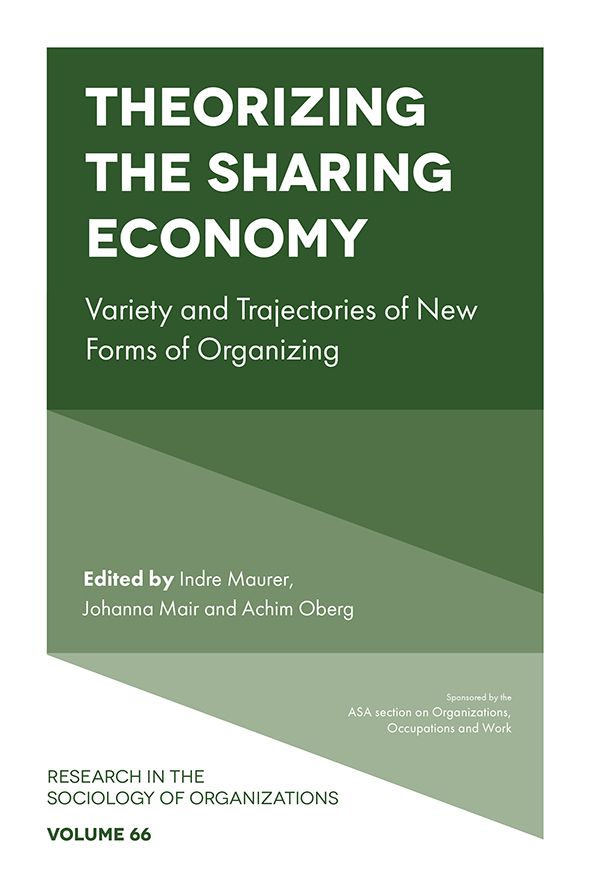

Theorizing the Sharing Economy

Variety and Trajectories of New Forms of Organizing

Indre Maurer|Johanna Mair|Achim Oberg
Emerald
Emerald

This book can be opened with

Glassboxx eBooks and audiobooks can be opened on phones, tablets, iOS and Android devices

Hardback
9781787561809
10 April 2020
$138.99
eBook (PDF)
9781787561793
10 April 2020
$138.99
eBook (ePub)
9781787561816
10 April 2020
$138.99

Note on our eBooks and Audiobooks: you can read our eBooks (ePUB or PDF) and listen to audiobooks on the free Emerald Books app on iOS, Android, and desktop. Or read and listen on Emerald's online reader (ePUB eBooks and audiobooks only). To purchase a digital book you will need to create an account if you don’t already have one. After purchasing you will receive instructions on how to get started.

  • Description
  • Contents
  • About
The sharing economy is one of the most influential developments of the last decade. The emergence of new forms of organizing it brings with it has affected modern (business) life at multiple levels: Sharing organizations have blurred the distinction between the individual roles of provider, user, and employee; they have introduced organizational practices of coordinating members and communities; and they have sparked societal, political, and economic debates in multiple fields. These dynamics at the individual, organizational, and field level provide an opportunity for organization scholars to take stock of and theorize the sharing economy. 

This volume takes advantage of this opportunity by presenting a collection of empirical and conceptual work that explores the variety and the trajectories of new forms of organizing in the sharing economy, and in doing so builds on, rejuvenates, and refines existing organization theories. 

Together, the chapters included in this volume offer a comprehensive overview of theoretically grounded research that deepens our understanding of new forms of organizing and indicates future avenues for research.

Introduction: Theorizing Variety And Trajectories Of New Forms Of Organizing In The Sharing Economy; Indre Maurer, Johanna Mair, Achim Oberg Chapter 1. Market, Hierarchy, Or Clan? Types Of Governance In The Sharing Economy; Philipp C. Mosmann, Jennifer Klutt  Chapter 2. Shaping Emotional Labour Practices In The Sharing Economy; Eliane Bucher, Christian Fieseler, Christoph Lutz, Gemma Newlands  Chapter 3. An Institutional Logics Perspective On The Gig Economy; Koen Frenken, Taneli Vaskelainen; Lea Fünfschilling; Laura Piscicelli   Chapter 4. The Sharing Economy As An Emerging And Contested Field - How Classic And Institutional Entrepreneurs Cope With Plural Theoretical Frames; Aurélien Acquier, Valentina Carbone, Laëtitia Vasseur Chapter 5. Is The Sharing Economy A Field? How A Disruptive Field Nurtures Sharing Economy Organizations; Dominika Wruk, Tino Schöllhorn, Achim Oberg   Chapter 6. Category Kings And Commoners: Within And Cross- Category Spill-Overs In The Sharing Economy; Pinar Ozcan, Kerem Gurses, Mareike Möhlmann  Chapter 7. "Turning The Sharing Economy Into A Fair Economy …": Strategic Issue Work In The Vienna City Administration; Sebastian Vith, Markus A. Höllerer  Chapter 8: Regulating The Sharing Economy: A Field Perspective; Stefan Kirchner, Elke Schüßler

    Indre Maurer is a professor of business administration holding a Chair for Organization and Corporate Development. She serves on the Faculty of Business and Economics of Göttingen University, Germany. 
    Johanna Mair is Professor of Organization, Strategy and Leadership at the Hertie School in Berlin. She is a Distinguished Fellow and co-directs the Global Innovation for Impact Lab at the Stanford Center on Philanthropy and Civil Society. 
    Achim Oberg is Assistant Professor at the Institute of Organization Studies at the Vienna University of Economics and Business, and Senior Researcher at the Institute for SME Research and Entrepreneurship at the University of Mannheim.