
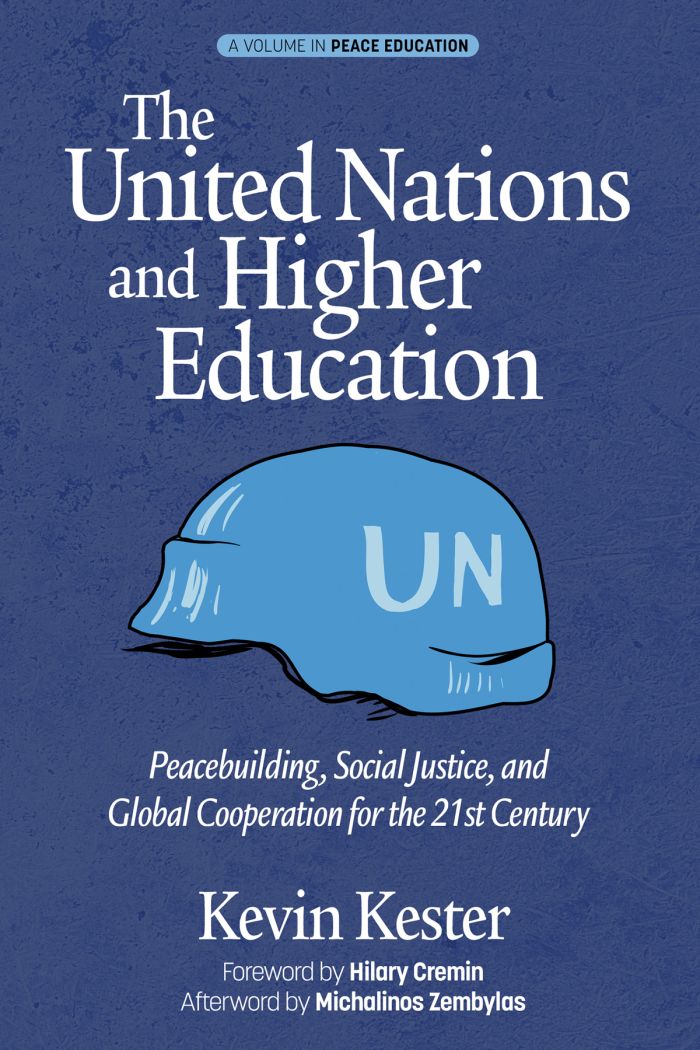
The United Nations and Higher Education
Peacebuilding, Social Justice and Global Cooperation for the 21st Century

This book can be opened with

Note on our eBooks and Audiobooks: you can read our eBooks (ePUB or PDF) and listen to audiobooks on the free Emerald Books app on iOS, Android, and desktop. Or read and listen on Emerald's online reader (ePUB eBooks and audiobooks only). To purchase a digital book you will need to create an account if you don’t already have one. After purchasing you will receive instructions on how to get started.
- Description
- Contents
In this book, Kevin Kester details how the United Nations promotion of higher education for peace and international understanding sometimes unintentionally contributes to the reproduction of conflict and violence across diverse cultures. He shows this through an indepth examination of peace curricula, pedagogy and policy in one United Nations higher education institution, where he indicates how dominant philosophical and pedagogical models that signify acceptable peace education ultimately undermine the very goals of educational peacebuilding.
Kester contends that theoretical and pedagogical training must develop beyond the dominant psycho-social, rational and state-centric assumptions that permeate the field today if higher education is to better contribute to personal and societal peacebuilding. Drawing from the fields of educational philosophy and sociology, he argues for new concepts of poststructural violence and second order reflexivity that can assist scholars in reducing conflict and building peace in lasting ways. He complements his fieldwork findings with personal reflections throughout the book to reimagine the transformative possibilities of peacebuilding education for the 21st century.
Foreword; Hilary Cremin.
- Acknowledgments.
- Chapter 1. Introduction.
- Chapter 2. Situating Peace and Conflict Studies.
- Chapter 3. Peace and Conflict Studies in Higher Education.
- Chapter 4. Whiteness in Peace and Conflict Studies.
- Chapter 5. Peace and Conflict Studies Higher Education Inside the United Nations.
- Chapter 6. Analytical Framework.
- Chapter 7. Methodology.
- Chapter 8. The UN May Be the Biggest Obstacle.
- Chapter 9. There's a Reason That Someone Is Getting Paid to Be a Professor: Tensions With Critical Pedagogy in the Peace and Conflict Studies Classroom.
- Chapter 10. Reproducing Peace? Whiteness in the Curriculum and Teaching.
- Chapter 11. Re-Imagining Peace and Conflict Studies Education for the 21st Century.
- Chapter 12. Conclusion.
- Afterword; Michalinos Zembylas.
- References.
- About the Author.