
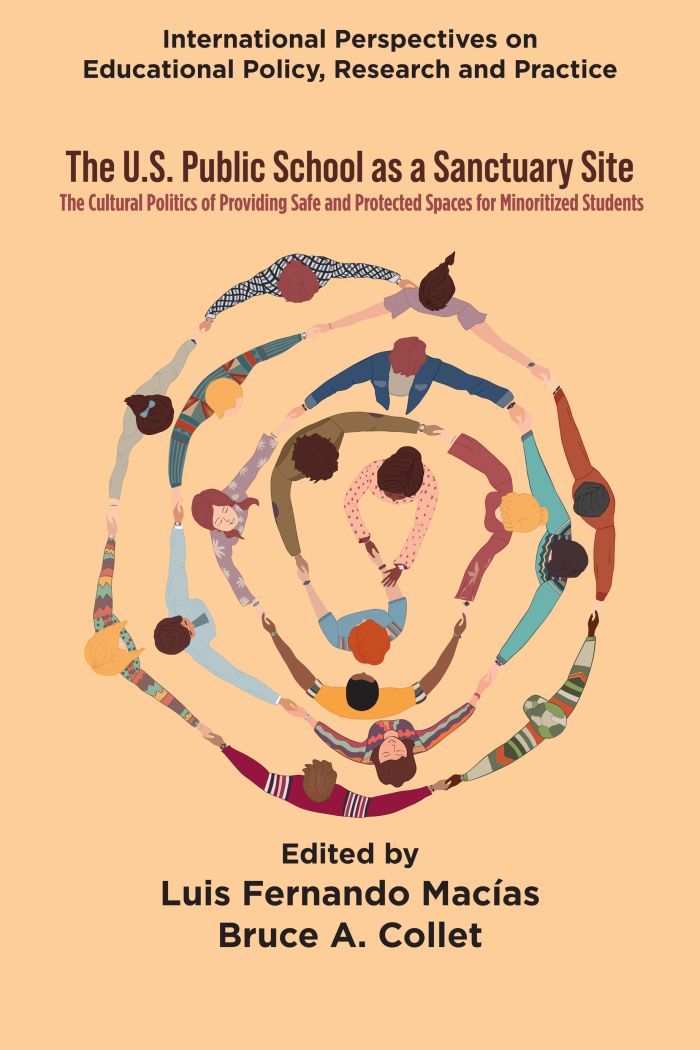
The U.S. Public School as a Sanctuary Site
The Cultural Politics of Providing Safe and Protected Spaces for Minoritized Students

This book can be opened with

Note on our eBooks and Audiobooks: you can read our eBooks (ePUB or PDF) and listen to audiobooks on the free Emerald Books app on iOS, Android, and desktop. Or read and listen on Emerald's online reader (ePUB eBooks and audiobooks only). To purchase a digital book you will need to create an account if you don’t already have one. After purchasing you will receive instructions on how to get started.
- Description
- Contents
- About
Why is it that our schools feel compelled to expand the safety and protection of sanctuary to a range of minoritized students? What are the underlying causes and conditions for this, and what particular cultural dynamics and processes are at work here? The U.S. Public School as a Sanctuary Site explores the cultural politics surrounding the designation of public schools as sanctuaries, with a particular emphasis on how this impacts minoritized student populations.
The sanctuary school concept gained popularity in the aftermath of the 2016 U.S. Presidential election, when hundreds of public-school districts across the country declared themselves as sanctuary campuses for students. Districts began crafting resolutions and policies that would provide some protections as well as an overall supportive environment largely, although not exclusively, for undocumented students. Hence, a “sanctuary school” is popularly understood as a physical location that staff and students have declared off-limits to immigration enforcement and student information-sharing efforts. Yet, in the editors’ multi-year and multi-phase examination of U.S. public schools within the New Sanctuary Movement, we found that many self-declared sanctuary public schools have adopted a more expansive notion of the sanctuary concept; sanctuary is not only provided to immigrant students, but virtually any student who is marginalized or minoritized in some way, from race and ethnicity to sexual orientation and gender.
This book examines sanctuary within public schools as a set of laws and guiding principles and practices for educators to adhere to so that all students (and particularly those from marginalized communities) can feel recognized, supported, and protected.
Introduction; Luis Fernando Macías and Bruce A. Collet
- Section I. School Leaders
- Chapter 1. Protecting Precious Children: Testimonios of Educational Leadership in Precarious Times; Melissa Colón and Almudena Abeyta
- Chapter 2. Networks of Sanctuary: The Internationals Network and the Collective Work of Protecting Immigrant Youth; Chandler Patton Miranda and Lara Evangelista
- Section II. Students and Practitioners
- Chapter 3. Building Connections to the Larger World: The Sanctuary Culture within a Career and Technical School; Elizabeth Davis and Cole Forbes
- Chapter 4. Y Si las Escuelas Fueran Free: Co-designing for Sanctuary and Human Dignity; Adria Padilla-Chávez
- Chapter 5. DACAmented Teaching as Sanctuary Work: The Conditional Belonging of DACAmented Educators in Public Schools; Chandler Patton Miranda
- Section III. Intersections
- Chapter 6. Cultural Politics of School Sanctuary and Safe Spaces in US Public Schools, 1990-2025; Christopher J. Frey
- Chapter 7. Declaring Safe Havens: Sanctuary School Districts as Defenders of a Universal Right to Public Education; Mai N. Do
- Section IV. Sanctuary in Place and Time
- Chapter 8. From the Border to the Bay: Exploring the Impact of Student Organizing and Sanctuary School Movements; Luis Fernando Macías and Matt Alexander
- Chapter 9. Sanctuary as Spatial, Social, and Spiritual Action: Exploring Schools, Churches, and the Multiple Sanctuaries of Los Angeles in the Trump Era; Francisco J. García Jr.
- Epilogue: A Purposeful Engagement in the Cultural Politics of Sanctuary Schools; Bruce A. Collet
Luis Fernando Macías is an Associate Professor in the Department of Chicano and Latin American Studies at California State University, Fresno, USA.
Bruce A. Collet is a Professor in the School of Counselling, Higher Education, Leadership, and Foundations at Bowling Green State University, Ohio, USA.