
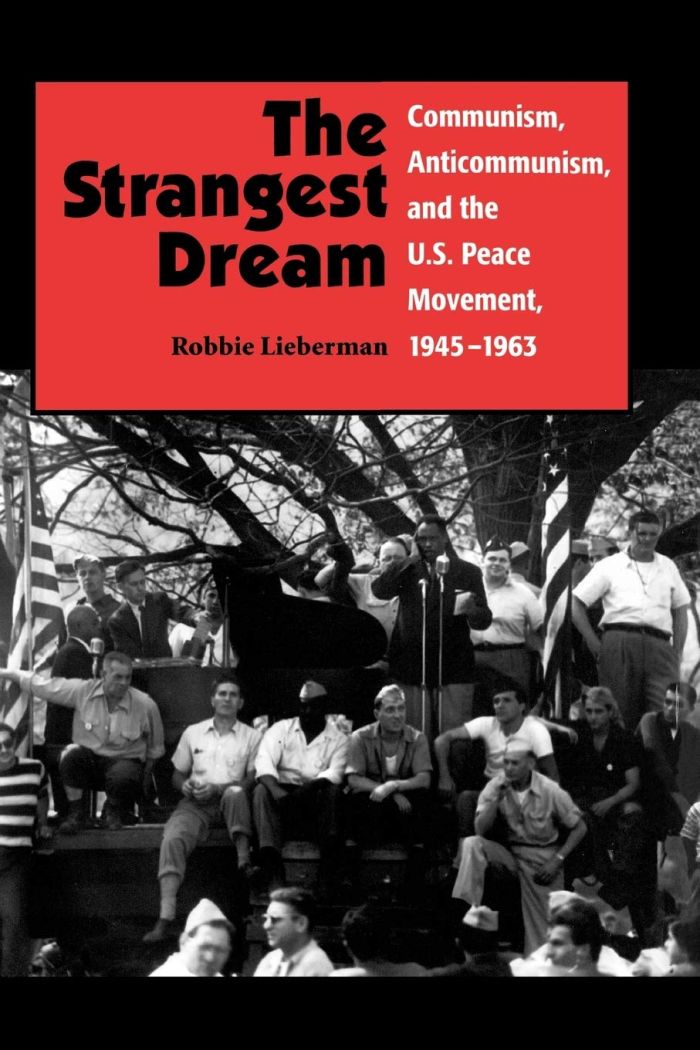

The Strangest Dream
Communism, Anticommunism, and the U.S. Peace Movement, 1945-1963

This book can be opened with

Note on our eBooks and Audiobooks: you can read our eBooks (ePUB or PDF) and listen to audiobooks on the free Emerald Books app on iOS, Android, and desktop. Or read and listen on Emerald's online reader (ePUB eBooks and audiobooks only). To purchase a digital book you will need to create an account if you don’t already have one. After purchasing you will receive instructions on how to get started.
- Description
- Contents
originally published by Syracuse University Press (May 2000)
Drawing on extensive archival material and oral history, Robbie Lieberman illustrates how grassroots peace activism in the United States became associated with Communist subversion after World War II. This association gave proponents of the Cold War a powerful weapon with which to try to silence the opposition. This weapon - anti-communism - was extremely effective until the early 1960s and its effects linger even today.
The persecution of peace activists as subversives dates back to the colonial era, but the specific link between communism and peace developed out of the unique conditions of the Cold War.Communist agitation for peace, American notions of national security and freedom that rested on containing communism at all costs. Not until peace organizations challenged external and internal anti-Communist attacks were they able to achieve a new level of respectability.
The end of the Cold War enabled scholars to take a fresh look at the peace movement in the early part of that era and how it was affected by fears about communism, whether imagined or real. With this book, Lieberman seeks to clarify American attitudes about peace and the fate of the peace movement in ways that previous studies have overlooked or avoided.
Illustrations
- Preface
- Introduction: “Study War No More”?
- Chapter 1. “The Spring Song”: Communism and the Decline of the 1930s Peace Movement
- Chapter 2. “Friendly Henry Wallace”: The Progressive Party Loses the “Fight for Peace”
- Chapter 3. “Hold the Line”: The Waldorf Conference and the Peekskill Riots
- Chapter 4. “Put My Name Down”: Responses to the Communist Peace Offensive
- Chapter 5. “The Strangest Dream”: McCarthyism in the Peace Movement
- Chapter 6. “The H-Bomb’s Thunder”: Communism and the Committee for a Sane Nuclear Policy
- Chapter 7. “Where Have All the Flowers Gone?”: Women Strike for Peace and the Early Sixties
- Epilogue: “The Times They Are A-Changing”?
- Notes
- Primary Sources
- Suggested Reading
- Index