
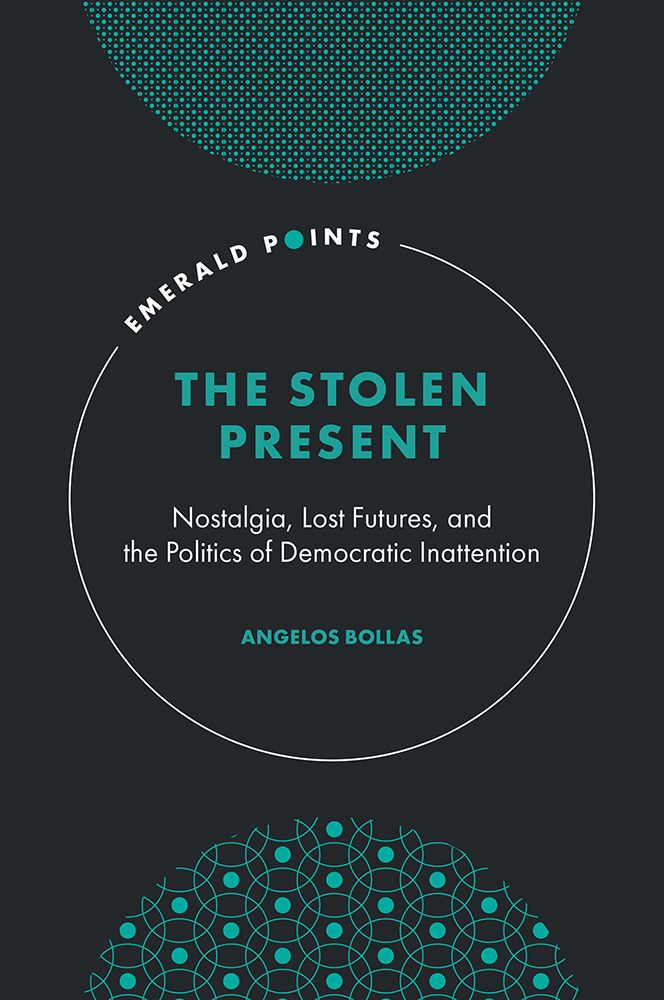
The Stolen Present
Nostalgia, Lost Futures, and the Politics of Democratic Inattention

This book can be opened with

Note on our eBooks and Audiobooks: you can read our eBooks (ePUB or PDF) and listen to audiobooks on the free Emerald Books app on iOS, Android, and desktop. Or read and listen on Emerald's online reader (ePUB eBooks and audiobooks only). To purchase a digital book you will need to create an account if you don’t already have one. After purchasing you will receive instructions on how to get started.
- Description
- Contents
- About
Nostalgia, crisis politics, platform-mediated attention, climate delay, housing precarity, insecure work, culture wars, institutional distrust, democratic exhaustion. As these terms increasingly become the markers of contemporary democracies, The Stolen Present investigates how citizens are repeatedly invited to look backwards towards a mythologised past or forwards towards a promised but continually deferred future, while the present itself becomes harder to inhabit as the time in which power can be scrutinised and contested.
A short theoretical monograph about political time, this book develops the concept of present dispossession to describe the political and affective process through which citizens are separated from the present as a meaningful site of democratic attention, accountability, and collective intervention. Bringing together hauntology, nostalgia studies, theories of lost futures, critiques of neoliberalism, media and attention theory, and democratic thought, Angelos Bollas presents a four-part framework for understanding present dispossession through nostalgic displacement, futural deferral, accelerated immediacy and neoliberal privatisation. A unique conceptual intervention, the work also develops a specific use of the concept of slow power to describe the incremental, administrative, procedural, and often unspectacular ways through which political and economic arrangements are reorganised while public attention is captured elsewhere.
Offering practical democratic principles for reclaiming the present without succumbing to idealism, the book concludes with a civic framework to help scholars, educators, students and community organisations, and public institutions help understand ways of resisting temporal displacement and rebuilding collective democratic attention.
Introduction: The Present Has Been Stolen
- Chapter 1. Haunted Time
- Chapter 2. The Usable Past
- Chapter 3. The Future That Never Arrives
- Chapter 4. The Stolen Present
- Chapter 5. The Noisy Now: Media, Crisis, and Democratic Inattention
- Chapter 6. Who Benefits from Broken Time?
- Conclusion: Reclaiming the Present
Angelos Bollas is a scholar of Society and Culture.