
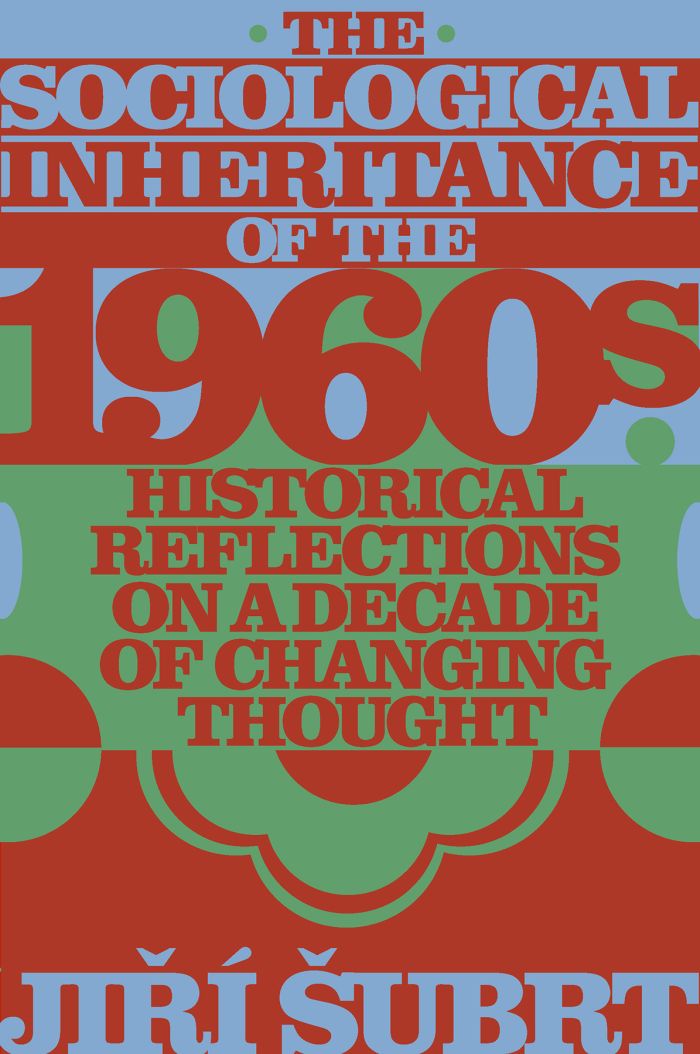

The Sociological Inheritance of the 1960s
Historical Reflections on a Decade of Changing Thought

This book can be opened with

Note on our eBooks and Audiobooks: you can read our eBooks (ePUB or PDF) and listen to audiobooks on the free Emerald Books app on iOS, Android, and desktop. Or read and listen on Emerald's online reader (ePUB eBooks and audiobooks only). To purchase a digital book you will need to create an account if you don’t already have one. After purchasing you will receive instructions on how to get started.
- Description
- Contents
- Reviews
- About
The 1960s saw pioneering changes in the realms of international politics, science, culture and art. Turning this historical lens onto the study of sociology, The Sociological Inheritance of the 1960s reveals both the continuities and the departures the field has seen in its core principles and approaches over the past several decades.
Beginning with an overview of society in the ‘60s, Jiří Šubrt provides an important reflection on a period worthy of contemporary reflection. In this context, what new concepts emerged? What were the popular methodological approaches? What controversies and debates emerged? How did sociology form part of a wider landscape of creative explosion throughout the decade? What implications does this have for contemporary sociology?
Inspiring an enriched understanding of a legacy still deeply relevant to current issues and concerns across the field, The Sociological Inheritance of the 1960s proves that, despite the half a century that has since passed, we still have much to learn from this rich period of sociological development.
Chapter 1. A time when progress was still believed in (in place of an introduction)
- Chapter 2. Societies of the 1960s, sociologically speaking
- Chapter 3. The legacy of positivism, or how to make a sociological theory
- Chapter 4. How to focus the systems approach on modern societies
- Chapter 5. Social classes and stratification
- Chapter 6. Conflicts may not bring only evil
- Chapter 7. Media and mass communication
- Chapter 8. Imagination – creative and sociological
- Chapter 9. The birth of sociological constructivism
- Chapter 10. What about individual human freedom?
- Chapter 11. The point is to change the world
- Chapter 12. One thing ends, another begins (in place of a conclusion)
Understanding the 1960s as a decade of hope and a call for radical change, Šubrt . . . masterfully makes astute observations outside of ideas already posited, using language that demonstrates that sociologists are not only dry repeaters of previous thinkers, but instead creative, thoughtful minds, reflecting on society and how it can move forward, even if there is no clear trajectory where that forward might take us . . . The Sociological Inheritance of the 1960s is a useful tool for sociologists as both a reference and as a means to better understand their field, giving credence to the value of historical sociology and placing social phenomena in its appropriate time and place along with context. This is done to the benefit of all, demonstrating that the past, present, and future are all connected in a continuum, showcasing that the present state of sociology did not arise out of nowhere.
[Šubrt] skillfully situates his work in the concerns and events of historical time, geographical space, and political power. Specifically, he clarifies how US, as well as Western and Eastern European, political and economic structures shaped and legitimized specific ways of thinking . . . Especially informative and powerful for analyzing today’s historically situated social problems, Dr. Šubrt’s work provides the context needed to better understand the development and use of sociological theory, as well as society itself.
Jiří Šubrt lectures in sociology at Charles University, Prague, Czech Republic. It was there that he founded the Department of Historical Sociology at the Faculty of Humanities. He is the author and editor of numerous books, mainly dealing with contemporary sociological theory, particularly with regard to issues of action, structure, social systems and social change.