
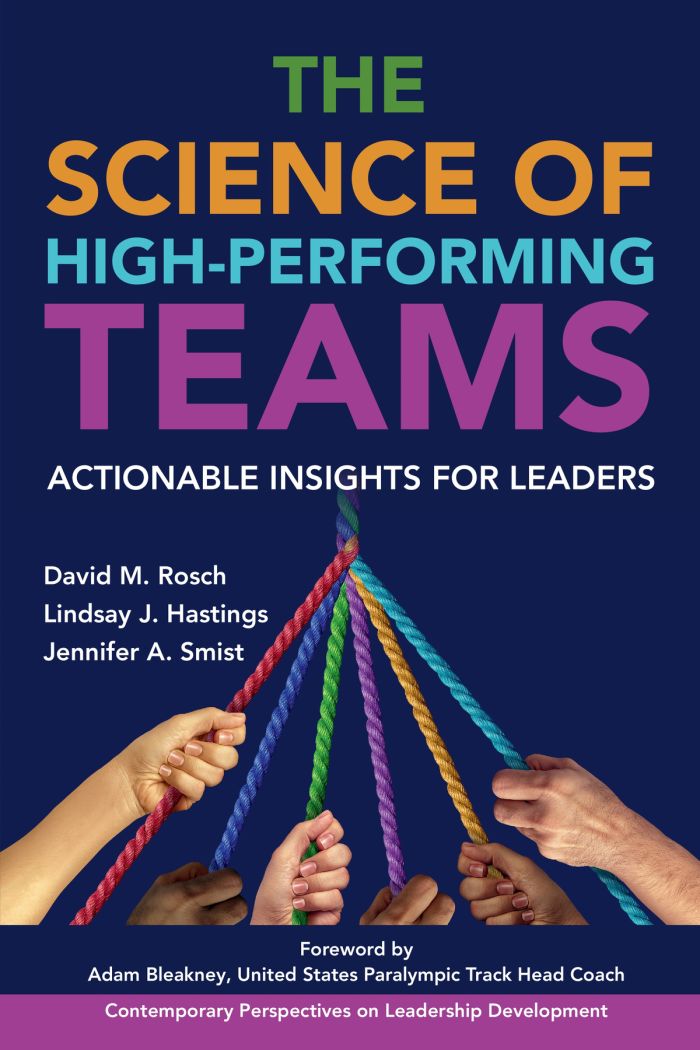
The Science of High-Performing Teams
Actionable Insights for Leaders

This book can be opened with

Note on our eBooks and Audiobooks: you can read our eBooks (ePUB or PDF) and listen to audiobooks on the free Emerald Books app on iOS, Android, and desktop. Or read and listen on Emerald's online reader (ePUB eBooks and audiobooks only). To purchase a digital book you will need to create an account if you don’t already have one. After purchasing you will receive instructions on how to get started.
- Description
- Contents
- About
The Science of High-Performing Teams describes how leaders need to “be” to manage teams, what they need to understand about human behavior to create teams from groups of individuals, and how to think about some of the basic – and more advanced – types of leader behaviors and group dynamics that often result in successful teamwork. The book will help readers assess their surroundings and their team’s environment to make good decisions in the moment. Everything in this book is grounded in decades of rigorous research on team success, drawing on insights from countless scholars across generations.
While “leadership” is all around us, most people in positions of authority or influence have little formal training or education in how to use that authority and influence to manage the teams for which they are responsible. The Science of High-Performing Teams explains and exemplifies the current state of research on team dynamics and leadership. It serves as a tool and training resource for aspiring leaders; new managers in professional settings; organizational consultants focusing on interpersonal dynamics; students enrolled in courses focused on those topics; and the secondary and post-secondary faculty who oversee those courses.
Chapter 1. An Introduction to Leading and Managing Teams
- Chapter 2. The “Invisible Work” of Team Leaders
- Chapter 3. Fundamental Dynamics for Team Success
- Chapter 4. A Team Leader’s Two Primary Jobs
- Chapter 5. Getting Work Done in Teams
- Chapter 6. Forming, Then Building, a Team
- Chapter 7. Leading Virtual and Hybrid Teams
- Chapter 8. Developing Cultural Competence in Teams
- Chapter 9. Leading Teams that Last
- Chapter 10. Developing Collective Leadership Capacity
- Chapter 11. A Final Word
David M. Rosch currently serves as an associate professor in the Agricultural Leadership, Education, and Communications Program at the University of Illinois Urbana–Champaign, USA.
Lindsay J. Hastings serves as the Clifton Professor in Mentoring Research and Research Director for NHRI Leadership Mentoring at the University of Nebraska–Lincoln, USA.
Jennifer A. Smist is a teaching assistant professor at the University of Illinois Urbana–Champaign, USA.