
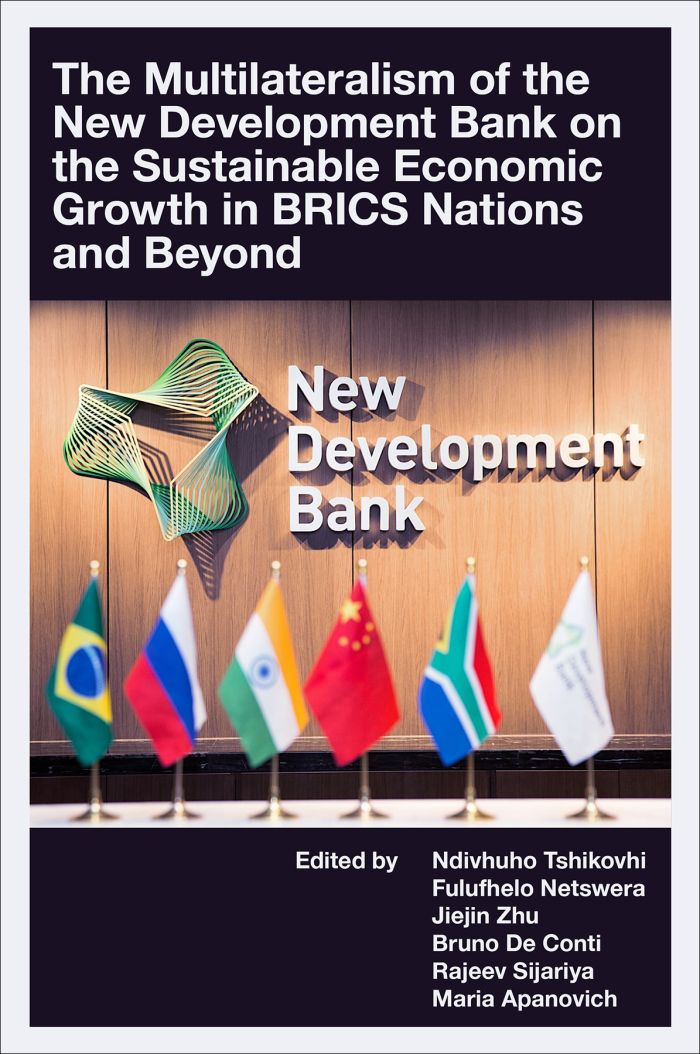

The Multilateralism of the New Development Bank on the Sustainable Economic Growth in BRICS Nations and Beyond

This book can be opened with

Note on our eBooks and Audiobooks: you can read our eBooks (ePUB or PDF) and listen to audiobooks on the free Emerald Books app on iOS, Android, and desktop. Or read and listen on Emerald's online reader (ePUB eBooks and audiobooks only). To purchase a digital book you will need to create an account if you don’t already have one. After purchasing you will receive instructions on how to get started.
- Description
- Contents
- About
Founded in 2015 as an alternative to the World Bank, the BRICS New Development Bank (NDB) offers vital financial resources for its member nations and supports development in emerging and developing economies. The Multilateralism of the New Development Bank on the Sustainable Economic Growth in BRICS Nations and Beyond brings together diverse perspectives to assess the NDB's effectiveness and its role in promoting global sustainability. It examines the BRICS Multilateral Cooperation and Co-Financing Agreement for Sustainable Development, highlighting projects focused on climate change mitigation, sustainable infrastructure, renewable energy, and the preservation of natural resources.
Suitable for bankers, development analysts, policymakers, NGOs and students, this book offers crucial insights into the evolving landscape of global development finance.
Foreword; Irina Yarygina
- Part I: Introduction to Multilateralism and NDB
- Chapter 1. Introduction to: The Multilateralism of the New Development Bank on the Sustainable Economic Growth in BRICS Nations and Beyond; Ndivhuho Tshikovhi, Fulufhelo Netswera, Jiejin Zhu, Bruno De Conti, Rajeev Sijariya, and Maria Apanovich
- Chapter 2. Challenges and Feasibility of a Democratic Global Financial Governance; Murilo Gaspardo and Daniel Campos de Carvalho
- Chapter 3. Finance, Governance, and Sovereignty after COVID-19: A Normative Argument for the Need to Democratise Global Finance; Robert Hanson
- Chapter 4. BRICS – A Comprehensive Mechanism Bringing Changes into the World Financial System and International Climate Diplomacy; Eka Khorbaladze
- Chapter 5. De-dollarization, the New Development Bank, and BRICS Trade Currency Changing Multilateralism and Geopolitical Arrangements; Ndivhuho Tshikovhi, Fulufhelo Netswera, and Bruno De Conti
- Part II: The Role of NDB in Supporting Sustainability
- Chapter 6. NDB and SDGs: Does the Bank Fulfill its Mandate?; Leonid Grigoryev and Alexandra Morozkina
- Chapter 7. The New Development Bank's Role in the Low Carbon Transition: An Analysis of Institutional Strategies and Projects Financed; Rafaela Mello Rodrigues de Sá
- Chapter 8. Notes on the Performance of the New Development Bank; Jonnas Esmeraldo Marques de Vasconcelos and Ana Elisa Saggioro Garcia
- Chapter 9. The Role of BRICS Business Council and the New Development Bank in Environmental, Social and Governance (ESG) Agenda; Rafaela Mello Rodrigues de Sá
- Chapter 10. Development Effectiveness: The Role of Multilateral Development Banks and Their Evaluation – Reference and Insights for New Development Bank; Xiaochen Hou
- Part III: Case Studies
- Chapter 11. Export Sophistication and Industrial Upgrading: A Study of Energy Vehicles in BRICS; Xuwen Cao and Rajah Rasiah
- Chapter 12. New Development Bank in India: Growth, Development and Futuristic Prospects; Zakia Tasmin Rahman, Ruhi Lal, and Ravinder Rena
- Conclusion; Irina Yarygina
Ndivhuho Tshikovhi is a Postdoctoral fellow at the Durban University of Technology Faculty of Management Sciences, South Africa.
Fulufhelo Netswera is Executive Dean Faculty of Management Sciences at Durban University of Technology, South Africa, tasked to develop the Business School.
Jiejin Zhu is a professor at the School of International Relations and Public Affairs and the deputy director of the Centre for UN and International Organizations Studies at Fudan University, Shanghai, China.
Bruno De Conti is Associated Professor at the Institute of Economics, University of Campinas, Brazil.
Rajeev Sijariya is currently associated with Jawaharlal Nehru University, Delhi, India as the Chairperson of the Special Centre for E-Learning and as a Professor at Atal Bihari Vajpayee School of Management and Entrepreneurship, New Delhi, India.
Maria Apanovich has been teaching at Moscow State Institute of International Relations since 2013. she has been a lecturer at the Department of Demography and Migration Policy since 2017.