
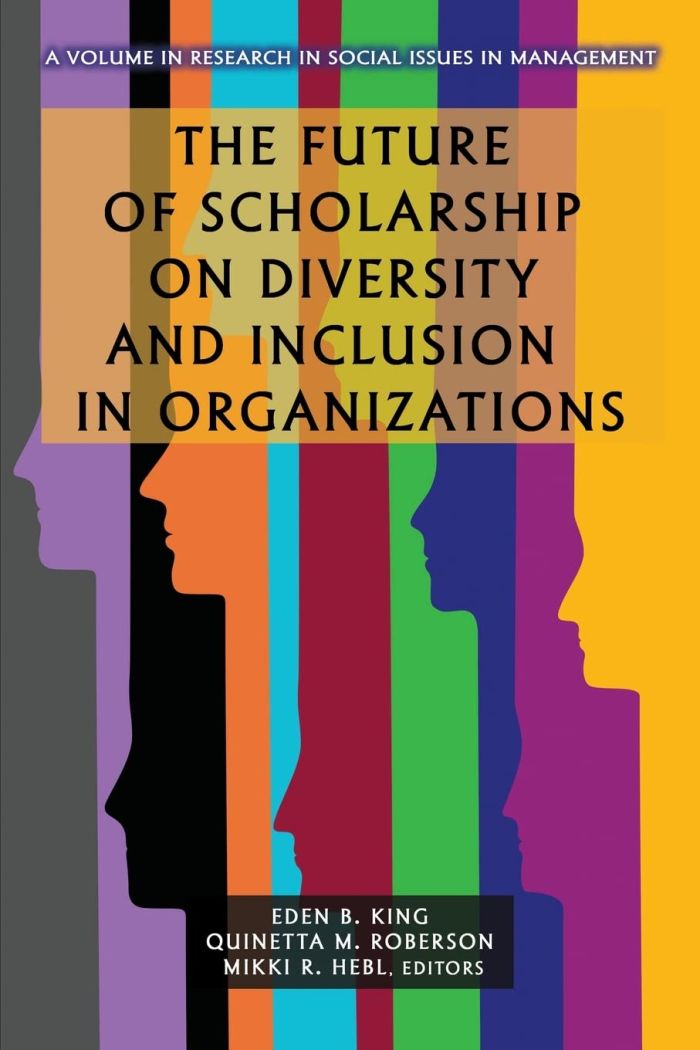
The Future of Scholarship on Diversity and Inclusion in Organizations

This book can be opened with

Note on our eBooks and Audiobooks: you can read our eBooks (ePUB or PDF) and listen to audiobooks on the free Emerald Books app on iOS, Android, and desktop. Or read and listen on Emerald's online reader (ePUB eBooks and audiobooks only). To purchase a digital book you will need to create an account if you don’t already have one. After purchasing you will receive instructions on how to get started.
- Description
- Contents
The current volume, the fourth in the series, provides a broad look at the meaning and understanding of diversity and inclusion in organizations. The contributors to this book look toward the future of D&I in organizations and the scholarship of these phenomena. This future focus references not only the content of the chapters-- which we hoped would offer new ideas, emphases, theories, and predictions-- but also to the contributors, emerging scholars who are the future of the field. Indeed, the chapters in this volume offer new perspectives on diversity in organizations, problematize existing perceptions and practices, and offer potential directions for change. Together, the questions and ideas offered these chapters generate a path forward for a thoughtful and nuanced view of D&I in future organizational science. In spite and because of their critiques of the status quo, the scholars and scholarship highlighted here provide hope for positive change.
Preface; Quinetta M. Roberson, Eden B. King, and Mikki R. Hebl.
- Chapter 1. The Business and Employee Cases for Inclusion: Implications for Organizations; Lyangela J. Gutierrez and Samantha J. Kellar.
- Chapter 2. Board Diversity: Why We Need It and How We Get It; Charlena S. Aumiller.
- Chapter 3. Representative Bureaucracy and Identity Salience: Insights From Social Identity Theory and Self-Categorization Theory; Amani Edwards.
- Chapter 4. What We (Don't) Talk About When We Talk About Diversity: Interrogating the Subtext of Diversity, Equity, and Inclusion Initiatives; Naomi M. Fa-Kaji and Anna L. Yan.
- Chapter 5. Empowering Differences: Disentangling the Effect of Power Inequalities in the Theory and Practice of Inclusion in Organizations; Alexandria Webber, Pratibha Deepak, and Gouri Mohan.
- Chapter 6. Diversity in the Digital Age: Cybervetting, Doxxing, and Employment Discrimination; Arturia Melson-Silimon, Rebecca Harmata, Rose LeFevre-Levy, Tara S. Behrend, and Nathan T. Carter.
- Chapter 7. Masculinity Contest Cultures and Inclusive Cultures: Insights From an Agent-Based Model of Organizational Socialization and Promotion; John Meluso, James Bagrow, Laurent Hébert-Dufresne, and Rob Razzante.
- Chapter 8. But I'm Not Diverse: Exploring the Contexts and Consequences of Calling Individual People (Versus Groups of People) Diverse; Linda T. Nguyen and N. Derek Brown.
- Chapter 9. What About Pregnancy Loss: An Examination of Wellness in the Workplace; Bhindai Mahabir, Joel Hernandez, and Ho Kwan Cheung.
- Chapter 10. Leadership in Times of Crisis: Emergence of Feminine Leadership Over Masculine and Androgynous Leadership Styles; Devalina Nag and David F. Arena Jr.
- Chapter 11. Reimagining Leadership: Breaking the Box of Leadership Theorizing and Methods; Miriam S. Yates, Ree Jordan, and Terrance W. Fitzsimmons.
- Chapter 12. Diversity as an Evaluative Tool: The Composition of Multidisciplinary Theories to Achieve Organizational Equity and Inclusion; Gino J. Howard, Sydney N. Green, Horatio D. Traylor, Hannah Perkins Stark, and Rachel Williamson Smith.
- Chapter 13. Utilizing Virtual Reality for Diversity Training May Increase Training Transfer; Lauren A. Collier-Spruel and Jo M. Alanis.
- Chapter 14. Deliberate Inclusion: Considering Underrepresented Perspectives in Psychology; Vivian L. Xiao.
- About the Authors.