
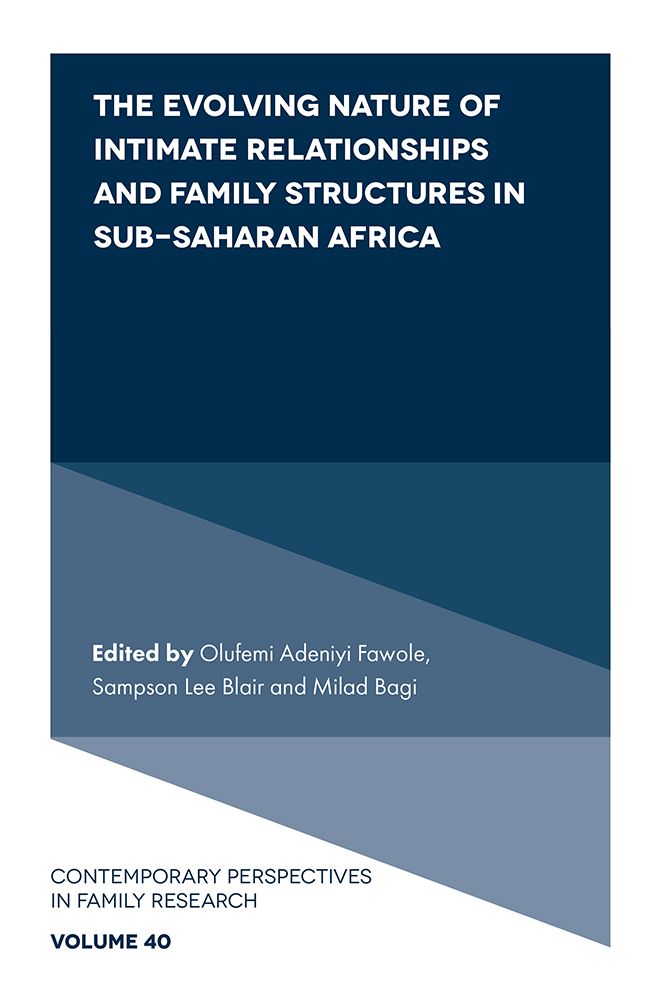
The Evolving Nature of Intimate Relationships and Family Structures in Sub-Saharan Africa

This book can be opened with

Note on our eBooks and Audiobooks: you can read our eBooks (ePUB or PDF) and listen to audiobooks on the free Emerald Books app on iOS, Android, and desktop. Or read and listen on Emerald's online reader (ePUB eBooks and audiobooks only). To purchase a digital book you will need to create an account if you don’t already have one. After purchasing you will receive instructions on how to get started.
- Description
- Contents
- About
Families in Sub-Saharan Africa are undergoing significant transformation within diverse cultural and social contexts. The Evolving Nature of Intimate Relationships and Family Structures in Sub-Saharan Africa provides a nuanced examination of how these changes reshape family life and intimate relationships across the region.
Bringing research that explores how families are shaped by shifting social, economic, and cultural conditions across the region, this volume examines how processes such as urbanization, migration, and globalization interact with longstanding kinship structures and intergenerational relationships. Exploring topics such as how gender dynamics, economic pressures, and religious influences shape everyday family practices, the chapters also consider the effects of digitalization, evolving policy and health challenges. Richly comparative, the book demonstrates that family life in Sub-Saharan Africa must be analyzed as a dynamic set of relationships influenced by local traditions and broader structural change.
Offering an important contribution to family research by foregrounding both continuity and transformation within African contexts, this volume equips readers with a deeper understanding of family change in one of the world’s most diverse regions.
Chapter 1. The Aftermath of the COVID-19 Pandemic on Family Affairs: Implications for Social Work Family-Related Services in the Future; Robert Mutemi Kajiita and Eleanor Alvira Hendricks
- Chapter 2. Religion and Net-Fertility in Africa: History, Geography, and Culture; Michel Garenne
- Chapter 3. Family Structures in Zambia: Continuity and Change; Esther Ng’ambi
- Chapter 4. Examining the Implications of Elder Abuse on Family Structure and Relationships in South Africa; Tanusha Raniga and Carmel Murugen
- Chapter 5. Family Care Settings and Child Wellbeing: Insights from Kinship Families in Tanzania; Nabwera H. Rashid, Janeth Kigobe, Lucas Wissmann, Getrude Mkinga, Eliud Kabelege, Christina Nelson Mbilinyi, and Tobias Hecker
- Chapter 6. Fluid Identities? Lineage Identity among Women in Ghana; Victor Agyei-Yeboah, Eric Y. Tenkorang, and Gervin A. Apatinga
- Chapter 7. Cohabitation in Sub-Saharan Africa, 1986–2021: Levels, Trends, and Social Gradients; Souleymane Sanogo and Sangeetha Madhavan
- Chapter 8. Negotiating Power and Resilience: Gender Dynamics, Family Relationships, and Women’s Tolerance in the Context of HIV/Aids in Rural African Families; Limkile Mpofu, Zamokuhle Mbandlwa, and Jarrot Mpofu
- Chapter 9. Is Contraception Still a Woman’s Business? Men’s Gender Ideologies and Their Implications for Intimate Relationships and Family Formation in Africa; Turnwait Otu Michael
- Chapter 10. De-Objectifying Fatherhood Construction in Ghana: Insights from Women’s Professional Voices; Esmeranda Manful and Kwame Adusei
- Chapter 11. Families and Adverse Childhood Experiences in South Africa: Insights from Women’s Narratives; Itumeleng Masisi
- Chapter 12. What’s in a Name? – Surnames, Identity and Family Culture through J.J. and Another vs Minister of Home Affairs and Another; Tafadzwa N. Mavindidze
- Chapter 13. Having a Child with a Rare Disease in a Couple: Cameroonian Mothers’ Perspective; Rose-Danielle Ngoumou
Olufemi Adeniyi Fawole is Associate Professor at the Department of Sociology, University of Ilorin, Kwara State, Nigeria.
Sampson Lee Blair is a family sociologist and demographer at The State University of New York (Buffalo), USA.
Milad Bagi is Assistant Professor of demography at Bu-Ali Sina University, Iran.