
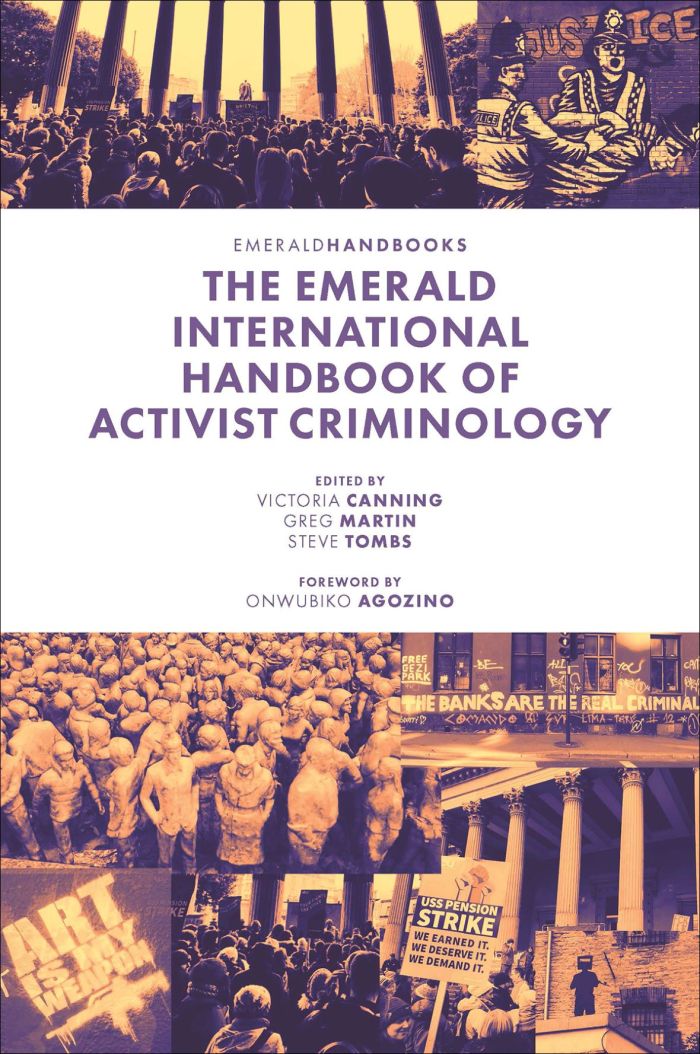

The Emerald International Handbook of Activist Criminology

This book can be opened with

Note on our eBooks and Audiobooks: you can read our eBooks (ePUB or PDF) and listen to audiobooks on the free Emerald Books app on iOS, Android, and desktop. Or read and listen on Emerald's online reader (ePUB eBooks and audiobooks only). To purchase a digital book you will need to create an account if you don’t already have one. After purchasing you will receive instructions on how to get started.
- Description
- Contents
- Reviews
- About
Although intervention and campaigning have long been integral to critical criminology, in recent years, criminal justice activism has taken new directions and gathered momentum, especially with the advent of digital technologies and social media. These have made it easier than ever for ordinary citizens and professional journalists alike to comment on perceived injustices and potentially intervene in formal criminal justice processes.
The Emerald International Handbook of Activist Criminology examines the history of both recent and more established justice campaigns and interventions. Spanning contributions from activists, activist academics, and practitioners from five continents, chapters address a range of criminological perspectives that engage in questions of effecting change through activism. Contributors also consider prominent international issues including feminist criminology, juvenile justice, migrant rights, corporate and state crime, indigenous rights, green/environmental criminology, sentencing and wrongful conviction, the harms of prisons, corrections and abolitionism, and justice for victim/survivors of harm and crime.
Collectively, The Emerald International Handbook of Activist Criminology explores the contemporary terrain around new and emergent issues and forms of activism, and offers cutting edge conceptualizations of the methodological and practical applications of activist engagement, solidarity, and resistance.
Foreword; Onwubiko Agozino
- Chapter 1. Why ‘Activist Criminology’, Why Now? ; Victoria Canning, Greg Martin, and Steve Tombs
- Part One: Foundational Epistemological, Methodological and Political Considerations
- Chapter 2. Activist Criminology Methods; Joanne Belknap and Alejandra Portillos
- Chapter 3. Janus-Faced Criminology: Negotiating the Boundaries Between Activist and Administrative Research; Keir Irwin-Rogers
- Chapter 4. Criminological Artivism: Examining the Potential of Collaboration and Coproduction Between Socially Engaged Art and Critical Criminology; Will Jackson, Will McGowan, and Emma Murray
- Chapter 5. Activists as Knowledge Producers: How can Grassroots Activism Contribute to Green Criminological Scholarship?; Ayse Sargin
- Chapter 6. Cultural Criminology Activism at the Intersection of Crime-Media Research; Greg Martin
- Chapter 7. Hope in Activist Criminology; Rachel Seoighe
- Part Two: Historical Interventions as Activist Criminology
- Chapter 8. In Defence of Human Rights: The Political-Academic Experience of The Centre for the Study of Violence, Brazil; Gustavo Lucas Higa, Marcos César Alvarez, and Roxana Pessoa Cavalcanti
- Chapter 9. The Summer of Discontent: The British Prisoners’ Strike of 1972; Cormac Behan
- Chapter 10. An Activist Criminology Against Torture and Institutional Violence (And Its Academic Denials); Alejandro Forero-Cuéllar and Iñaki Rivera-Beiras
- Chapter 11. Militarized Democracy and Criminalization of Civil Activism in Nigeria; Luke Amadi And Imoh Imoh-Ita
- Part Three: Situating Sites Of Activism And Resistance
- Chapter 12. Theater in Prison: Toward a Subversive Stance in Criminology; Chloé Branders
- Chapter 13. Open Your Eyes: Confronting Indigenous Genocide with Pedagogy; David Rodríguez Goyes
- Chapter 14. The Struggle for Agency: Worker Resistance Narratives in Norway; Hanna Maria Malik
- Chapter 15. What about Environmental ‘Victims’? Methodological Reflections for an Activist Criminology; Lorenzo Natali, Anna Berti Suman, and Marília de Nardin Budó
- Chapter 16. Power, Agency, and The Politics of Dissention in Activist Spaces: Sea-Rescue Ngos’ Resistance to Illegalisation and its Contradictions; Giulia Ferranti
- Chapter 17. Rise Up: Activist Criminology, Colonial Injustice and Abolition; Thalia Anthony and Vicki Chartrand
- Chapter 18. Institutional Child Sexual Abuse Activism: Reconsidering The Role Of Public Inquiries; Dave McDonald and Jessica C. Oldfield
- Part Four: Practice-Based Interventions in Activist Criminology
- Chapter 19. Bridging Urban-Rural Grassroots Activism: Activist Criminology in Support of Unified Struggles for Social Change and Social Justice; Tim Goddard and Amy M. Magnus
- Chapter 20. Craftivism and Crime: Craft as a Vehicle for Criminal and Social Justice Activism; Alyce McGovern and Tal Fitzpatrick
- Chapter 21. You Have the Right to Remain! Building the ‘Asylum Navigation Board’ to Mitigate UK Border Harms; Victoria Canning and Lisa Matthews
- Chapter 22. Sports-Based Interventions as Anti-Crimmigration Activism in Rome’s Working-Class Suburb: Self-Reflections on Building Solidarity; Ilaria Aversa
- Chapter 23. Survivors Speak Out: The Successes and Failures of Hashtag Activism; Stephanie Fohring and Lily Horsfield
- Chapter 24. Police Accountability Through Community-Focused Officer Training; Jodie M. Dewey
- Part Five: The Trials And Tribulations Of Advancing Activist Criminology In Contemporary Academia
- Chapter 25. Teaching Activist Criminology in the Neoliberal University; Aidan O’Sullivan
- Chapter 26. Making a Difference? Reflections on Sex Work, Activism, and Research for Social Change; Lynzi Armstrong
- Chapter 27. Walking on Eggshells: Acts of Resistance in Social Work; Linda Briskman
- Chapter 28. Inquiries and Data Traps: Do Activists Need More Evidence?; Becka Hudson
- Chapter 29. The Dilemmas of A Dissident Intellectual and Inadequate Activist; Liv S.Gaborit
The editors and contributors are to be congratulated for providing an urgent and much needed critical response to the global politics of harm and the local practices of violence that swirl around, in, and through our collective psyches and our interdependent humanity. This Handbook is an indispensable criminological resource for activists, academics, policy professionals, and students of justice.
This groundbreaking book sets the tone for the criminological debate, making it clear that science can no longer be understood in isolation from social change. Crime, punishment and social control shape the lives of the most vulnerable sections of society, and their voices demand to be included in any transformative project that genuinely seeks to overturn existing injustices. The book raises this demand from a decolonial and intersectional perspective that includes Indigenous, abolitionist, transfeminist and Southern perspectives that make clear that Western-centred solutions are neither epistemically nor empirically sufficient to promote real transformation.
This Handbook constitutes a fundamental milestone and essential reading for all those in the criminological field who, beyond traditional views, claim a style of knowledge production politically committed to the current struggles for transformation and social justice.
The Emerald International Handbook of Activist Criminology is a timely collection of cutting-edge contributions by established and emerging activist researchers and advocates. These are bold and creative interventions from a range of diverse perspectives, all unified with the common objective of resisting the epistemic violence of a discipline traditionally tethered to state and increasingly corporate research agendas that continue to be implicated in and directly reproduce social injustice, violence and harm. Together, they compose a bold and comprehensive response to a frequently asked question: should criminology be abolished? This book is an important, instructional and heartening manual for the growing number of radically oriented and activist researchers struggling on the margins of the discipline to build meaningful community, solidarity and intervention that result in genuine structural change and the dismantling of injustice and social harm.
A book of consistently high quality that provides much food for thought as well as a useful pedagogical resource.
Victoria Canning is Associate Professor of Criminology at the University of Bristol, UK.
Greg Martin is Associate Professor of Criminology, Law and Society in the School of Social and Political Sciences at the University of Sydney, Australia.
Steve Tombs is Emeritus Professor at The Open University, UK.