
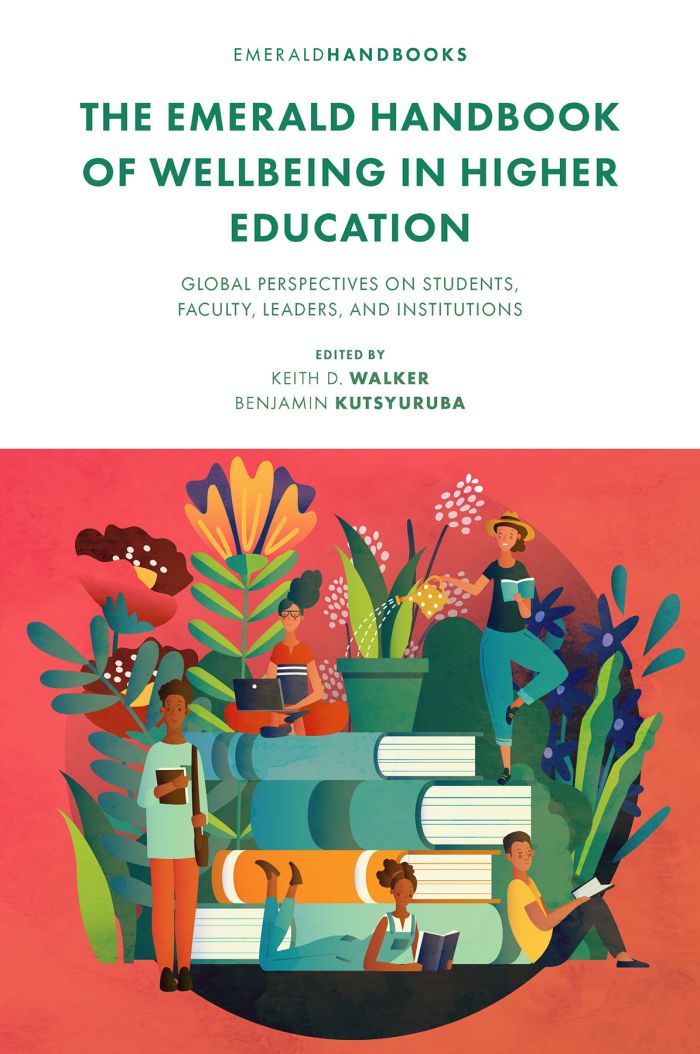

The Emerald Handbook of Wellbeing in Higher Education
Global Perspectives on Students, Faculty, Leaders, and Institutions

This book can be opened with

Note on our eBooks and Audiobooks: you can read our eBooks (ePUB or PDF) and listen to audiobooks on the free Emerald Books app on iOS, Android, and desktop. Or read and listen on Emerald's online reader (ePUB eBooks and audiobooks only). To purchase a digital book you will need to create an account if you don’t already have one. After purchasing you will receive instructions on how to get started.
- Description
- Contents
- Reviews
- About
There has been an increased focus on the need to address the wellbeing and mental health challenges that affect humans across organizational settings, including the higher education sector.
This comprehensive Handbook is organized into three sections: student wellbeing, faculty and leader wellbeing, and wellbeing initiatives at institutional or systems-level. Scholars from around the globe discuss initiatives, practices, and structures that provide a positive outlook on individual and organizational flourishing in higher learning and offer lessons from efforts to promote positive emotional and social aspects for students, leaders, and faculty. Topics include student resilience and leadership, supervisory relationships, appreciative mentoring, student thriving, issues of mental and physical health, faculty and leader wellbeing, development of wellbeing interventions and health promotion frameworks, and international student wellbeing.
The interventions and experiences presented in The Emerald Handbook of Wellbeing in Higher Education are aimed at enhancing flourishing among students, faculty and staff, and across institutions. This Handbook will be helpful to higher education leaders and managers as they consider ways to promote and implement wellbeing strategies within their institutions, whilst encouraging all readers to adopt an appreciative, strengths-based, positive approach to teaching, learning, and leading in higher education contexts.
Foreword; Kabini Sanga
- Chapter 1. Introduction: Towards Wellbeing in Higher Education Institutions; Benjamin Kutsyuruba and Keith D. Walker
- Section One: Student Wellbeing Focus
- Chapter 2. Resilience, Wellbeing, and Authentic Leadership in Student Transition to University; Jodi Basch
- Chapter 3. Thriving in First-Year Higher Education Settings; Amy Lean MacArthur
- Chapter 4. Supporting Student Wellbeing During Graduate Internships; Carlie Pagens and Margaret Clarke
- Chapter 5. Enhancing the Wellbeing of Academic Staff, Educational Leaders, and Students through Co-constructing Learning: A Maltese Experience; Christopher Bezzina
- Chapter 6. Mutual Commitments and Wellbeing in Doctoral Faculty Advisor-Student Relationships; Smart Chukwu
- Chapter 7. Student Thriving and Supervisory Relationships: Making or Breaking Graduate School; Heather A. Coe-Nesbitt and Eleftherios K. Soleas
- Chapter 8. Savoring Good Times: How Do Canadian Doctoral Students Maintain Their Wellbeing?; Maha Al Makhamreh
- Chapter 9. Harnessing the Pacific Power of Appreciative Mentoring Relationships in Tertiary Education, Aotearoa New Zealand; Cherie Chu-Fuluifaga
- Section Two: Faculty and Leader Wellbeing Focus
- Chapter 10. The ABCs of Faculty Wellbeing Dana L. Mitra
- Chapter 11. Exploring Wellbeing Strategies Among Saudi Female Leaders in Higher Education; Laila Albughayl
- Chapter 12. Reciprocal Wellbeing in Higher Education; Richard Nyarko and Keith D. Walker
- Chapter 13. Six Middle Leaders Speak to Wellbeing Initiatives in Two Jamaican Teacher Training Colleges; Ann-Marie Wilmot
- Chapter 14. Success and Flourishing of Academic Leaders in Higher Education Settings; Shannon Hill and Benjamin Kutsyuruba
- Chapter 15. Higher Education Leadership and Personal Wellbeing; Megan Crawford
- Chapter 16. Advancing Wellbeing in Higher Education through Instructional Leadership; Haim Shaked
- Section Three: Institution and System-Level Wellbeing Focus
- Chapter 17. A Tertiary Institution’s Approach to Strategic Planning and Implementations for Faculty Wellbeing; Ardene Virtue
- Chapter 18. Promoting Wellbeing in A Large Public University: The Case of The Alma Mater Studiorum - Università di Bologna; Mario Pontieri and Angelo Paletta
- Chapter 19. Māori Leadership, Māori Youth, and The Academy Space: Developing A Wellbeing Agenda; Adreanne Ormond And Martyn Reynolds
- Chapter 20. Promoting Wellbeing in Higher Education: Capability, Capacity, and Sustainability for Educational Leaders’ Flourishing; Darcia Roache
- Chapter 21. Leadership as Hosting in Higher Education: Competencies that Enhance Stakeholders' Wellbeing; Wilfred Beckford, Keith D. Walker, and Kameka Spence
- Chapter 22. Fostering International Student Transitions and Wellbeing; Smart Chukwu
- Chapter 23. Supporting Wellbeing with the Okanagan Charter: A Health Promotions Framework; Vicki Squires
- Conclusions
- Chapter 24. Keeping the Momentum for Wellbeing in Higher Education Through Moral Imagination: Concluding Thoughts; Keith D. Walker and Benjamin Kutsyuruba
It is hard to imagine a timelier contribution for leaders in higher education: evidence suggests that campuses are less vital, students are increasingly seeking mental health services, and performance pressures are increasing. This handbook offers promising approaches to revitalizing the human side of higher education and, by drawing from many countries and perspectives, provides a base for thoughtful discussions in the varied contexts that serve the tertiary education sector.
This is a timely volume for thinkers and practitioners of higher education development. Led by two prominent Canadian scholars, the handbook offers a rich collection of empirical studies and theoretical insights on student and educator wellbeing. In the days of growing precarity, the research and reflection on this topic are hugely important for all of us taking care of new generations of learners and citizens.
Thoughtfully curated by two leading experts in human flourishing in organizations, this comprehensive volume presents a thorough examination of the intricate dimensions of well-being within the academic sphere. Its diverse chapters explore critical facets of student, faculty, and leader wellbeing, along with institution-level considerations. The international cadre of contributors, with their distinct perspectives, elevates this work to an indispensable resource for scholars, researchers, and administrators who are intent on advancing their understanding and contributing to the scholarly discourse on fostering wellbeing in higher education.
The Emerald Handbook of Wellbeing in Higher Education is an illuminating guide to student, faculty, leader, and system wellbeing. Contributing authors create a fascinating look at the interpersonal nature of thriving and learning in higher education. This collection brims with hope, ideas, and the belief that putting purpose to wellbeing is a cornerstone of the learning community.
The Emerald Handbook of Wellbeing in Higher Education is a timely volume that will provide academic leaders ideas on improving wellbeing on their campuses. The book will help to close the scholar-practitioner gap by providing actionable, evidence-based strategies to promote human flourishing on campuses.
This is another fine book by the editors that adds to the impressive contributions that they have been making in the field of inquiry into wellbeing in educational settings and contexts. The book is rich on case studies on wellbeing of students and of faculty and on institutional approaches to wellbeing in higher education from around the word. It will be welcomed as a valuable resource to higher education institutions as they work on putting their wellbeing agendas into practice.
In a thorough and well-balanced collection of chapters, Walker and Kutsyuruba have gathered important works focused on wellbeing of students, faculty, leaders, and institutions of higher education across the world. Built upon extensive research conducted in widely diverse settings, the chapters are focused on action, as illustrated by evocative action verbs such as harnessing, savoring, exploring, thriving, flourishing, and advancing. This handbook offers inspiration and motivation for everyone engaged in pursuing wellbeing in higher education.
Keith D. Walker is a Professor in the Department of Educational Administration at the University of Saskatchewan, Canada. Keith is currently a Provincial Cabinet appointed member of the Saskatchewan Higher Education Quality Assurance Board.
Benjamin Kutsyuruba is a Professor of Educational Leadership, Policy, and School Law in the Faculty of Education at Queen’s University, Kingston, Ontario, Canada. Benjamin has worked as a teacher, researcher, manager, and professor in the field of education in Ukraine and Canada.