
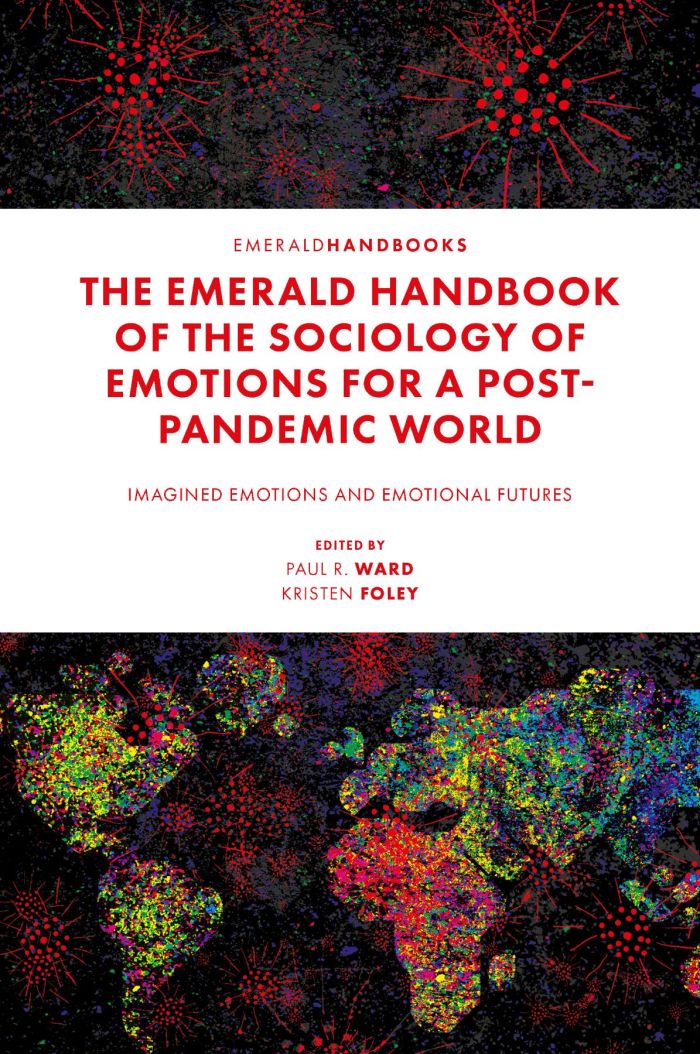

The Emerald Handbook of the Sociology of Emotions for a Post-Pandemic World
Imagined Emotions and Emotional Futures

This book can be opened with

Note on our eBooks and Audiobooks: you can read our eBooks (ePUB or PDF) and listen to audiobooks on the free Emerald Books app on iOS, Android, and desktop. Or read and listen on Emerald's online reader (ePUB eBooks and audiobooks only). To purchase a digital book you will need to create an account if you don’t already have one. After purchasing you will receive instructions on how to get started.
- Description
- Contents
- Reviews
- About
The study of how emotions are socially patterned is a young and promising field within sociology. This handbook offers a sociological examination of the lived impacts of the COVID-19 pandemic through culture(s) of emotion – from hope to anger, optimism to grief, and courage to boredom.
The Emerald Handbook of the Sociology of Emotions for a Post-Pandemic World considers the dynamics and structures of affect as they have been experienced by local and global populations in a time of global health crisis. Advancing a theoretical agenda in the sociology of emotions and drawing from empirical evidence of emotional impacts, the authors cover a range of philosophical and methodological questions about how to study emotions, and why doing so is critical in turbulent times.
Including policy and planning insights for how to reconcile our emotional lives and collective experiences in a post-pandemic world, this collection is a refreshing contribution to a new and exciting sub-discipline; and is a compelling read for theorists, researchers, and students of the social, cultural, and political sciences.
Chapter 1. Introduction - Pandemic-Emotions, Ontologies of Uncertainty, and Imagining Emotional Futures; Paul R. Ward and Kristen Foley
- Chapter 2. Grief: Challenges to death, dying, disposal and grief in corona times; Michael Hviid Jacobsen
- Chapter 3. Hoping in a COVID-19 world; Patrick Brown and Marci Cottingham
- Chapter 4. Nostalgia and the corona pandemic: A tranquil feeling in a fearful world; Krystine I. Batcho, Michael Hviid Jacobsen, and Janelle L. Wilson
- Chapter 5. Courage, Risks and Dating in the COVID-19 Crisis; Poul Poder
- Chapter 6. Is Happiness a Fantasy only for the Privileged? Exploring Women’s Classed chances of being happy through alcohol consumption during COVID-19; Belinda Lunnay, Megan Warin, Kristen Foley, and Paul R. Ward
- Chapter 7. Pandemic anger and semiotic meaning-making of loss of lifeworld freedoms; Kingsley Whittenbury
- Chapter 8. Imagining Intimacy after COVID; Clare Southerton and Marianne Clark
- Chapter 9. Constructing Heroism in the Time of Covid; Amir Marvasti and Travis Saylor
- Chapter 10. Boredom, screens, and homesickness amidst the crisis; Patrick Gamsby
- Chapter 11. Feeling and (Dis)trusting in Modern, Post-Truth, Pandemic Times; Kristen Foley, Belinda Lunnay, and Paul R. Ward
- Chapter 12. ‘I want to remember how nice it felt to talk to someone’: Optimism and positive emotions in the linguistic reconstruction of COVID-19 lockdown experiences in the UK; Stella Bullo, Lexi Webster, and Jasmine Hearn
- Chapter 13. Fear and Loathing in an Indonesian Island: an Ethnographic Study of Community Responses to the COVID-19 Pandemic; Christopher Raymond and Paul R. Ward
- Chapter 14. Popular soup kitchens: loving, feeding, and sharing; Adrian Scribano
[The Emerald Handbook for the Sociology of Emotions] cover[s] productions from the five continents, [and] it exposes how the pandemic generated changes in the prominence, pattern, and value of some emotions so that we can see the particularities of the different countries as well as the similarities between them. [...] Taking the relationship between bodies/emotions/environment for granted, the Handbook presents emotions from a sociological perspective at no time neglecting that these are physical-psycho-social processes.[...] it presents substantial contributions to thinking about the past, but in the 'meantime', without nostalgia -or nostalgic enough – to reflect on what we were, to think about what we are and to create what we can be."
Paul R. Ward is Professor of Public Health at Torrens University, Australia. An internationally distinguished and highly influential social scientist, he leads a research centre that seeks to move public health away from purely biomedicine, towards a more open-ended assemblage of possibilities.
Kristen Foley is a Researcher and Doctoral Candidate at Torrens University, Australia. She has a theoretical interest in human flourishing, knowledge economies, and social structure and a methodological in developing innovative qualitative methods; and uses these frames to explore relations of care, commercialisation, and consumption in everyday life.