
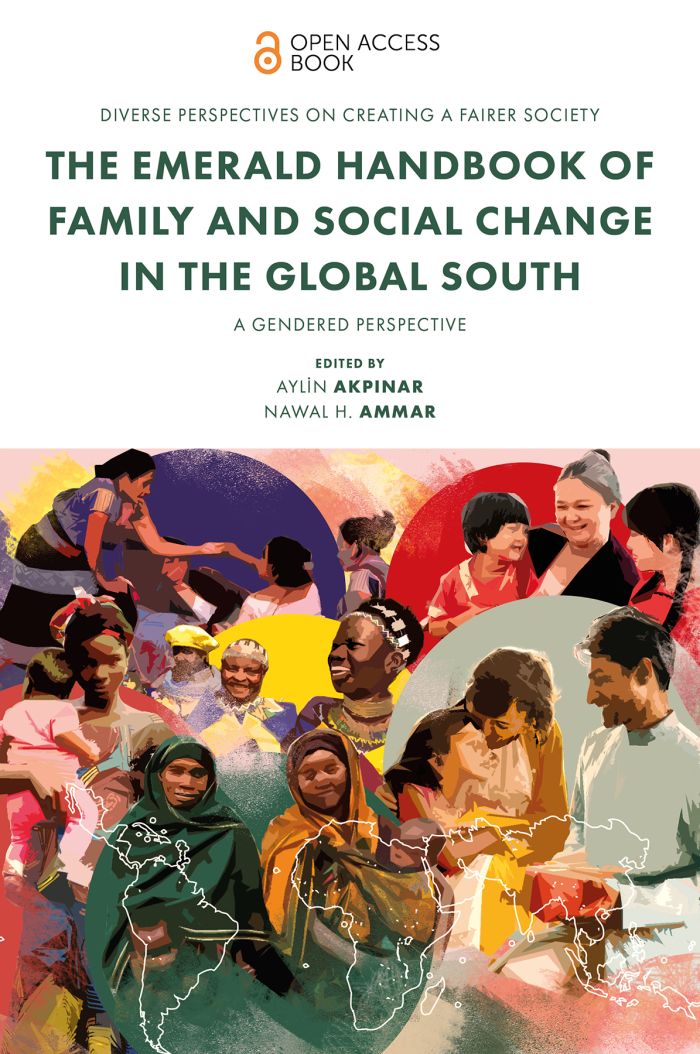
The Emerald Handbook of Family and Social Change in the Global South
A Gendered Perspective

This book can be opened with

Note on our eBooks and Audiobooks: you can read our eBooks (ePUB or PDF) and listen to audiobooks on the free Emerald Books app on iOS, Android, and desktop. Or read and listen on Emerald's online reader (ePUB eBooks and audiobooks only). To purchase a digital book you will need to create an account if you don’t already have one. After purchasing you will receive instructions on how to get started.
- Description
- Contents
- Reviews
- About
- Open Access
The ebook edition of this title is Open Access and freely available to read online.
There is a gap in research on families in the Global South and those that address the issue with a gendered and critical perspective. Considering the Global South and its articulations of power and resistance, this handbook presents chapters on the family in the Global South, acknowledging gender differences and their impact on individuals and societies in those nations and cultures.
Exploring the complex intersection among three significant social dynamics – families, the forces of societal transformation, and gender-related matters within the framework of the Global South and acknowledging the ongoing debate surrounding the Global South concept – the chapters illuminate and critically examine some of the debated matters pertaining to shifts in family dynamics from a gendered perspective. Demonstrating that examining changes in living arrangements and family dynamics through a gendered lens is indispensable not only to understand the ongoing socio-cultural processes in the Global South but also to develop social policies and service delivery practices, authors present case studies from the Middle East, Asia, Africa, and Latin America. To what extent do structural and cultural contexts influence gendered family dynamics and living arrangements in various societies of the Global South? In diverse societies of the Global South, how do individuals from intersectional backgrounds navigate the challenges posed by economic and social instabilities? What role does the family play in regulating these transformations?
Compelling reading for students, researchers and policymakers from various disciplines, chapters address a rich diversity of the issues relating to the family, social change and gender relations with a critical focus on the countries/cultures/communities that have been significantly underrepresented in the literature.
Foreword: Southern Voices of Change and Their Formidable Challenges; Göran Therborn
- Introduction: The Family as a Gendered Site of Continuity and Change; Nawal H. Ammar and Aylin Akpınar
- Section I. Dynamics within Gendered Households
- Chapter 1. Social Capital and Meeting Household Needs: A Study of Male- and Female-Headed Households in Ghana; Albert Kpoor and Sylvia Esther Gyan
- Chapter 2. Determinants of Women’s Empowerment in Agriculture in Botswana: The Abbreviated Women’s Empowerment in Agriculture Index (A-WEAI) Approach; Masa V. Motaung and Martin Bosompem
- Chapter 3. ‘Although Food is Not Always on the Table, I Feel Happy with My Family’. The Life Satisfaction among Mayan Families; Lukasz Czarnecki
- Section II. Understandings of Caregiving and Gendered Agency
- Chapter 4. The COVID-19 Border Closure as an Opportunity for New Gender Roles: Moroccan Women Trapped in the Spanish Enclave of Melilla; Lucía Granda, Rita Sobczyk, and Rosa M. Soriano-Miras
- Chapter 5. Gendered Subjectivities of Care among Street Trading Women in Rural Venda: Negotiations and Resistance to Norms and Stereotypes; Pfarelo Matsila
- Chapter 6. Who Cares for the Carers of People with Disabilities? Stories, Solutions and a Model from South Asia; Mary Wickenden and Ruth Patil
- Section III. Changes and Challenges in Sexuality, Reproduction and Kinship Practices
- Chapter 7. Reproduction as a Form of Aspiration: Medicalised Childbirth and the Case of Chinese Birth Tourism in the United States and Canada (1980-2017); Brandon Folse, Arafaat A. Valiani, and Bo Yang
- Chapter 8. Redefining Adoptive Family Practices in Contemporary India; Sushri Sangita Puhan
- Chapter 9. The Discursive Frontiers of ‘Sacred Familialism’ and Islamist Gender Nativism in Authoritarian Populist Politics in Turkey; Didem Unal
- Chapter 10. Constructing Sexuality as Shame: Turkish Women’s Emotions in Marriage; Aylin Akpınar
- Section IV. Challenges in Heterosexual Systems
- Chapter 11. LGBTQ+- Headed Families in Brazil and Chile: An Examination of Policies, Social Initiatives and Social Challenges; Kate Luxion, Diego Castro, and Bruno de Brito Silva
- Chapter 12. LGBTQI+ Social Change in the Global South: Repositioning Resistance Risk, Equality and Wellbeing in Fiji; Mark Vicars, Ann Cheryl Armstrong, Peter Sipeli, John Tenamo Mānoa Erasito Teaiwa, Ratu Manoa Rokotavaga, and Mark Shaheel Lal
- Chapter 13. A Family with Fluid Boundaries and Possible Ruptures: An Ethnographic Study of a Transgender Parivar in South India; Nimisha John
- Section V. Domestic Worlds, Political Struggles: Gender at the Nexus of Family and State
- Chapter 14. Dismantling ‘Gender-Appropriate’ Scripts: Young Jordanians’ Practices of Creative Agency within Family Contexts; Ivana Cosmano
- Chapter 15. Mundane Violence and Gender Politics: Young Women’s Narratives from Northern Nigeria; Máiréad Dunne, Dauda Moses, Safiya Adamu, and Barbara Crossouard
- Chapter 16. Politics of Gender and Resistance in the Arabian Gulf: A Feminist Theological Reading; Jihan Zakarriya
- Chapter 17. Mothers’ and Daughters’ Relationships in the Aftermath of the Salvadoran Armed Conflict: A Strenuous Relationship; Paula Cuellar Cuellar
- Epilogue – The Family as a Frontier of Hope: Gender, Agency, and Transformation in the Global South; Nawal H. Ammar and Aylin Akpınar
This edited volume offers a groundbreaking rethinking of the family as a dynamic, gendered site of both continuity and transformation across the Global South. Moving beyond Western-centric paradigms, it brings together rich case studies that illuminate how care, kinship, and resistance are negotiated under shifting social, political, and economic conditions. By centring relationality, collective survival, and feminist praxis from the South, the book expands the theoretical landscape of gender and family studies, offering an indispensable contribution to global feminist scholarship and to the ongoing redefinition of what constitutes family, power, and care.
What a timely book! With family research from the postcolonial South built on today’s voices, this volume conveys hope and optimism in a world that can look rugged if you just read the news. The family is seen as both an intimate and a political arena, “a site of both constraint and creativity”, based on ongoing negotiations. The heterosexual paradigm is challenged and the creativity among queer families is uplifted. The approach is sociological and feminist, building on relational intersectionality, where the Western stress on autonomy is questioned, and gendered agency is seen as an ability to act in webs of interdependence. The 17 chapters are case studies from a broad array of Southern countries analyzing work, care, religion, reproduction and sexuality in families. The volume will be useful both to researchers and policymakers around the world.
This handbook offers a rich and illuminating contribution to the study of family studies and social change in the Global South. Throughout the book, in different chapters, the family is critically examined as both a practice and an institution at the intersection of gender/sexuality, kinship/household, nation/state, politics/religion, and production/reproduction.
Care giving practices are explored from various perspectives within the reproduction of the family institution. It is not surprising that the gendered agency of women is highlighted in each case study representing different regions of the Global South. Women, men, queer actors, and young people from diverse backgrounds resist, oppose, and negotiate against the patriarchal structures represented in different chapters. The reader learns about a variety of innovative practices. Each chapter in the handbook is valuable and should be read for its unique contribution to the study of the family as a gendered practice against the backdrop of challenging global transformations.
Academics and practitioners working in the field are invited to participate in the ongoing political debate on 'decolonizing knowledge and recognizing the multiplicity of family forms' in the Global South. In this context, the handbook is invaluable as a timely contribution to the literature on family sociology and gender studies.
Aylin Akpınar is Senior Lecturer in the Department of Social Studies, Faculty of Social Sciences at Linnaeus University, Sweden.
Nawal H. Ammar is Dean of the College of Humanities and Social Sciences at Rowan University, USA.