
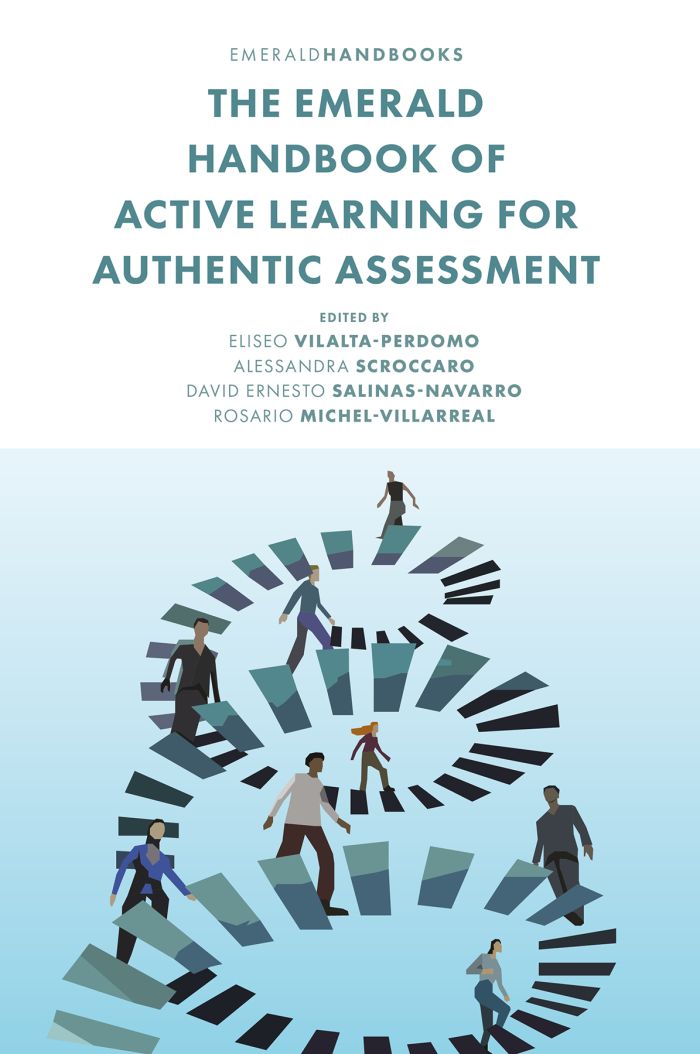

The Emerald Handbook of Active Learning For Authentic Assessment

This book can be opened with

Note on our eBooks and Audiobooks: you can read our eBooks (ePUB or PDF) and listen to audiobooks on the free Emerald Books app on iOS, Android, and desktop. Or read and listen on Emerald's online reader (ePUB eBooks and audiobooks only). To purchase a digital book you will need to create an account if you don’t already have one. After purchasing you will receive instructions on how to get started.
- Description
- Contents
- About
Written by teachers for educators and researchers, this is the first handbook to present a series of insights that teachers may use to conceive, design, execute, and develop active learning experiences for authentic assessment that will enrich students’ learning experiences.
Active Learning considers a series of educational methods where students play an active role in the learner-centered process, engaging beyond passive listening and note taking, through hands-on learning experiences. Contributions from international experts introduce the notion of authentic assessment, where students evidence their knowledge through thoughtful understanding, by being able to do something effective, transformative, or novel with a problem or complex situation.
Showcasing a range of active learning approaches such as collaborative learning, experiential learning, gamification and learning by teaching, chapters also tackle one of the most urgent challenges in higher education – the emergence of artificial intelligence. All the chapters presented in this handbook are practical in scope and can be adjusted for use in both pedagogic and andragogic environments.
Chapter 1. Introduction to Active Learning and Authentic Assessment: Concepts and applications; Eliseo Vilalta-Perdomo, Alessandra Scroccaro, David Ernesto Salinas-Navarro, and Rosario Michel-Villarreal
- Chapter 2. Scientometric Analysis of Active Learning and Authentic Assessment between 2002 and 2024: Recent trends and further research; Nini Johana Marín-Rodríguez, Blanca Viridiana Guízar Morán, and Flor Silvestre Gerardou
- Chapter 3. Debate and Argumentation in E-learning Times: An authentic assessment perspective; Maria A. M. Trindade
- Chapter 4. Authentic Assessment In Challenge-Based Learning: How to assess 21st-century skills in innovation and entrepreneurship education; Alessandra Scroccaro, Jeanette Engzell, and Charlotte Norrman
- Chapter 5. The Authentic Assessment Potential of Fieldtrips: Energy justice in action; Valeria Tolis
- Chapter 6. Dialogic Learning: A tool for authentic assessment; Cheri L. Hatcher
- Chapter 7. Active Learning and Authentic Assessment through Gamification: A board game experience; Matilde Ruiz-Arroyo, Ana Castillo, and Leopoldo Gutierrez
- Chapter 8. An Exploration of Role-Playing within the Context of Management Consultancy Learning and Teaching; Joy Garfield and Amrik Singh
- Chapter 9. Learning by Experience: Political science and international relations; Sheriff F. Folarin and Elizabeth O. Njoaguani
- Chapter 10. Learning by Teaching: Active learning and authentic assessment; Joellen E. Coryell
- Chapter 11. Strategic Integration of Project-Based Learning and Authentic Assessment in Capstone Proposal Development; Agatha da Silva-Ovando, Ana Luna, Mario Chong, and Aymara Escobar
- Chapter 12. Service-Learning: Pedagogy for student growth and success; Steven W. Rayburn and Jana R Minifie
- Chapter 13. Exploring the Potential of AI for Authentic Assessment in Education: Towards a new model of interaction; Federica Picasso, Daniele Agostini, and Anna Serbati
- Chapter 14. Online Teaching in China: Active learning and authentic assessment challenges; Humberto Gumeta
- Chapter 15. Sustainability Education through Active Learning and Authentic Assessment; Beate Klingenberg and Albachiara Boffelli
- Chapter 16. Challenge-Based Learning for Active Learning in Industrial Engineering Education; Jaime A. Palma-Mendoza, David Ernesto Salinas-Navarro, Ivan A. Arana-Solares, and Froylan Franco-Herrera
- Chapter 17. The Use of Business Modelling Software to Facilitate Active Learning, Challenge-Based Learning, and Authentic Assessment on a Taught MSc Entrepreneurship and Innovation Module; Thomas Coogan and Andrew Greenman
- Chapter 18. What Active Learning and Authentic Assessment in Higher Education Can Do for the World; David Ernesto Salinas-Navarro and Eliseo Vilalta-Perdomo
Eliseo Vilalta-Perdomo is Senior Teaching Fellow and co-director of the Community Resilience and Sustainability Education Lab (CoRSEL) at Aston Business School, Aston University, United Kingdom.
Alessandra Scroccaro is an Assistant Professor at the Department of Economics and Management at the University of Trento, Italy.
David Ernesto Salinas-Navarro is Senior Lecturer in Operations Management, Facultad de Ingeniería, Universidad Panamericana, Mexico City, Mexico.
Rosario Michel-Villarreal is a Lecturer in Sustainability and Business in the Sustainability Research Institute at the University of Leeds, UK.