
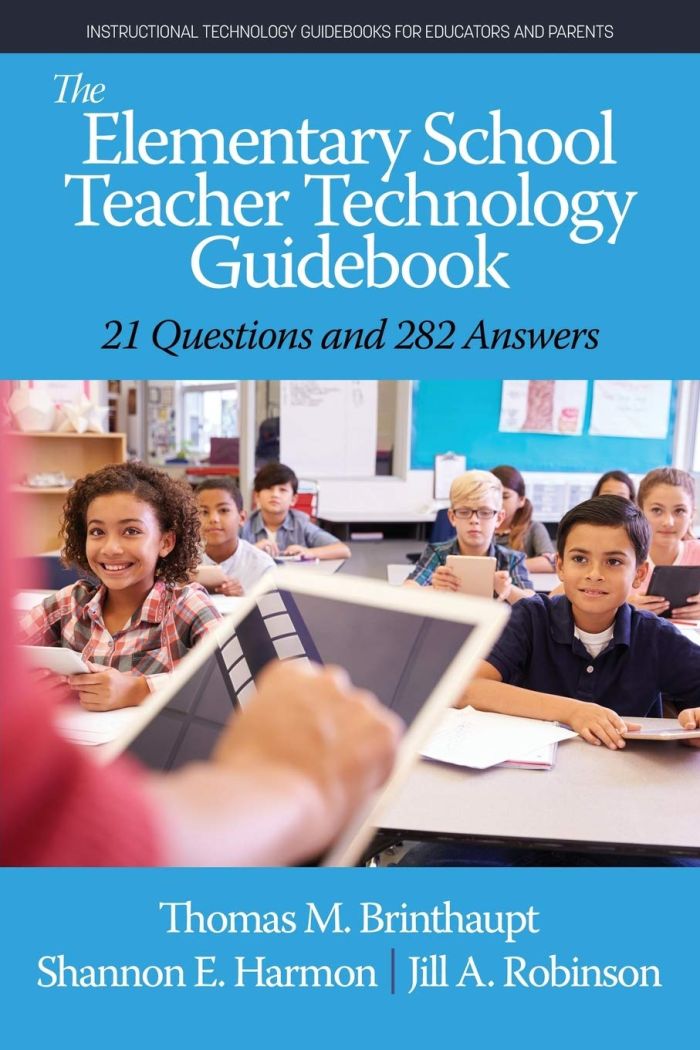
The Elementary School Teacher Technology Guidebook
21 Questions and 282 Answers

This book can be opened with

Note on our eBooks and Audiobooks: you can read our eBooks (ePUB or PDF) and listen to audiobooks on the free Emerald Books app on iOS, Android, and desktop. Or read and listen on Emerald's online reader (ePUB eBooks and audiobooks only). To purchase a digital book you will need to create an account if you don’t already have one. After purchasing you will receive instructions on how to get started.
- Description
- Contents
This guidebook is designed to be the elementary school teacher’s friend in addressing a wide variety of questions regarding the use of educational and instructional technologies. It can serve as a companion and guide through the myriad challenges and opportunities related to the effective use of technology in one’s classroom and school.
A sample of U.S. elementary school teachers provided us with detailed answers about their experiences with using technology in their teaching. Specifically, they shared their challenges, barriers, ideas, and suggestions for working successfully with administrators, technology specialists, students, fellow teachers, and parents when teaching with technology. We have organized the teachers’ experiences and recommendations according to each stakeholder group.
Rather than recommending or reviewing specific educational technology companies, applications, or tools, we provide a large number of strategies that are “built to last” and should be applicable regardless of the specific tool under consideration. We assume that it doesn’t ultimately matter what the tool or technology is that you’re using—it’s how and why you’re using it for teaching and learning that will determine whether it is successful or not. The “how” and “why” aspects encompass the built-to-last strategies included in this guidebook.
Preface: Introduction to the Guidebook.
- Part I. Technology Questions And Issues When Working With School/district Administration.
- Chapter 1. What can I do to ensure that I have a voice in my district's or building's technology decisions?
- Chapter 2. Are there good strategies for my school or district to use to introduce new technologies?
- Chapter 3. What can I do if I'm not permitted to download an app or program?
- Chapter 4. What can I do to get a tool or technology approved for use?
- Chapter 5. What can I do to ensure that my students can access blocked sites or materials?
- Part II. Technology Questions and Issues When Working With Technology Specialists.
- Chapter 6. How can I work best with my tech specialist?
- Chapter 7. What should I do if I don't have a tech person (or my tech person cannot help me)?
- Chapter 8. How can I get my system or school to hire qualified tech specialists who can work well with me and my colleagues?
- Part III. Technology Questions and Issues When Working With Students.
- Chapter 9. How can I utilize technologies for instructional purposes?
- Chapter 10. How can I manage my students' use of technology while in class?
- Chapter 11. How can I get my students to help me with classroom technology when I don't know how to use it?
- Part IV. Technology Questions and Issues When Working With Fellow Teachers.
- Chapter 12. How can I benefit from the technology experiences and expertise of my fellow teachers?
- Chapter 13. How can I get my school or district to harness the technology experiences and expertise of my fellow teachers?
- Chapter 14. How can I encourage my fellow teachers to use technology?
- Part V. Technology Questions and Issues When Working With Parents.
- Chapter 15. What can I do about my students not having home Internet or computer access?
- Chapter 16. What can I do to inform parents about how I am teaching with technology?
- Chapter 17. How can I work with parents to enhance my teaching with technology?
- Chapter 18. What can I do when my students' parents have questions or concerns about my teaching with technology?
- Part VI. Solving Technology Questions and Issues On Our Own.
- Chapter 19. How can I decide to use a specific technology?
- Chapter 20. How can I get more proficient with different educational technologies?
- Chapter 21. How can I use my limited time to learn more about teaching with technology?
- Part VII. Supplemental Resources.