
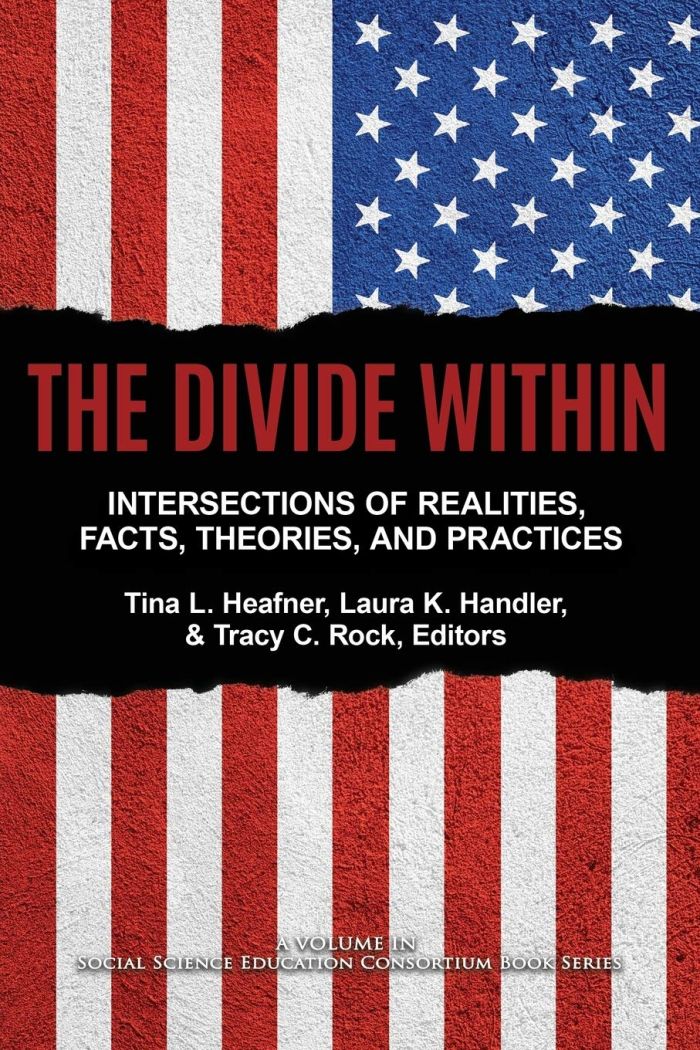

The Divide Within
Intersections of Realities, Facts, Theories, and Practices

This book can be opened with

Note on our eBooks and Audiobooks: you can read our eBooks (ePUB or PDF) and listen to audiobooks on the free Emerald Books app on iOS, Android, and desktop. Or read and listen on Emerald's online reader (ePUB eBooks and audiobooks only). To purchase a digital book you will need to create an account if you don’t already have one. After purchasing you will receive instructions on how to get started.
- Description
- Contents
Globalization, modernization, and technologization have brought rapid social and economic change while also increasing diversity of democratic societies. Plurality of democracy, once viewed as a progressive ideology, has been met by the movement of identity politics to the margins of society. Although social movements demanding recognition on the part of groups that were once invisible to mainstream society have brought attention to systemic inequities, prejudice, and discriminatory policies, other groups feeling a loss of status and a sense of displacement have pushed back with counterclaims and protests. These conflicting narratives have fractured society and segmented the populace along narrowly defined identities, creating a new era of democracy and isolationism.
Today in the United States we see the troubling effects of increasingly polarized political discourse: amplified gridlock within government, the politicization and fragmentation of economic and social life, and the suppression of the spread of information across ideological lines. The socio-political climate in America is characterized by skepticism, hostility, distrust, claims of fake news, and unwavering opposition. The divide within our nation has shifted the narrative of democracy from promoting the common good to protecting the interests of likeminded factions and the preservation of power and privilege.
Introduction; Tina L. Heafner, Laura K. Handler, Tracy C. Rock.
- Chapter 1. Exacerbating Existing Divides: Fake News, Desire, and Partisanship; Wayne Journell.
- Chapter 2. The NC ACCESS Program: Remediating or Deepening Divisions in Public Education? Laura K. Handler and Tracy C. Rock.
- Chapter 3. Socioeconomic Disparities: A Case Study Addressing the Urban/Rural Divide Using a World Cafe; Daniel A. Yonto.
- Chapter 4. A Quantitative Comparison of Rural and Urban School Teacher Characteristics; Jessica Norwood, Tina L. Heafner, and Paul Fitchett.
- Chapter 5. Discipline Disparities: An Analysis of School Discipline Practices in a North Carolina High School; Yvonna Hines-McCoy, Tina L. Heafner, and Jeanneine Jones.
- Chapter 6. Primary Contradictions: Qualitative Transformations of White Social Studies Teacher Identity; Dean P. Vesperman and Jill Leet-Otley.
- Chapter 7. Teaching to a Statue: John B. Gordon, History Textbooks, and the Creation of a Lost Cause Hero; Wade H. Morris and Chara Haeussler Bohan.
- Chapter 8. Bridging the Gap: One School's Attempt to Build Community Through Service Learning; Amy Allen.
- Chapter 9. Evaluating the Effects of Discipline Literacy Versus General Literacy in Adolescent Readers; Antoinette M. L. Rochester, Tina L. Heafner, and Kristen Beach.
- Chapter 10. Responding to an Era of Globalization with Multicultural Education; Amanda R. Casto and Greg Wiggan.
- Chapter 11. Promoting Student Achievement: Arts Integration in Urban Schools in the United States and Canada; Portia M. York and Greg Wiggan.
- Chapter 12. Understanding United States Economic Inequality and the Strain on Our Democracy; James E. Davis.
- Chapter 13. Bridging the Divide between Data and Solutions: A Closer look at a Restorative Framework for School Discipline; Bettie Ray Butler.