
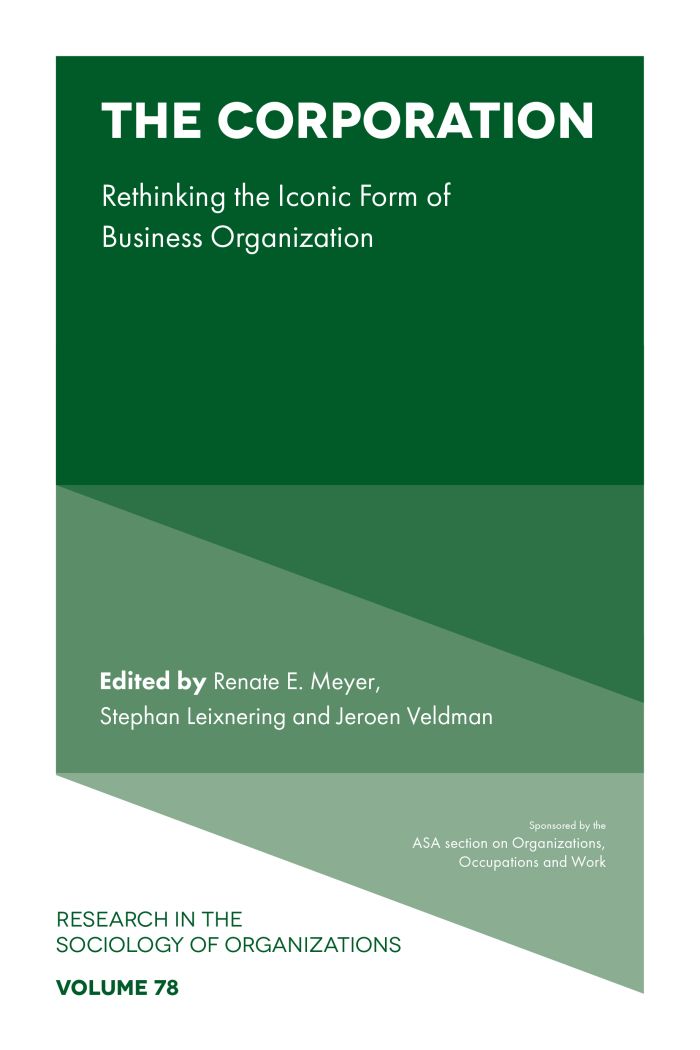

The Corporation
Rethinking the Iconic Form of Business Organization

This book can be opened with

Note on our eBooks and Audiobooks: you can read our eBooks (ePUB or PDF) and listen to audiobooks on the free Emerald Books app on iOS, Android, and desktop. Or read and listen on Emerald's online reader (ePUB eBooks and audiobooks only). To purchase a digital book you will need to create an account if you don’t already have one. After purchasing you will receive instructions on how to get started.
- Description
- Contents
- About
For more than a century, the corporation has shaped our thinking of organizations. This deeply institutionalized form is still regarded as both the iconic business organization and the core structural unit of our economic order. Today, however, it stands at a crossroads. Economic, social, and environmental failures of the recent past as well as misconduct and scandals are widely associated with deficits of the corporate form and its governance.
The Corporation engages with current issues of the corporation as an institutionalized organizational form, approaching the concept from the backgrounds of organization theory, law, and economics, combining different theoretical views and empirical approaches. This volume addresses the corporation's entanglement with capitalism, examines a spectrum of constitutive features and purposes of the corporate form, offers historical perspectives on its emergence, and provides reflections on its future development.
Encouraging you to rethink the corporation, each contribution also adds to the conceptual development of the corporate form as the iconic business organization.
Chapter 1. Rethinking the Corporation: Introduction; Renate E. Meyer, Stephan Leixnering, and Jeroen Veldman
- Chapter 2. Concentrated Ownership, Socioemotional Wealth, and the 'Third Possibility': Bringing Society Back In; Loizos Heracleous and Luh Luh Lan
- Chapter 3. The Elusive Nature of Shareholders' Claims Over the Corporation, or the Strange Non-Death of Shareholder Primacy; Olivier Butzbach
- Chapter 4. Constitutionalizing the Corporation; Anna Grandori
- Chapter 5. Exploring the Middle Way: The Istituto per la Ricostruzione Industriale (IRI) In Between Corporate Capitalism and Planned Economy (1948–1973); Patrizio Monfardini, Paolo Quattrone, and Pasquale Ruggiero
- Chapter 6. The Past as Prologue: Purpose Dynamics in the History of the Aktiengesellschaft; Stephan Leixnering, Renate E. Meyer, and Peter Doralt
- Chapter 7. Community, Enterprise, and Self-Help: The Coevolution of Capitalism and Non-Profit and For-Profit Businesses in Britain and Germany; Heather A. Haveman and Nataliya Nedzhvetskaya
- Chapter 8. Shareholder Value or Public Purpose? From John Maynard Keynes and Adolf Berle to the Modern Debate; Suzanne J. Konzelmann, Victoria Chick, and Marc Fovargue-Davies
- Chapter 9. Social Ontology of the Modern Corporation: Its Role in Understanding Organizations; Jeroen Veldman and Hugh Willmott
- Chapter 10. Rethinking the Purpose of the Corporation With the Creative Power of the Enterprise; Blanche Segrestin, Armand Hatchuel, and Kevin Levillain
- Chapter 11. Learning From Alternatives: Analyzing Alternative Ways of Organizing as Starting Points for Improving the Corporation; Joost Luyckx, Anselm Schneider, and Arno Kourula
- Chapter 12. Concluding Reflections: The Future of the Corporation and Research on the Corporate Form; Gerald F. Davis
Renate E. Meyer is the Chair of Organization Studies at Vienna University of Economics and Business, Austria and Part-time Professor in Institutional Theory at Copenhagen Business School. Current research includes institutional renewal, novel organizational forms, collective action in crises, and governance structures and governance gaps in urban contexts.
Stephan Leixnering is a Senior Scientist at Vienna University of Economics and Business, Austria, Research Institute for Urban Management and Governance. His research focuses on organizational governance in the public and the private sectors, with a focus on how organizations address public interests.
Jeroen Veldman is Associate Professor at Nyenrode Business University, Netherlands, and MINES ParisTech and Section Editor Corporate Governance at the Journal of Business Ethics. He leads the Modern Corporation Project.