
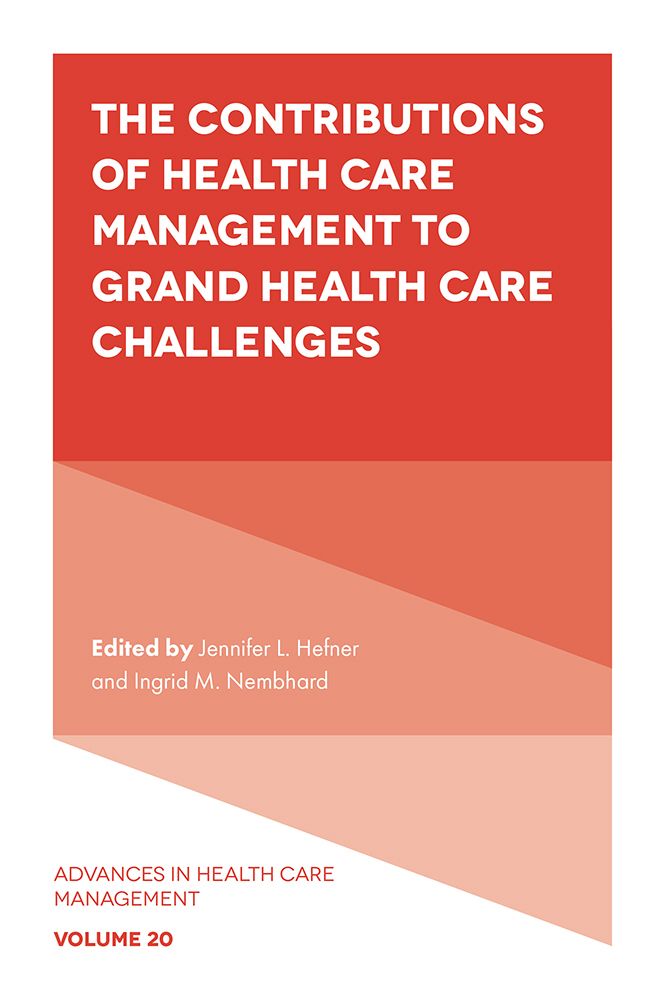
The Contributions of Health Care Management to Grand Health Care Challenges

This book can be opened with

Note on our eBooks and Audiobooks: you can read our eBooks (ePUB or PDF) and listen to audiobooks on the free Emerald Books app on iOS, Android, and desktop. Or read and listen on Emerald's online reader (ePUB eBooks and audiobooks only). To purchase a digital book you will need to create an account if you don’t already have one. After purchasing you will receive instructions on how to get started.
- Description
- Contents
- About
The 20th volume of Advances in Health Care Management showcases how health care management research helps to further understand grand challenges in health care: what they are, why they exist, the consequences that they have, and what can be done to address them. Grand challenges are large, unresolved problems. “Grand health care challenges” include current events such as the COVID-19 pandemic, and ongoing challenges related to the quadruple aim of health care: improving the health of populations, reducing the cost of healthcare, improving patient care experiences, and improving the experience of working in health care. The book demonstrates that these challenges are amenable to organizational and managerial solutions, and therefore health care management research has many important lessons to contribute.
For this volume, The Contributions of Health Care Management to Grand Health Care Challenges, we define health care management as the planning, direction, and coordination of health services and the management of health care professionals. Included chapters consider five grand challenges facing the health care sector: (1) caring for vulnerable populations; (2) maintaining the health care workforce; (3) translating innovation into practice; (4) sustaining organizations; and (5) navigating pandemics. Each challenge is discussed in its own section and addressed by two chapters that offer different perspectives and approaches to the challenge. Across chapters a variety of methodologies are used including ethnographic case studies, survey data analysis, interviews, literature review, and informed commentary. Together, the chapters in this volume synthesize current information in the field, direct future research efforts, and generate actionable insights for managers and policymakers.
Preface; Jennifer L. Hefner and Ingrid M. Nembhard
- Section 1. The Challenge of Caring for Vulnerable Populations
- Chapter 1. Emergent Homecare Models are Shaping Care in England: An Ethnographic Study of Four Distinct Homecare Models; Karla Zimpel-Leal
- Chapter 2. Aligning Health Care and Social Services for Patients with complex needs: The Multiple Roles of Inter-Organizational Relationships; Amanda Brewster
- Section 2. The Challenge of Maintaining the Workforce – Retention and Equity
- Chapter 3. The Challenge of Employee Retention in Medical Practices across the United States: An Exploratory Investigation into the Relationship between Operational Succession Planning and Employee Turnover; Heather Moore, Lihua Dishman, and John Fick
- Chapter 4. An Exploration of Gender Bias Affecting Women in Medicine; Amber L. Stephenson, Amy B. Diehl, Leanne M. Dzubinski, Mara McErlean, John Huppertz, and Mandeep Sidhu
- Section 3. The Challenges of Translating Innovation Into Practice
- Chapter 5. Technological Change and Frontline Care Delivery Work: Toward the Quadruple Aim; Adam Seth Litwin
- Chapter 6. Improving Training Motivation and Transfer in Hospitals: Extension of a Conceptual Model; Megan E. Gregory, Daniel M. Walker, Lindsey N. Sova, Sheryl A. Pfeil, Clayton D. Rothwell, Jaclyn J. Volney, Alice A. Gaughan, and Ann Scheck McAlearney
- Section 4. The Challenge of Organizational Sustainability
- Chapter 7. Hospital Ownership and Financial Stability: A Matched Case Comparison of a Non-Profit Health System and a Private Equity Owned Health System; Aimee La France, Rosemary Batt, and Eileen Appelbaum
- Chapter 8. NCHL’s ‘Best Organizations for Leadership Development’ Program: A Case Study in Improving Evidence-Based Practice through Benchmarking & Recognition; Andrew N. Garman, Melanie P. Standish, Cassia Carter, Matthew M. Anderson, and Callie Lambert
- Section 5. The Challenge of Pandemics for Patients, Workers and Practices – Lessons from Covid-19
- Chapter 9. Impact of COVID-19 on Primary Care Practice Sites and their Vulnerable Patients; Sara J. Singer, Jill Glassman, Alan Glaseroff, Grace Joseph, Adam Jauregui, Bianca Mulaney, Sara Kelly, Samuel Thomas, Stacie Vilendrer, and Maike Tietschert
- Chapter 10. Even Superheroes need Rest: A Guide to Facilitating Recovery from Work for Health Care Workers during COVID-19 and Beyond; Bram P. I. Fleuren, Amber L. Stephenson, Erin E. Sullivan, Minakshi Raj, Maike V. Tietschert, Abi Sriharan, Alden Y. Lai, Matthew J. DePuccio, Samuel C. Thomas, and Ann Scheck McAlearney
Jennifer L. Hefner is an Associate Professor in the Division of Health Management and Policy, The Ohio State University. Her research focuses on applying management and organizational theories to the study of health care transformation.
Ingrid M. Nembhard is the Fishman Family President's Distinguished Associate Professor of Health Care Management at The Wharton School of the University of Pennsylvania. Her research focuses on how characteristics of health care organizations, their leaders, and staff contribute to their ability to implement new practices, engage in continuous organizational learning, and ultimately improve quality of care.