
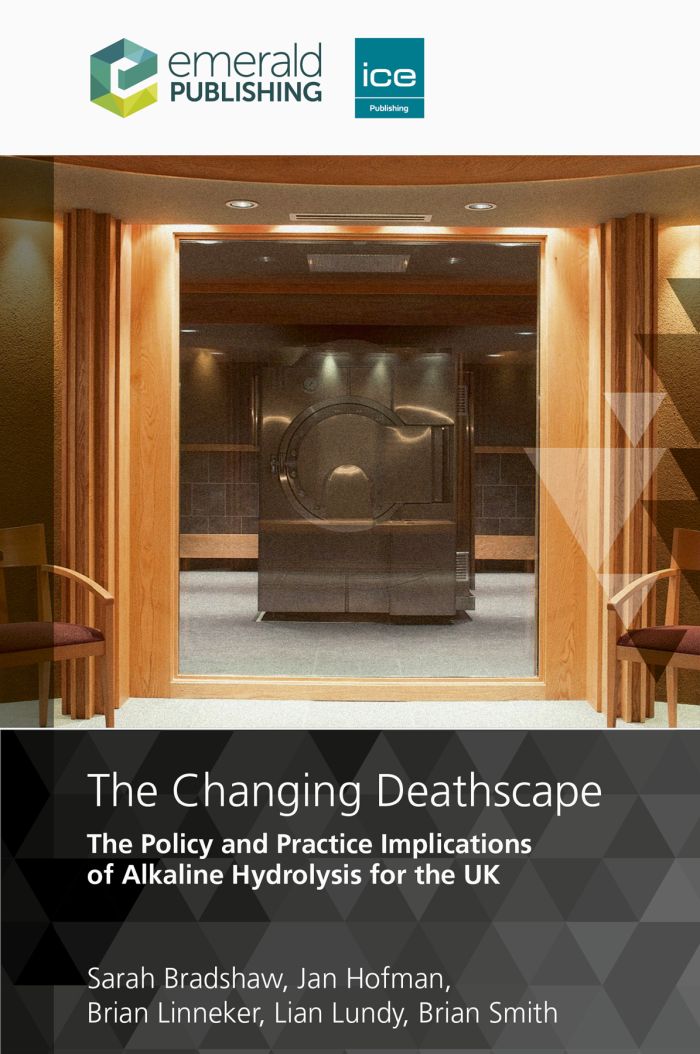
The Changing Deathscape
The Policy and Practice Implications of Alkaline Hydrolysis for the UK

This book can be opened with

Note on our eBooks and Audiobooks: you can read our eBooks (ePUB or PDF) and listen to audiobooks on the free Emerald Books app on iOS, Android, and desktop. Or read and listen on Emerald's online reader (ePUB eBooks and audiobooks only). To purchase a digital book you will need to create an account if you don’t already have one. After purchasing you will receive instructions on how to get started.
- Description
- Contents
- About
Alkaline Hydrolysis (AH) offers an alternative method to burial and cremation for disposing of human remains, and in the UK it is neither illegal, nor unlawful, and requires regulation rather than legislation. However, attempts to introduce it has led to negative media headlines and concerns among the public.
The Changing Deathscape: The Policy and Practice Implications of Alkaline Hydrolysis for the UK provides the context, questioning the current options for end-of-life body disposition including their relative environmental credentials. Written in non-technical language to be accessible not only to academics but to policy makers and practitioners as well as undergraduate and postgraduate students, the book explores existing professional practice across the sectors involved – engineering, water industry, funeral professions and related business – as well as the view of the public, and the factors that influence them such as religion and culture. It combines the assessment of scientific factors such as chemical analysis and technical issues, process management, operation and maintenance, the business aspects, and societal pressures and factors that influence acceptability.
The aim of this book is to allow evidence-based, informed decision making on end-of-life options based on knowledge as much as norms, with the potential to change the end-of-life deathscape.
Chapter 1. Introduction
- Chapter 2. The green credentials of existing end-of-life technologies
- Chapter 3. Alkaline Hydrolysis: From inputs to outputs
- Chapter 4. Regulators
- Chapter 5. Gatekeepers
- Chapter 6. Public Perception
- Chapter 7. Concluding thoughts
Sarah Bradshaw is a Professor of Gender and Sustainable Development at Middlesex University, London.
Jan Hofman is Professor of Water Science and Engineering in the Department of Chemical Engineering at the University of Bath and the co-director of the Water Innovation and Research Consortium (WIRC) at the University.
Brian Linneker is an Independent Scholar and Senior Research Fellow in Economic Geography and the Environment.
Lian Lundy is a Professor of Environmental Science at Middlesex University (UK).
Brian Smith has a background in mechanical, electrical and civil engineering and a wide-ranging career spanning 47 years,