
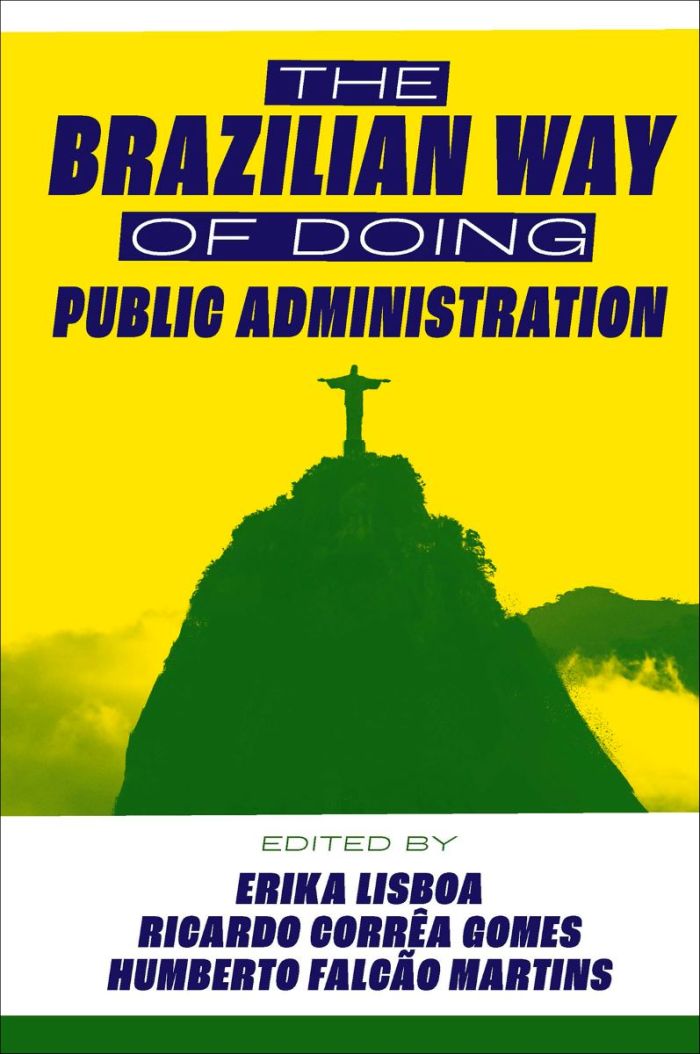


The Brazilian Way of Doing Public Administration
Brazil with an 's'

This book can be opened with

Note on our eBooks and Audiobooks: you can read our eBooks (ePUB or PDF) and listen to audiobooks on the free Emerald Books app on iOS, Android, and desktop. Or read and listen on Emerald's online reader (ePUB eBooks and audiobooks only). To purchase a digital book you will need to create an account if you don’t already have one. After purchasing you will receive instructions on how to get started.
- Description
- Contents
- About
Brazil is a pioneer in the development of participation policies, with the most advanced banking systems in the world and a health system that serves the majority of a population scattered over more than 8.5 million square kilometres. However, Brazil also displays one of the highest rates of social and economic inequality worldwide, unable to fight illiteracy, school dropout, lack of basic sanitation, and unemployment.
The Brazilian Way of Doing Public Administration is an accessible collaboration between scholars and practitioners rich with findings applicable worldwide, exploring Brazil’s government’s functioning at various points in recent history. Comprehensively presenting public management cases and theories in two sections – public management and public policy – the chapters provide scholars and practitioners with unique and previously underexplored insights and experiences.
Exploring links between administrative systems and policy performance,
The Brazilian Way of Doing Public Administration is a necessary book for practitioners, policymakers and researchers in management, public administration, business, and economics.
Introduction: Brazil is Not for Beginners
- Chapter 1. Public Sector Planning; Alexandre A. Gomide and Leandro F. Couto
- Chapter 2. The Open Budget and its Actions: The Brazilian Case; Welles Matias de Abreu, Marcio Luiz Albuquerque Oliveira, and Ricardo Corrêa Gomes
- Chapter 3. Human Resource Management in the Brazilian Public Sector; Evelyn Levy and Fernando Coelho
- Chapter 4. Public Finance in Brazil; Josué Pellegrini e Felipe Salto
- Chapter 5. The Different Shades of Public Procurement in Brazil; Renato Fenili
- Chapter 6. The Silent Reform: digital governance as a strategy for state reform in Brazil; Fernando Filgueiras
- Chapter 7. Public-Private Partnerships; Sandro Cabral
- Chapter 8. Performance Management in the Brazilian Public Administration; Humberto Falcão Martins, Ricardo Corrêa Gomes, and Renata Vilhena
- Chapter 9. Social Assistance Policy in Brazil After the Federal Constitution of 1988; Natália Guimarães Duarte Sátyro, Eleonora Schettini Martins Cunha, Isabela de Vasconcelos Teixeira, and Kelly Cordeiro dos Santos
- Chapter 10. Transformations in Brazilian Education from the COVID 19 Crisis; Claudia Costin
- Chapter 11. The Brazilian Contemporary Industrial Policy: Facts, Fallacies, and Controversies; Mauro Borges Lemos and Hamilton Ferreira Jr.
- Chapter 12. Environmental Perspectives in Brazil; Fabio Feldmann and Izabella Teixeira
- Chapter 13. The Healthcare System in Brazil: a primary care approach; Andreza Davidian and Elize Massard da Fonseca
- Chapter 14. State, Public Policies and Financial Inclusion; Lauro Gonzalez, Erika Lisboa, and Ettore Oriol
- Chapter 15. Public Policies in Innovation: Government funding S&T through a Federal Agency; Cristina Castro-Lucas, Erika Lisboa, Leopoldo Gomes Muraro, and Alerino Silva Filho
- Chapter 16. Public Policy Formulation in Brazil: experimentation of policy analysis to combine graduate teaching, research, and outreach; Leonardo Secchi, Luiz Filipe Goldfeder Reinecke, and Willian Carlos Narzetti
- Chapter 17. Public Policy Implementation in a Context of Extreme Inequality: between universalist ambitions and practical selectivity; Gabriela Lotta e Roberto Pires
- Chapter 18. Evaluating Public Policies and Programmes: an introduction to evaluation concepts, instruments and criteria; Paulo de Martino Jannuzzi
- Chapter 19. Mediations in the Interaction of Public Policies with their Implementation; Francisco Gaetani
Erika Lisboa is a Lecturer in the Department of Management at the Centro Universitário de Brasília, Brazil.
Ricardo Corrêa Gomes is an Adjunct Professor of Public Management at the Fundação Getulio Vargas São Paulo School of Business, Brazil.
Humberto Falcão Martins is a Professor of Public Management at Fundação Dom Cabral, Brazil.