
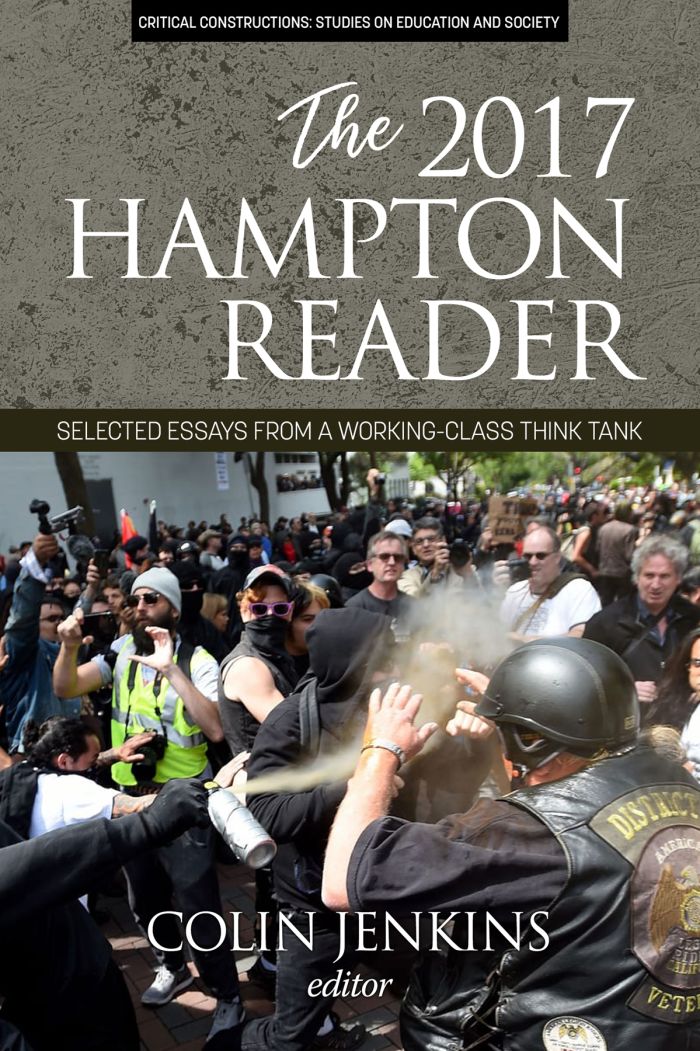
The 2017 Hampton Reader
Selected Essays from a Working-Class Think Tank

This book can be opened with

Note on our eBooks and Audiobooks: you can read our eBooks (ePUB or PDF) and listen to audiobooks on the free Emerald Books app on iOS, Android, and desktop. Or read and listen on Emerald's online reader (ePUB eBooks and audiobooks only). To purchase a digital book you will need to create an account if you don’t already have one. After purchasing you will receive instructions on how to get started.
- Description
- Contents
Through dozens of diverse and timely political essays and analyses, this book addresses the most pressing problems of our contemporary world. Instead of the tired, detached academic inquiry that permeates from institutions of higher education, these pages contain writings that have been produced by political organizers and revolutionaries throughout the course of their daily activity in social, economic, and political movements.
The 2017 Hampton Reader includes the most popular essays from The Hampton Institute: A Working-Class Think Tank. The Hampton Institute is an intellectual and political organization that seeks to develop the working class into a self-conscious class-for-itself capable of fundamentally changing the nature of society. The essays herein are the products of a collective of organic intellectuals united by the task of clarifying our political moment, sparking a revival in working-class intellectualism, and pushing the revolutionary struggles of our day forward.
Part I. Criminal Justice.
- Chapter 1. Doing Ferguson and Baltimore at the Intersection of Racial Oppression and Hopelessness; Jason Michael Williams.
- Chapter 2. For Abolition: Prisons and Police Are More Than Brutality, They're State Terror; Frank Castro.
- Chapter 3. Spider Webs for the Rich and Mighty: An Anarchist Critique of Criminal Law; Colin Jenkins.
- Part II. Education.
- Chapter 4. Pedagogy of the Oppressed Against Trump: Communist Pedagogy in the Emerging Mass Movement; Derek R. Ford.
- Chapter 5. Academia's Other Diversity Problem: Class in the Ivory Tower; Alfred Vitale and Allison L. Hurst.
- Chapter 6. Marxism, Intersectionality, and Therapy; David I. Backer.
- Chapter 7. Freedom to Dissent From Delhi to Ferguson; Meghna Chandra.
- Chapter 8. The Courage of Hopelessness: Democratic Education in the Age of Empire; E. Wayne Ross.
- Chapter 9. Against Zombie Intellectualism: On the Chronic Impotency of Public Intellectuals; Derek R. Ford.
- Chapter 10. Consequences of the Post Truth Era; Brayden White.
- Chapter 11. Democracy, Higher Education, and the Ivory Tower Critique of Neoliberalism; Jacob Ertel.
- Part III. Gender Studies.
- Chapter 12. Gentrification Is a Feminist Issue: A Discussion on the Intersection of Class, Race, Gender, and Housing; Cherise Charleswell.
- Chapter 13. How Much Do You Cost? A Story of Sexual Neocolonialism; Sonasha Braxton.
- Chapter 14. Interdisciplinary Feminism: Why Building Alliances Is Critical; Cherise Charleswell.
- Part IV. Labor Issues.
- Chapter 15. Capitalism, Exploitation, and Degradation; Nicholas Partyka.
- Chapter 16. Deconstructing Workplace Hierarchies: On the Paradox of Contrived Leadership and Arbitrary Positions of Power; Colin Jenkins.
- Part V. Politics And Government.
- Chapter 17. Our Revolution is Not a Revolutionary Movement; Dan Arel.
- Chapter 18. American Cartel: How America's Two Major Parties Helped Destroy Democracy; Frank Castro.
- Chapter 19. Notes on the Peaceful Transition of Power: The Continuity of Violence in America's Imperial Democracy; Bryant William Sculos.
- Chapter 20. Power Politics and the Empire of Economics: An Introduction; Andrew Gavin Marshall.
- Chapter 21. Russophobia and the Logic of Imperialism; Ava Lipatti.
- Chapter 22. The Question of Hierarchy: An Interview With Colin Jenkins; Brenan Daniels.
- Chapter 23. The Working Class, the Election, and Trump: An Interview With Sean Posey; Brenan Daniels.
- Part VI. Race And Ethnicity.
- Chapter 24. Salt in the Wounded Knee: Psychopathy in the Commemoration of Genocide; Sonasha Braxton.
- Chapter 25. The Ancestors, Africanism, and Democracy; Nyonsuabeleah Kollue.
- Chapter 26. The Black Working Class and the Early Civil Rights Movement; Devon Bowers.
- Chapter 27. The Monarchy of Materialism: Understanding White Fragility; Sonia Calista.
- Part VII. Social Economics.
- Chapter 28. Thuggin in Baltimore City: Capitalism and the Political Economy of Breaking Slaves; Asha Layne.
- Chapter 29. Expropriation or Bust: On the Illegitimacy of Wealth and Why It Must Be Recuperated; Colin Jenkins.
- Chapter 30. The Bosses' Utopia: Dystopia and the American Company Town; Nicholas Partyka.
- Chapter 31. The Science of Corrosive Inequality; Nicholas Partyka.
- Part VIII. Social Movement Studies.
- Chapter 32. Americanism Personified: Why Fascism Has Always Been an Inevitable Outcome of the American Project; Colin Jenkins.
- Chapter 33. Identity, Inc.: Liberal Multiculturalism and the Political Economy of Identity Politics; Jacob Ertel.
- Chapter 34. Rethinking the Marxist Conception of Revolution; Chris Wright.
- Part IX. Society And Culture.
- Chapter 35. Eternal Fascism and the Southern Ideology; Jeremy Brunger.
- Chapter 36. Gangsters for Capitalism: Why the U.S. Working Class Enlists; Colin Jenkins.
- Chapter 37. Institutionalizing Lone-Wolf Terrorism: How Fascist, Organizations Inspire Mass Violence; Shane Burley.
- Part X. Spirituality And Religion.
- Chapter 38. Islamophobia and the Rise of Trump; P. Joshua Hatala.
- Chapter 39. Religion and the Russian Revolution; P. Joshua Hatala.
- Chapter 40. A Critique of David Harvey's Conception of the People's Republic of China; Collin Chambers.