
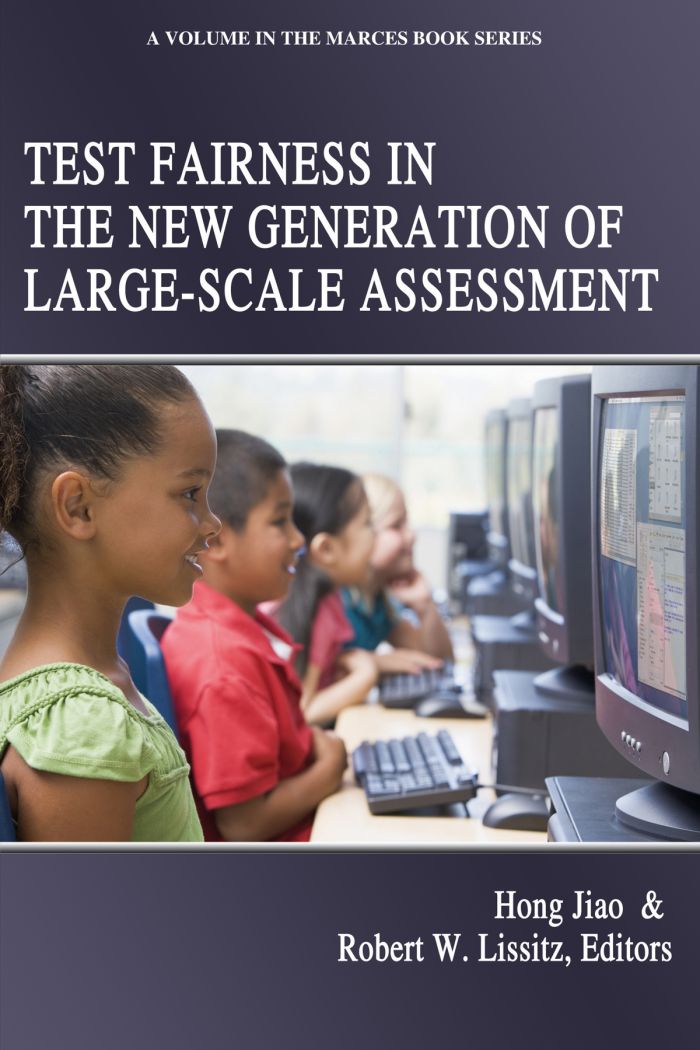
Test Fairness in the New Generation of Large-Scale Assessment

This book can be opened with

Note on our eBooks and Audiobooks: you can read our eBooks (ePUB or PDF) and listen to audiobooks on the free Emerald Books app on iOS, Android, and desktop. Or read and listen on Emerald's online reader (ePUB eBooks and audiobooks only). To purchase a digital book you will need to create an account if you don’t already have one. After purchasing you will receive instructions on how to get started.
- Description
- Contents
The new generation of tests is faced with new challenges. In the K-12 setting, the new learning targets are intended to assess higher-order thinking skills and prepare students to be ready for college and career and to keep American students competitive with their international peers. In addition, the new generation of state tests requires the use of technology in item delivery and embedding assessment in real-world, authentic, situations. It further requires accurate assessment of students at all ability levels. One of the most important questions is how to maintain test fairness in the new assessments with technology innovative items and technology delivered tests. In the traditional testing programs such as licensure and certification tests and college admission tests, test fairness has constantly been a key psychometric issue in test development and this continues to be the case with the national testing programs.
As test fairness needs to be addressed throughout the whole process of test development, experts from state, admission, and licensure tests will address test fairness challenges in the new generation assessment. The book chapters clarify misconceptions of test fairness including the use of admission test results in cohort comparison, the use of international assessment results in trend evaluation, whether standardization and fairness necessarily mean uniformity when test-takers have different cultural backgrounds, and whether standardization can insure fairness. More technically, chapters also address issues related to how compromised items and test fairness are related to classification decisions, how accessibility in item development and accommodation could be mingled with technology, how to assess special populations with dyslexia, using Blinder-Oaxaca Decomposition for differential item functioning detection, and differential feature functioning in automated scoring.
Overall, this book addresses test fairness issues in state assessment, college admission testing, international assessment, and licensure tests. Fairness is discussed in the context of culture and special populations. Further, fairness related to performance assessment and automated scoring is a focus as well. This book provides a very good source of information related to test fairness issues in test development in the new generation of assessment where technology is highly involved.
Chapter 1. Resolving the Paradox of Rich Performance Tasks; Robert Mislevy.
- Chapter 2. The Effect of Item Preknowledge On Classification Accuracy; Patrick Obregon and Ray Yan.
- Chapter 3. Considerations in Making Next Generation Assessments Accessible and Fair; Linda Zimmerman and Paul C. Grudnitski.
- Chapter 4. Redesigning the SAT Using Principles of Fairness and Equity; Sherral Miller, Michael Walker, and Lynn Letukas.
- Chapter 5. Analyzing the Invariance of Item Parameters Used to Estimate Trends in International Large-Scale Assessments; Maria Elena Oliveri and Matthias von Davier.
- Chapter 6. Culture in Fair Assessment Practices; Edynn Sato.
- Chapter 7. Using Blinder-Oaxaca Decomposition to Explore Differential Item Functioning: Application to PISA 2009 Reading; Daniel Bolt, Maritza Dowling, Yu-Shan Shih, and Wei-Yin Loh.
- Chapter 8. Differential Feature Functioning in Automated Essay Scoring; Mo Zhang, Neil Dorans, Chen Li, and Andre Rupp.
- Chapter 9. Defining and Challenging Fairness in Tests Involving Students With Dyslexia: Key Opportunities in Test Design and Score Interpretations; M. Christina Schneider, Karla Egan, and Brian Gong.
- About the Authors.