
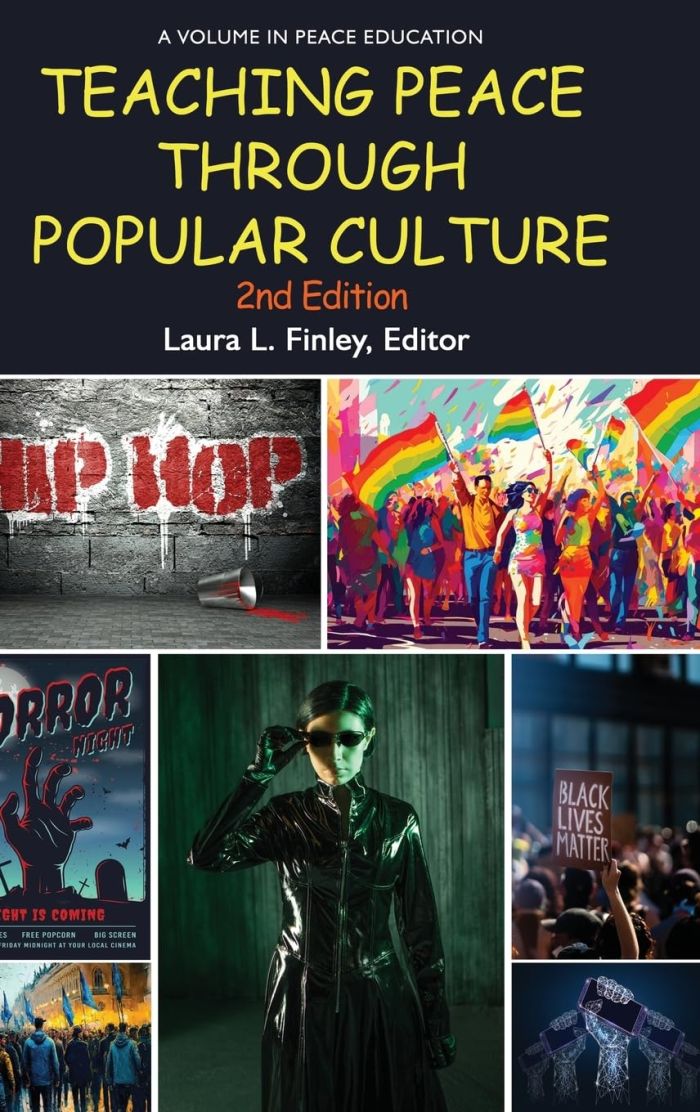
Teaching Peace Through Popular Culture

This book can be opened with

Note on our eBooks and Audiobooks: you can read our eBooks (ePUB or PDF) and listen to audiobooks on the free Emerald Books app on iOS, Android, and desktop. Or read and listen on Emerald's online reader (ePUB eBooks and audiobooks only). To purchase a digital book you will need to create an account if you don’t already have one. After purchasing you will receive instructions on how to get started.
- Description
- Contents
Drawing from many disciplinary areas, this edited volume illustrates the many ways that popular culture can be used to teach peace and justice. Chapters address such topics as teaching about racism, domestic violence, structural violence, conflict analysis, decolonization, critiques of capitalism, and peacebuilding, showing how different forms of popular culture can be utilized to enhance student learning. Contributors provide both theoretical backgrounds and concrete lessons using TV, film, music, graphic novels, and more.
Acknowledgments and Dedication; Laura L. Finley.
- Chapter 1. Introduction; Laura L. Finley.
- Chapter 2. Using Horror Films to Teach About Structural Violence and Nonviolent Conflict Resolution; Laura L. Finley.
- Chapter 3. Runnin' From The Pharcyde and T.I.'s Warzone: Sneaking Peace and Social Justice Into the Classroom; Wim Laven.
- Chapter 4. Armageddon It Been in Effect: Utopia, Dystopia, or UNtopia? A Conversation With Ursula K. Le Guin, Sarah Pinsker, & N. K. Jemisin; G. Michelle Collins-Sibley.
- Chapter 5. Dangerous Education: Teaching College Writing Using Nonfiction Graphic Novels; Heidi Huse.
- Chapter 6. Using Popular Culture to Teach About Domestic Abuse and Healthy Relationships; Laura L. Finley.
- Chapter 7. Stephen King's Horror Films and Child Abuse and Neglect: Lessons to Be Learned for Understanding, Assistance, and Prevention; Laura L. Finley.
- Chapter 8. The Critiques of Structural Functionalism, Colonialism, and Capitalism Using Violence in Modern Science Fiction Classics: The Matrix, Alien: Resurrection, and Starship Troopers; Christian A. I. Schlaerth and Aaron Puhrmann.
- Chapter 9. Learning to Transform Conflict Through Popular Culture Analysis; Dean J. Johnson.
- Chapter 10. A Literature, Design, and Arts-Based English as a Second Language (ESL) Classroom Model; Kyra E. Whitehead.
- Chapter 11. Hearing All of the Americas: Coloniality and Authenticity in the Music of Kendrick Lamar and Residente; Heather Rae Brady.
- Chapter 12. Conclusion; Laura L. Finley.
- About the Editor and Authors.