
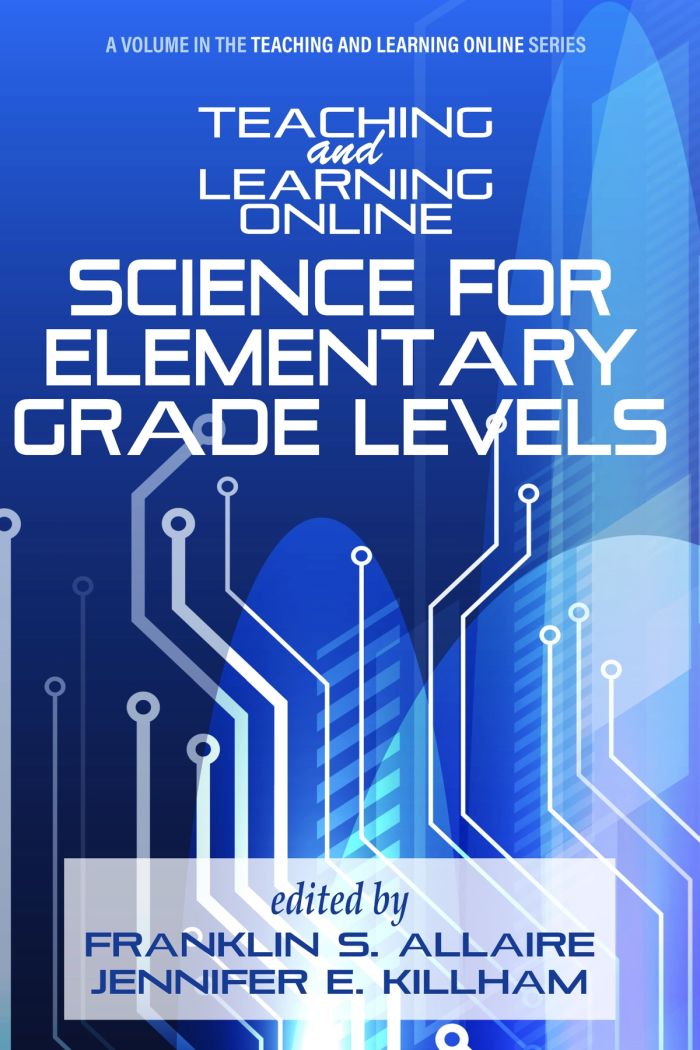
Teaching and Learning Online
Science for Elementary Grade Levels

This book can be opened with

Note on our eBooks and Audiobooks: you can read our eBooks (ePUB or PDF) and listen to audiobooks on the free Emerald Books app on iOS, Android, and desktop. Or read and listen on Emerald's online reader (ePUB eBooks and audiobooks only). To purchase a digital book you will need to create an account if you don’t already have one. After purchasing you will receive instructions on how to get started.
- Description
- Contents
Science is unique among the disciplines since it is inherently hands-on. However, the hands-on nature of science instruction also makes it uniquely challenging when teaching in virtual environments. How do we, as science teachers, deliver high-quality experiences in an online environment that leads to age/grade-level appropriate science content knowledge and literacy, but also collaborative experiences in the inquiry process and the nature of science?
The expansion of online environments for education poses logistical and pedagogical challenges for early childhood and elementary science teachers and early learners. Despite digital media becoming more available and ubiquitous and increases in online spaces for teaching and learning (Killham et al., 2014; Wong et al., 2018), PreK-12 teachers consistently report feeling underprepared or overwhelmed by online learning environments (Molnar et al., 2021; Seaman et al., 2018). This is coupled with persistent challenges related to elementary teachers’ lack of confidence and low science teaching self-efficacy (Brigido, Borrachero, Bermejo, & Mellado, 2013; Gunning & Mensah, 2011).
Teaching and Learning Online: Science for Elementary Grade Levels comprises three distinct sections: Frameworks, Teacher’s Journeys, and Lesson Plans. Each section explores the current trends and the unique challenges facing elementary teachers and students when teaching and learning science in online environments. All three sections include alignment with Next Generation Science Standards, tips and advice from the authors, online resources, and discussion questions to foster individual reflection as well as small group/classwide discussion. Teacher’s Journeys and Lesson Plan sections use the 5E model (Bybee et al., 2006; Duran & Duran, 2004). Ideal for undergraduate teacher candidates, graduate students, teacher educators, classroom teachers, parents, and administrators, this book addresses why and how teachers use online environments to teach science content and work with elementary students through a research-based foundation.
Introduction: Teaching and Learning Online: Science for Elementary Grade Levels; Franklin S. Allaire and Jennifer E. Killham.
- Part I. Frameworks
- Chapter 1. Strategies And Tips For Teaching Nature Of Science Lessons In Online Settings; Omah M. Williams-Duncan.
- Chapter 1. Issues of Diversity, Equity, and Inclusivity in Online Elementary STEM Education; Anne Mangahas.
- Chapter 2. Integrating Social Justice Pedagogy in an Online Elementary Science Classroom; Tonya D. Jeffery, Emily A. Jackson-Osagie, and Justina A. Ogodo.
- Chapter 3. Science Language Routines for Online Settings: Supporting Science Learning for English Learners in Elementary Grades; Preetha K. Menon.
- Chapter 4. Using TPACK and T3 Lenses to Promote and Support Science Online Learning Experiences in Early Childhood; Kheng Ly-Hoang, Valerie Y. Sun, and Sharon H. Ulanoff.
- Chapter 5. Strategies and Tools for Success in Inquiry-Based Online Collaborative Learning Environments; Sahar Alameh, Sagan Goodpaster, and Christopher Preece.
- Chapter 6. Let's Talk Science: Using Questioning to Foster Discussion in the Online Elementary Classroom; Jennifer C. Stark, Shim Lew, and John L. Pecore.
- Chapter 7. Adapting to the New Science Classroom: Leveraging the 5Es in Online Settings; L. Octavia Tripp and Victoria Cardullo.
- Part II. Teacher's Journeys.
- Chapter 8. Exploring Media Use in Online Hands-On 2nd Grade Bridge Unit; Maaike Bouwmeester and Shilpa Sahay.
- Chapter 9. Plants, Plants, What Do You Need? An Online Second-Grade Science Lesson; Tynetta Jenkins and Jami C. Friedrich.
- Chapter 10. Empowering Elementary Students Through Interactive Nature Journaling; Tina Cheuk.
- Chapter 11. Getting Hands On In-Person and Online with Science Olympiad's "Save the Ice!"; Katrina A. Pavlik, Shari J. Haug, Jennifer A. Kopach, and John F. Loehr.
- Part III. Lesson Plans.
- Chapter 12. Flowing Charges; Philomena N. Agu.
- Chapter 13. Testing Properties of Matter: Which Facemask Materials are Most Effective for Preventing the Spread of Disease? Jessica L. Chen.
- Chapter 14. Integrating Satellite Imagery and 360-Degree Photo Spheres to Teach: Environmental Science Online for Elementary Students; Matthew Clay.
- Chapter 15. Tracking Clouds in the Cloud; Sagan Goodpaster and Sahar Alameh.
- Chapter 16. Hurricanes and the Incredible Mystery of Disappearing Land; David Steele, Tamar More, Sharon Sherman, Janet Stramel, and Sophia Jeong.
- Chapter 17. Saving The World, One R At a Time! Roxana Yanez Gonzalez, Christine D. Tippett, and Todd M. Milford.
- Chapter 18. Investigating Speed and Energy with Balloon Rockets; Amy Vo.
- Chapter 19. Using Chromatography to Identify Properties of Matter; Amy Vo.
- Biographies.