
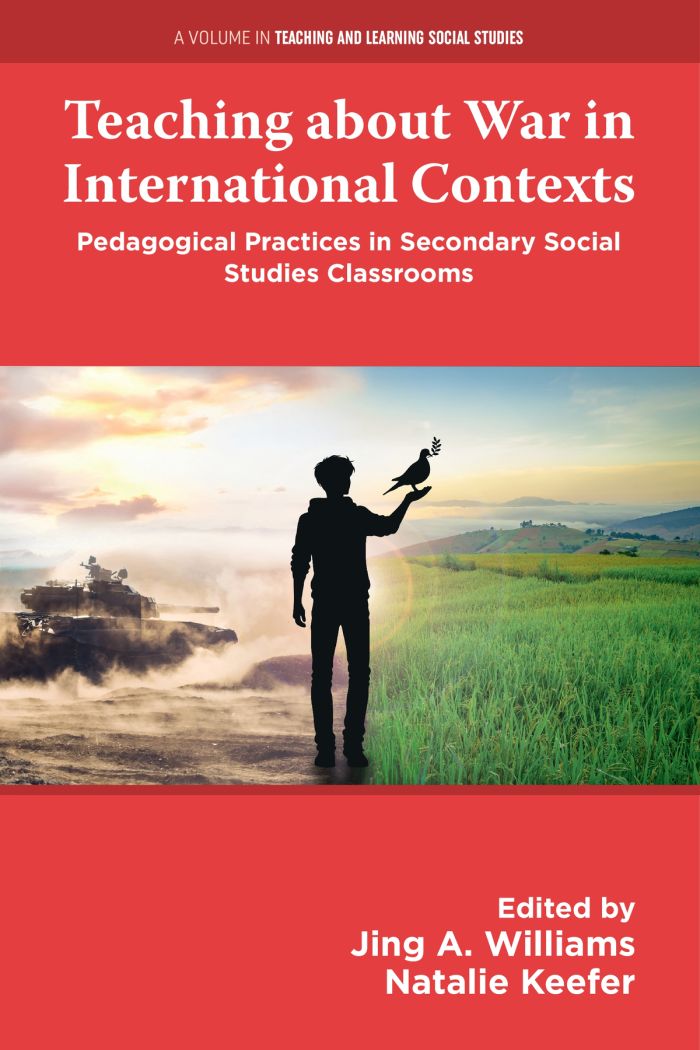
Teaching about War in International Contexts
Pedagogical Practices in Secondary Social Studies Classrooms

This book can be opened with

Note on our eBooks and Audiobooks: you can read our eBooks (ePUB or PDF) and listen to audiobooks on the free Emerald Books app on iOS, Android, and desktop. Or read and listen on Emerald's online reader (ePUB eBooks and audiobooks only). To purchase a digital book you will need to create an account if you don’t already have one. After purchasing you will receive instructions on how to get started.
- Description
- Contents
- About
Social studies teachers cannot avoid teaching about war. They must consider how they can teach about war and related topics meaningfully instead of relegating wars to a body of facts, such as dates, places, names, or casualties. Teaching about war helps students comprehend (de)colonization, cultivates their critical thinking skills, and facilitates student understanding of conflict and peace.
In Teaching about War in International Contexts, the contributors adopt the literal meaning of war—a state of armed conflict between nations, states, or groups within a country or state. While there are books out there focusing on how to teach a specific war, such as the Vietnam War or the Korean War, no books highlight the pedagogical practices of teaching global wars. Thus, Teaching about War in International Contexts fills the gap in the existing literature.
This edited book is an invaluable pedagogical resource highlighting the teaching of war in an international context in secondary (grades 6–12 or equivalent) social studies classrooms worldwide. Featuring the voices of classroom teachers, graduate students who used to be classroom teachers, and teacher educators, this book provides readers with classroom-tested practices for teaching about war. Readers will find examples of lesson planning, teaching strategies, teachers’ reflections, and further teaching resources on specific wars. This edited volume is an invaluable resource for secondary social studies classroom teachers, graduate and undergraduate social studies education students, and social studies curriculum and instruction experts.
Introduction; Jing A. Williams and Natalie Keefer
- Part I. Exploring the Legacy of Colonialism
- Chapter 1. The Decolonization of the Black Hills War; John Adamski and Michael Bayer
- Chapter 2. Deconstructing the Master Narrative of Japan’s Wars; Mizuki Hoshi and Sota Ono
- Part II. Fostering Critical Thinking Skills
- Chapter 3. Just War Theory and the American War of Independence; Jonathan L. Lancaster and Matthew McKenna
- Chapter 4. Teaching about War for Reconciliation: Gender, Memory, and Emotion in East Asia; Boeun Cha
- Chapter 5. Teaching the Cold War in Chinese International Schools: A Lesson about Political Socialization to Promote Reflective Learning; Kyle P. O’Brien and Peter Miller
- Part III. Considering War and Peace
- Chapter 6. Engaging with the Syrian Civil War through Drama Pedagogy: Reflections on Pre-Service Teacher Research; MJ Palombo
- Chapter 7. Creating Memory through a Digital Archive: Inquiry-Based Learning and Holocaust Education; Taylor Hamblin
- Chapter 8. Is the North Atlantic Treaty Organization Producing Chaos or Providing Security? A Lesson about the Complexities of Global Relationships and Agreements; Clint Kovach and Elizabeth Yaeger Washington
- Chapter 9. Teaching Conflict and Peace: Strategies through a Human Rights Education Approach; Jacob Skrzypiec, Sarah Wiederecht, and Ian McGregor
Jing A. Williams is Professor of Social Studies Education at the University of South Dakota.
Natalie Keefer is an Associate Professor of Social Studies Education, Graduate Coordinator, and Co-Director of the Louisiana Center for Research and Education on Languages and Literacies (LA CREoLL) at the University of Louisiana Lafayette.