
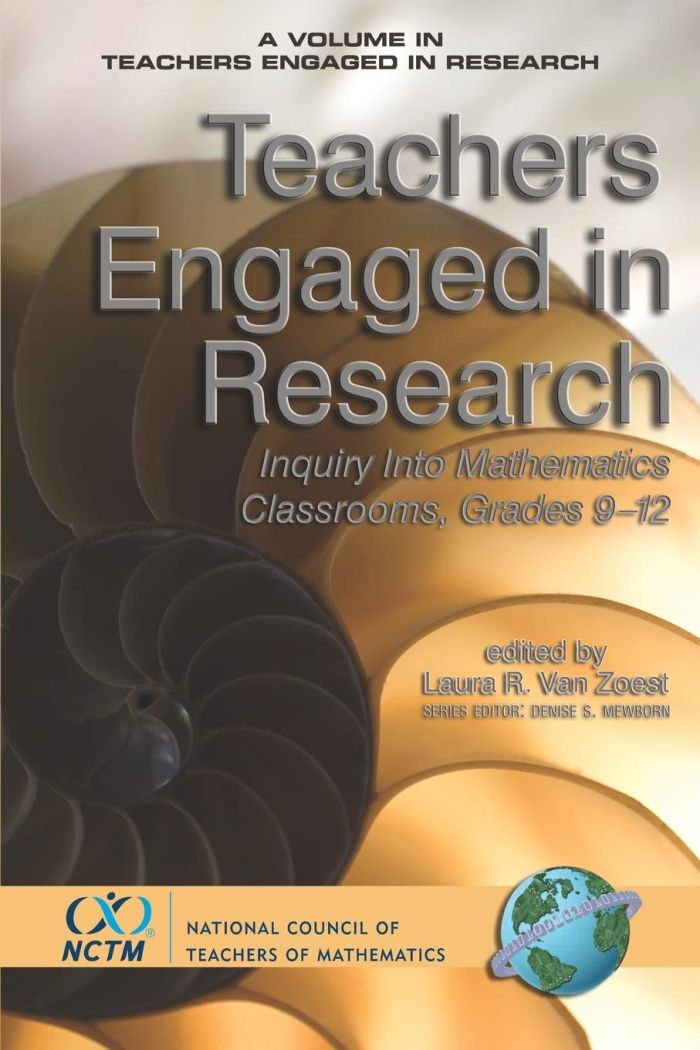
Teachers Engaged in Research
Inquiry in Mathematics Classrooms, Grades 9-12

This book can be opened with

Note on our eBooks and Audiobooks: you can read our eBooks (ePUB or PDF) and listen to audiobooks on the free Emerald Books app on iOS, Android, and desktop. Or read and listen on Emerald's online reader (ePUB eBooks and audiobooks only). To purchase a digital book you will need to create an account if you don’t already have one. After purchasing you will receive instructions on how to get started.
- Description
- Contents
This book provides examples of the ways in which 9-12 grade mathematics teachers from across North America are engaging in research. It offers a glimpse of the questions that capture the attention of teachers, the methodologies that they use to gather data, and the ways in which they make sense of what they find. The focus of these teachers’ investigations into mathematics classrooms ranges from students’ understanding of content to pedagogical changes to social issues. Underlying the chapters is the common goal of enabling students to develop a deep understanding of the mathematics they learn in their classrooms.
Introduction to the Series; Marilyn Cochran-Smith.
- Chapter 1. Introduction to the 9–12 Volume; Laura R. Van Zoest.
- Chapter 2. Probability Simulation: What a Teaching Experiment Revealed About Student Reasoning and Beliefs; Gwendolyn Zimmermann.
- Chapter 3. Student Understanding of the Concept of Limit in a Technological Environment; William J. Harrington.
- Chapter 4. Using Research to Analyze, Inform, and Assess Changes in Instruction; Heather J. Robinson.
- Chapter 5. From Teachers' Conversations to Students' Mathematical Communications; Florence Glanfield, Ann Oviatt and Darlene Bazcuk.
- Chapter 6. Lessons Teachers Can Learn About Students' Mathematical Understanding Through Conversations With Them About Their Thinking: Implications for Practice; Craig Huhn, Kellie Huhn, and Peg Lamb.
- Chapter 7. Navigating the Learning Curve: Learning to Teach Mathematics Through Lesson Study; John Carter, Robert Gammelgaard, and Michelle Pope.
- Chapter 8. Learning From Elementary School Mathematics Research: Changes in the Beliefs and Practices of Secondary School Teachers; Scott Hendrickson and Sharon Christensen, with Vicki Lyons and Adrianne Olson.
- Chapter 9. Giving Voice to Success in Mathematics Class; Janelle McFeetors.
- Chapter 10. Exploring Culture and Pedagogy in Mathematics Class Through Student Interviews; Jesse Solomon.
- Chapter 11. Teaching Mathematics With Problems: What One Teacher Learned Through Research; Nicole Garcia and Patricio G. Herbst.
- Chapter 12. Refreshing Mathematics Instruction Through Motion, Technology, and a Research Collaboration; Apolinário Barros and Dorina Sackman.
- Chapter 13. Collaborating to Investigate and Improve Classroom Mathematics Discourse; Maureen Grant and Rebecca McGraw.
- Chapter 14. Professional Development as a Catalyst for Classroom Change; Michael Verkaik and Beth Ritsema.