
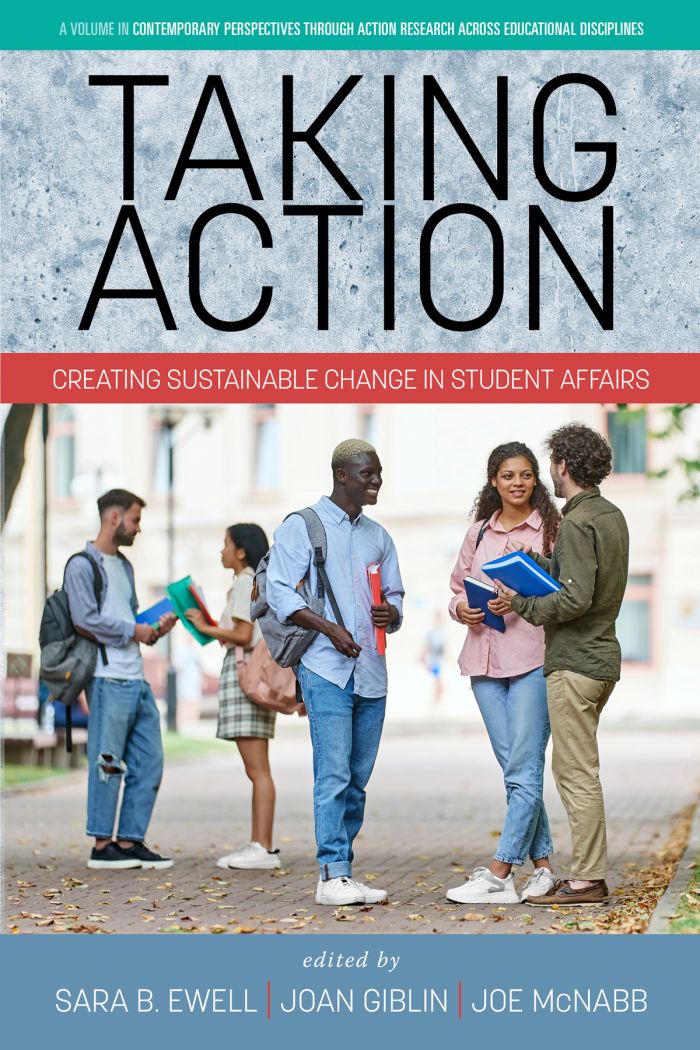
Taking Action
Creating Sustainable Change in Student Affairs

This book can be opened with

Note on our eBooks and Audiobooks: you can read our eBooks (ePUB or PDF) and listen to audiobooks on the free Emerald Books app on iOS, Android, and desktop. Or read and listen on Emerald's online reader (ePUB eBooks and audiobooks only). To purchase a digital book you will need to create an account if you don’t already have one. After purchasing you will receive instructions on how to get started.
- Description
- Contents
Action Research can empower all administrators in higher education to engage more effectively in resolving challenges in colleges and universities. Action Research is a powerful, localized methodology for impacting difficult and complex issues embedded in organizations. Higher education administrators regularly confront these types of difficult issues and hold the responsibility to solve these problems. This book explores the power of action research to impact the work of higher education professionals in student affairs.
Introduction; Sara B. Ewell, Joseph McNabb, and Joan Giblin.
- Acknowledgments.
- Chapter 1. Understanding the Impact of Student Affairs and Student Services Directors' Leadership Style on the Undergraduate Student Experience: An Action Research Study; Thomas Tressler-Gelok.
- Chapter 2. Investigating the Effects of a Peer Mentorship Program on Low-Income, First-Generation Students' Access to Financial Resources; Jennifer Bevins.
- Chapter 3. Sustaining Engagement Among Student Organizational Leads; Brandon Gross.
- Chapter 4. Lateral Transfer Students: What Drives their Decision to Leave and Why Do They Experience Transfer Shock; Christopher Collins.
- Chapter 5. The Importance of Connections and Collaborations to Enhance the Successful Graduate Student Experience; Kathy Dilks.
- Chapter 6. Integrating Mental Health Literacy in Student Affairs Master's Programs; Emily Bauer.
- Chapter 7. A Student Centered Approach: Using Systems Theory to Improve Community Engagement and Belonging; Joseph Castelot.
- Chapter 8. Understanding and Responding to Career Counseling Needs of Chinese International Graduate Students; Lindsey Plewa.
- Chapter 9. A Study of Community College Dropouts: Action Research on How a Peer Mentorship Program Through Phi Theta Kappa (PTK) Honor Society Can Improve Students' Performance; Chunfu Jeff Cheng.
- Chapter 10. Improving Retention of High-Achieving, Generation Z Students at a Private, Liberal Arts University; Lars Farabee.
- Chapter 11. Seeing the Unseen: An Action Research Study of First-Generation College Student Persistence at a Mid-Size Private Institution in the Northeast; Michael A. Urmeneta.
- Chapter 12. HERstory: Giving a Voice to the College Experiences of Black Female Students in the New England Area; Nicole Johnson.
- About the Editors.