
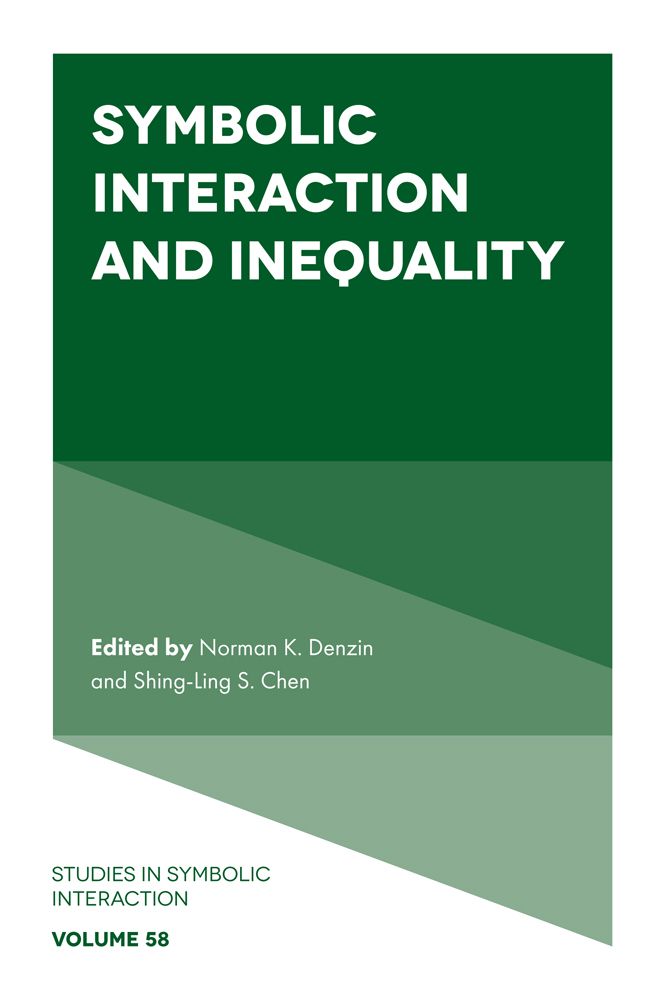


Symbolic Interaction and Inequality

This book can be opened with

Note on our eBooks and Audiobooks: you can read our eBooks (ePUB or PDF) and listen to audiobooks on the free Emerald Books app on iOS, Android, and desktop. Or read and listen on Emerald's online reader (ePUB eBooks and audiobooks only). To purchase a digital book you will need to create an account if you don’t already have one. After purchasing you will receive instructions on how to get started.
- Description
- Contents
- About
Acting as a follow up to Volume 41 of Studies in Symbolic Interaction (2013), Symbolic Interaction and Inequality explores further the concept of Radical Interactionism, a perspective of researching domination and subordination introduced by scholar Lonnie Athens.
Demonstrating advancements made in Radical Interactionism over the past decade, chapters examine the omnipresent and insidious nature of inequality as well as its social construction among family members, cisgender and gender-diverse people, as well as university students and personnel, particularly college athletes.
Highlighting fruitful accomplishments achieved by a range of symbolic interactionists, this volume exhibits the significance of studying inequality, a venture that not only enriches symbolic interactionism but human life as a whole.
Chapter 1. Inequality in Everyday Life; Michael A. Katovich and Shing-Ling S. Chen
- Chapter 2. Identity: Relations, Habitats, Artifacts and Alienation; Robert Perinbanayagam
- Chapter 3. “Too Many Genders?": Ambiguity as Resistance in the Biographical Work of Gender-diverse People; Lilith Green and Carol Rambo
- Chapter 4. A Radical Interactionist Perspective on Family Conflicts and Mothers with Substance Use Problems; Kimberly M. Baker
- Chapter 5. Breaking Step: Silence, Resonance, and Everyday Precariousness in Academic Settings; John C. Pruit, Carol Rambo, and Amanda G. Pruit
- Chapter 6. First-Generation Students’ Identity Construction, Concealment, & COVID-driven Reckonings: Reconciling Self-Definitions Amidst Institutional Contradiction; Linda M. Waldron, Danielle Docka-Filipek, Carlie Carter, and Rachel Thornton
- Chapter 7. Criminalized Subjectivity and Racial Stigma: Implications for the Identity and Self-Concept of Black University Students; Julien Grayer
- Chapter 8. Performance or Appearance: Paradoxical Generalized Others of the College Female Athletes; Shing-Ling S. Chen, Zhuojun Joyce Chen and Courtney Styron
Norman K. Denzin, the longtime editor of Studies of Symbolic Interaction, passed away in August 2023. Regarded as the ‘Father of Qualitative Inquiries’, Prof. Denzin is considered as one of the most important scholars in the 20th and 21st centuries. Other than editing Studies in Symbolic Interaction since its inception in 1978 to the time of his passing, for nearly half of a century, Prof. Denzin authored more than 30 books and countless journal articles, as well as launched and edited major journals and book series.
Shing-Ling S. Chen is Professor of Mass Communication in the Department of Communication and Media at the University of Northern Iowa, USA. Trained by Carl J. Couch as a symbolic interactionist, she studies information technologies and social orders, as well as communication processes and social relationships.