
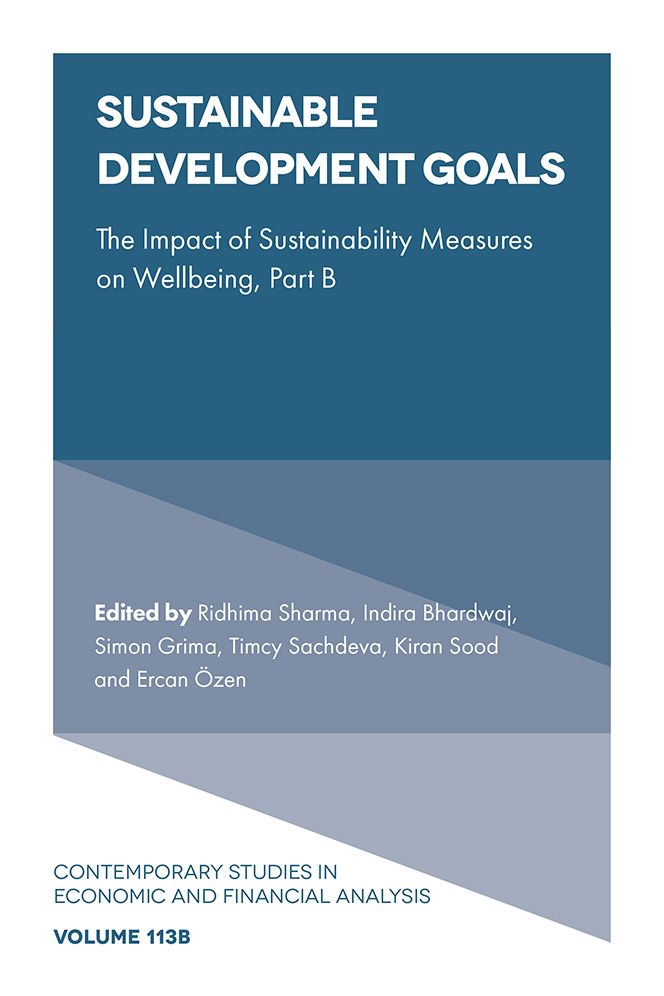

Sustainable Development Goals
The Impact of Sustainability Measures on Wellbeing

This book can be opened with

Note on our eBooks and Audiobooks: you can read our eBooks (ePUB or PDF) and listen to audiobooks on the free Emerald Books app on iOS, Android, and desktop. Or read and listen on Emerald's online reader (ePUB eBooks and audiobooks only). To purchase a digital book you will need to create an account if you don’t already have one. After purchasing you will receive instructions on how to get started.
- Description
- Contents
- About
The global community is at a critical moment in its pursuit of the Sustainable Development Goals (SDGs); crises are threatening decades of development gains, further delaying the urgent transition to greener, more inclusive economies, and throwing progress on the SDGs even further off track. When it comes to sustainability and combating our current climate emergency, we need sustainable solutions that can protect our water, energy and food resources while also aiming for zero waste.
Sustainable Development Goals considers these solutions throughout twelve chapters, introducing the subject of sustainable development then delving into detail of the framework to address these gaps and shortages in different disciplines and sectors. The global drivers of change are analysed and the opportunities and challenges of attainment of development goals are investigated.
Contemporary Studies in Economic and Financial Analysis publishes a series of current and relevant themed volumes within the fields of economics and finance. Both disciplinary and interdisciplinary studies are welcome.
Chapter 1. Investigating The Influence Of Gandhian Values’ On Sustainable Consumption Behaviour; Nancy Gupta, Meenakshi Gandhi, and Ipshita Bansal
- Chapter 2. Sustainable Tourism: A Roadmap for The 2030 Sustainable Development Agenda; Jatin Vaid
- Chapter 3. Sustainability through Human Resource Management: A Conceptual Framework; Nikita Agrawal, Kashish Beriwal, and Nisha Daga
- Chapter 4. Deterrents to Digital Sustainability in MSMEs; Kriti Dhingra and Kanika Dhingra Sardana
- Chapter 5. The Impact of Global Currencies on the Sustainability of the Indian Stock Market ; Isha Narula, Ankita Dawar, and Khushi Sehgal
- Chapter 6. Self-brand Connection and Brand Loyalty as an Outcome of Sustainable Cause-Related Marketing: A Conceptual Framework; Anu Bhardwaj, Nidhi Gupta, and Seema Wadhawan
- Chapter 7. A Systematic Study of Causal Interaction between Natural Gas, India's GDP, and Sustainable Growth; Anita Tanwar
- Chapter 8. Adopting Online Education for Sustainable and Economic Development: A Structural Equation Model; Rashi Jain and Broto R Bhardwaj
- Chapter 9. Increasing Financial Inclusion in India for Sustainable Economic Growth and Development- A SEM Approach; Jitender Kumar Goyal and Yamini Agarwal
- Chapter 10. A Systematic Literature Review on Corporate Governance in India; Anuj Aggarwal, Sparsh Agarwal, Vedant Jaiswal, and Poonam Sethi
- Chapter 11. Enhancing Sustainability through a Quality-Centric Approach; Baljinder Kaur, Adarsh Rajput, and Ayushi Garg
- Chapter 12. Fashion Vlogging for Sustainable Cosmetics: Modelling the Relationship between Hedonic Motivation and Impulse Buying Intention with Parasocial Interaction as a Mediator; Parul Manchanda, Nupur Arora, and Aanchal Aggarwal
Ridhima Sharma is Assistant Professor at Vivekananda Institute of Professional Studies-TC, India.
Indira Bhardwaj is Dean & Professor, School of Business Studies, Vivekananda Institute of Professional Studies-TC, India.
Simon Grima is the Deputy Dean of the Faculty of Economics, Management and Accountancy, Associate Professor and the Head of the Department of Insurance and Risk Management at the University of Malta. Simon is also a Professor at the University of Latvia, Faculty of Business, Management and Economics.
Timcy Sachdeva is Assistant Professor, School of Business Studies, Vivekananda Institute of Professional Studies-TC, India.
Kiran Sood is a Professor at Chitkara Business School, Chitkara University, Punjab, India. She also serves as an Affiliate Professor in the Department of Insurance and Risk Management at the University of Malta. Kiran holds the esteemed position of Research Fellow at the Women Researchers Council, Azerbaijan State University of Economics (UNEC).
Ercan Özen is Associate Professor of Finance in the Department of Finance and Banking, Faculty of Applied Sciences, University of Uşak, Türkiye.