
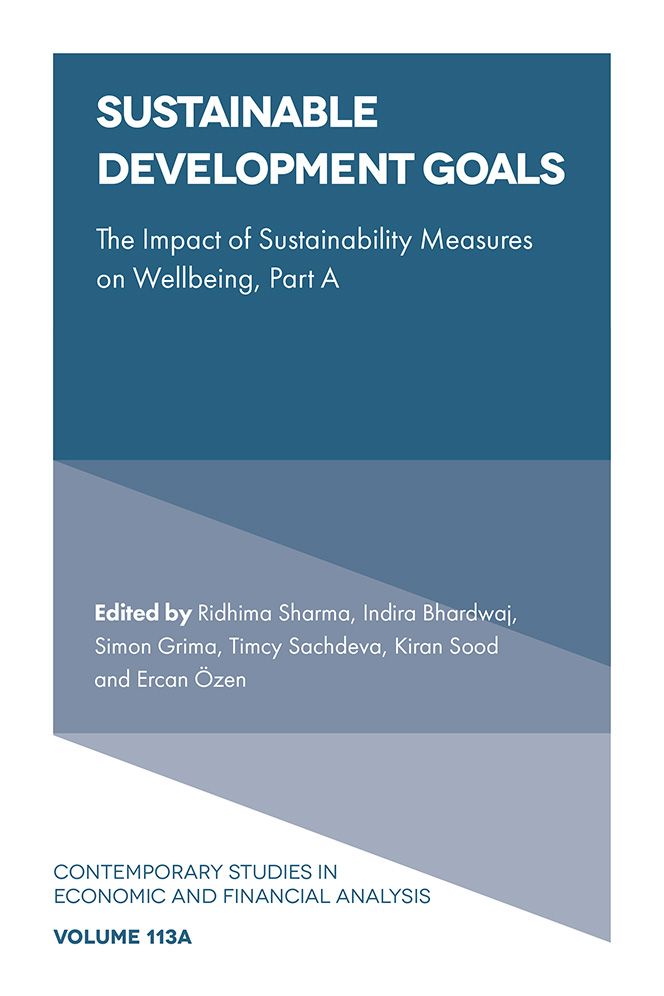

Sustainable Development Goals
The Impact of Sustainability Measures on Wellbeing

This book can be opened with

Note on our eBooks and Audiobooks: you can read our eBooks (ePUB or PDF) and listen to audiobooks on the free Emerald Books app on iOS, Android, and desktop. Or read and listen on Emerald's online reader (ePUB eBooks and audiobooks only). To purchase a digital book you will need to create an account if you don’t already have one. After purchasing you will receive instructions on how to get started.
- Description
- Contents
- About
The global community is at a critical moment in its pursuit of the Sustainable Development Goals (SDGs); crises are threatening decades of development gains, further delaying the urgent transition to greener, more inclusive economies, and throwing progress on the SDGs even further off track. When it comes to sustainability and combating our current climate emergency, we need sustainable solutions that can protect our water, energy and food resources while also aiming for zero waste.
Sustainable Development Goals considers these solutions throughout twelve chapters, introducing the subject of sustainable development then delving into detail of the framework to address these gaps and shortages in different disciplines and sectors. The global drivers of change are analysed and the opportunities and challenges of attainment of development goals are investigated.
Contemporary Studies in Economic and Financial Analysis publishes a series of current and relevant themed volumes within the fields of economics and finance. Both disciplinary and interdisciplinary studies are welcome.
Chapter 1. The Influence of Sustainability Communication on Consumer Loyalty and Brand Reputation; Ishfaq Hussain Bhat, Shilpi Gupta, and Satinder Singh
- Chapter 2. Enabling Sustainability in Higher Education via Perceived Employability, University Commitment, Perceived Organisational Prestige and Student Satisfaction: A PLS-SEM Approach; Shikha Agnihotri, Rekha Mewafarosh, and Shivani Malhan
- Chapter 3. The Key for Sustainable Companies: Difficulties In Measuring Service Quality And An Evaluation Of The Servqual Scale; Ali Kuzu
- Chapter 4. The Impact of Fintech on the Achievement of Environmental, Social, and Governance (ESG) Goals; Albulena Shala and Vlora Berisha
- Chapter 5. Investigating the Determinants and Consumer Preferences of Sustainable Consumption and Production Adoption among Fast Moving Consumer Goods (FMCG) Manufacturers; Zahid Hussain and Arman Khan
- Chapter 6. The Moderating Impact of Personality and Demographic Factors on the Relationship Between Work-Life Balance and Well-Being of the Ayurvedic Doctors: Evidence from Sri Lanka; Narayanage Jayantha Dewasiri ,Salwathura Acharige Menu Jayamini Salwathura, Mananage Shanika Hansini Rathnasiri, Simbiya Hevage Madu Lakmini Walakumbura, Jathun Dahanayaka Kaushalyani Ruwandika,Yasangi Anuradha Iddagoda, and Kiran Sood
- Chapter 7. Surveillance and the Right to Privacy for Sustainability of A Digital Economy: An Examination of the Data Protection Bill 2019; Farha Khan and Akansha Mer
- Chapter 8. Enhancing Banking Sustainability Through Employee Green Behaviour And Green Banking Initiative: A Synergistic Approach For A Greener Future; Jyoti Kumari, Chandan Gupta, Priya Jindal, Amar Mishra, and Kiran Sood
- Chapter 9. Achieving Sustainable Development Goals by Sustainable Marketing Practices: An Integrated Approach to Environmental, Social, and Economic Sustainability; Rajni Bala
- Chapter 10. Entrepreneurship and Frugal Innovation for Realising SDG Goals in Global Context; Namrata Prakash, Suruchi Sharma, and Priya Jindal
- Chapter 11. Aligning Investments with Values: Creating Portfolios Based on Corporate Social Responsibility and Nim; Sakshi Sachdeva and Latha Ramesh
- Chapter 12. The Impact of Carbon Neutrality Pledges on Indian Companies’ Stock Performance; Ashu Lamba and Anuj Aggarwal
Ridhima Sharma is Assistant Professor at Vivekananda Institute of Professional Studies-TC, India.
Indira Bhardwaj is Dean & Professor, School of Business Studies, Vivekananda Institute of Professional Studies-TC, India.
Simon Grima is the Deputy Dean of the Faculty of Economics, Management and Accountancy, Associate Professor and the Head of the Department of Insurance and Risk Management at the University of Malta. Simon is also a Professor at the University of Latvia, Faculty of Business, Management and Economics.
Timcy Sachdeva is Assistant Professor, School of Business Studies, Vivekananda Institute of Professional Studies-TC, India.
Kiran Sood is a Professor at Chitkara Business School, Chitkara University, Punjab, India. She also serves as an Affiliate Professor in the Department of Insurance and Risk Management at the University of Malta. Kiran holds the esteemed position of Research Fellow at the Women Researchers Council, Azerbaijan State University of Economics (UNEC).
Ercan Özen is Associate Professor of Finance in the Department of Finance and Banking, Faculty of Applied Sciences, University of Uşak, Türkiye.