
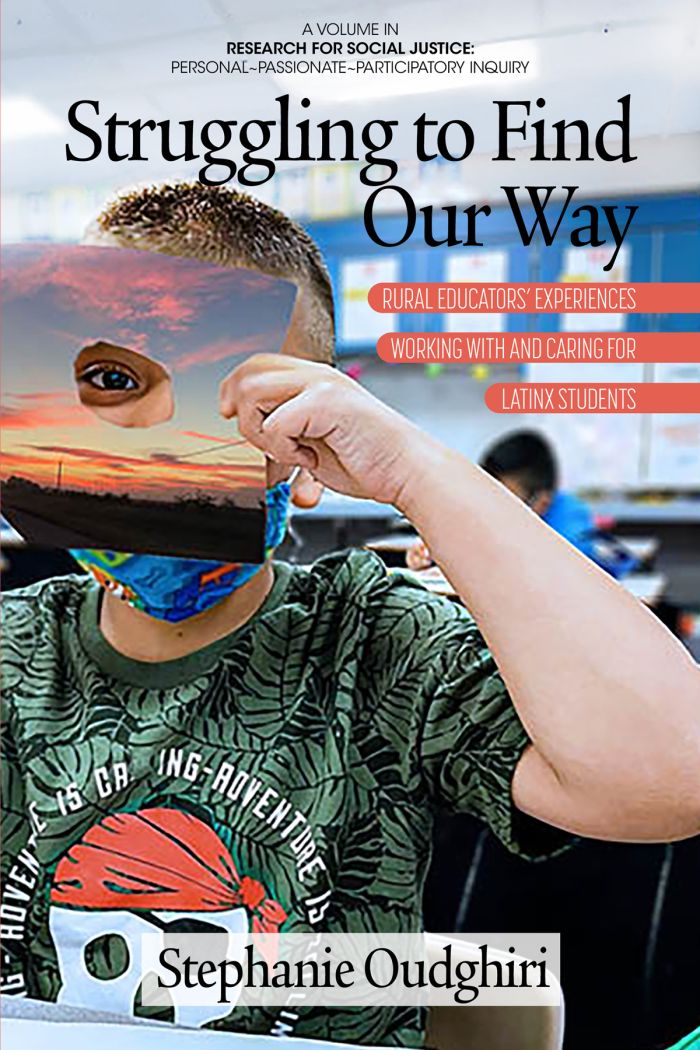
Struggling to Find Our Way
Rural Educators' Experiences Working With and Caring for Latinx Students

This book can be opened with

Note on our eBooks and Audiobooks: you can read our eBooks (ePUB or PDF) and listen to audiobooks on the free Emerald Books app on iOS, Android, and desktop. Or read and listen on Emerald's online reader (ePUB eBooks and audiobooks only). To purchase a digital book you will need to create an account if you don’t already have one. After purchasing you will receive instructions on how to get started.
- Description
- Contents
Rural communities across the United States are experiencing a rapid increase in the number of immigrant students. While the number of culturally and linguistically diverse students continues to grow within midwestern states, the demographics of teachers remain white, female, and monolingual. Often teachers have little to no training working with students and their families whose backgrounds differ from their own. Thus, there is a great urgency for teachers to develop culturally competent teaching practices that address the needs of all students. The purpose of this year-long, school-based narrative inquiry was to examine the beliefs, attitudes, and practices of rural educators as they described their work with Latinx immigrant, elementary students, negotiated the “space” between a professional and personal identity and demonstrated an ethic of care. This inquiry is arranged into “livings, tellings, retellings, and relivings” (Clandinin & Connelly, 2000, p. 70) and serves to shed light on the entwined lived experiences of myself, my participants, and the community in which we reside. Grounded in Noddings (1984; 2012) work on authentic caring and Valenzuela’s (1999) concept of culture and caring relations for Latinx students, Swanson’s middle range theory of care (1991, 1993) which served as the conceptual framework that illuminated how my participants discussed working with and caring for their Latinx immigrant students.
In Struggling to Find Our Way: Rural Educators’ Experiences Working with And Caring for Latinx Immigrant Students, Stephanie Oudghiri’s one-year school-based narrative inquiry is a carefully crafted balance of creativity and rigor with the right notes to engage the reader, challenge them to think, wonder at what they can do, and imagine possibilities for a more socially just education system. In this book, Oudghiri examines the beliefs, attitudes, and practices of two white teachers and one Hispanic paraprofessional working with and caring for immigrant students in a rural Indiana community.
Due to the sensitive nature of this inquiry, which focuses on teachers’ relationships with vulnerable populations (immigrant and undocumented), Oudghiri’s book serves as a model for active engagement by creating a strong sense of place, a strong sense of who these teachers and students are, and a strong sense of being in the midst of community and school life. What is unique and compelling about Oudghiri’s writing, is her focus on stories of the teachers working in her school site, and the children in their classrooms. She provides strong evidence using a compassionate lens and the art of storytelling to illuminate lives in the school.
Series Foreword; Ming Fang He and JoAnn Phillion.
- Foreword: Reliving and Retelling in Ririe, Indiana; Janet Alsup.
- Chapter 1. Life in Second Grade Consisted of a Daily Reminder That I Didn't Belong.
- Chapter 2. They Don't Know. They Don't Know Where We've Been and How We Got Here.
- Chapter 3. Choosing to Make Meaning of the World Narratively.
- Chapter 4. Come On. You Need to be Trying.
- Chapter 5. Care is the Same. I Mean, Yes, My ESL Kids Do Need More, But Care is Care.
- Chapter 6. Step Out of Doors.
- Chapter 7. In Community.
- Chapter 8. Active Hope.
- References.
- About the Author.