
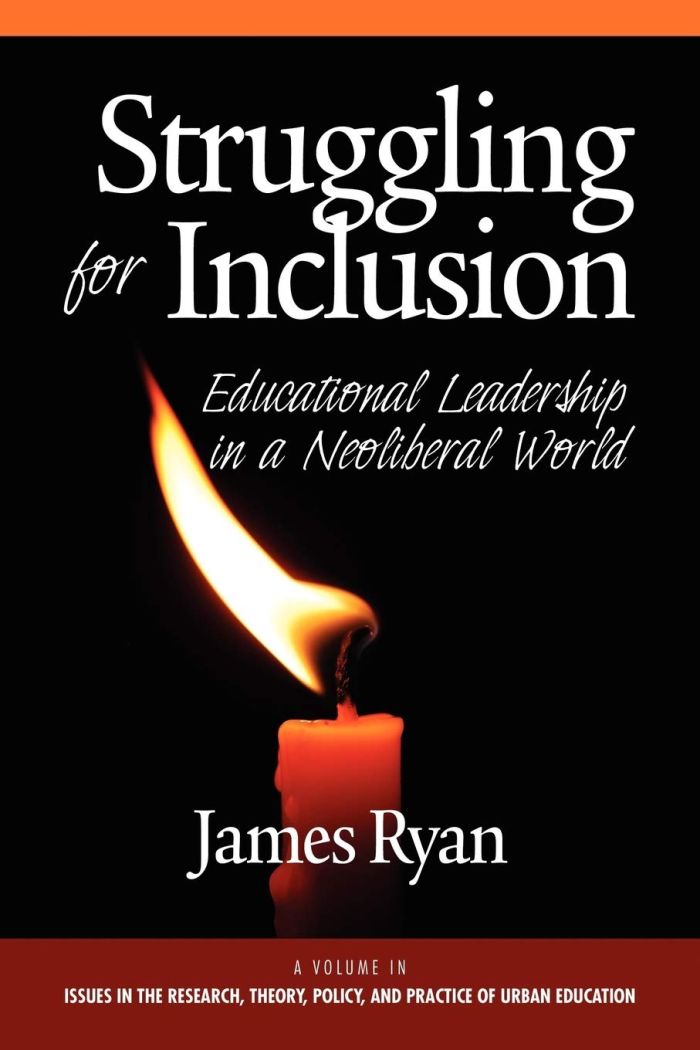

Struggling for Inclusion
Educational Leadership in a Neoliberal World

This book can be opened with

Note on our eBooks and Audiobooks: you can read our eBooks (ePUB or PDF) and listen to audiobooks on the free Emerald Books app on iOS, Android, and desktop. Or read and listen on Emerald's online reader (ePUB eBooks and audiobooks only). To purchase a digital book you will need to create an account if you don’t already have one. After purchasing you will receive instructions on how to get started.
- Description
- Contents
This book describes the struggles in which inclusive-minded administrators find themselves when they promote equity initiatives. Administrators routinely struggle when they attempt to include all members of their school communities – teachers, students, and parents – in the various aspects of schooling. Given the presence of a host of obstacles, setting right the injustices associated with racism, classism, sexism, ableism, homophobia, and other exclusive practices is not an easy thing to do. Resistance from colleagues who fail to recognize exclusive practices when they see them, and from others who do recognize them but see no harm, too few resources, exclusive policies, personal uncertainties or insecurities, and conflicted priorities are just a few of the phenomena that get in the way of these efforts. This book explores these struggles. It looks at the contexts within which these encounters occur, the various challenges that inclusive-minded administrators encounter, and the strategies that they employ to meet these tests.
Employing the results of original empirical studies, surveys of current research, recent theoretical literature and personal experiences, this book seeks to provide school leaders with a sense of what it is like to promote inclusion and equity in the contemporary neoliberal context. Among other things, it looks to provide educators of an understanding of the obstacles that stand in the way of inclusion, the nature of the struggles that await them, and ideas for what they might do. Among other things, the book concludes that in relation to the pursuit of inclusion: (1) exclusion continues to be part of contemporary schools and communities; (2) struggles for inclusion transcend individual educators, students and parents; (3) administrators are sometimes part of the problem of exclusion; (4) administrators struggle with issues of difference; (5) administrators struggle with circumstances they inherit, people with whom they work, and with themselves; and (6) administrators have resources to employ in their struggles for inclusion.
Acknowledgements
- Series Editors' Preface
- Chapter 1. Struggling for Inclusion
- Chapter 2. The Exclusive Neoliberal Context of Education
- Chapter 3. Struggling for Diversity in the Teacher Workforce: Leaky Pipelines, Bottlenecks, and Glass Ceilings.
- Chapter 4. Dialogue, Identity and Inclusion: Administrators as Mediators in Diverse School Contexts
- Chapter 5. Hierarchies, Markets, and Inclusion: Administrative
- Chapter 6. Communication in a Diverse School Context
- Chapter 7. Establishing Inclusion in a New School
- Chapter 8. Acumen and Inclusion: Principals' Political Strategies
- Chapter 9. Struggling for Inclusion
- References.