
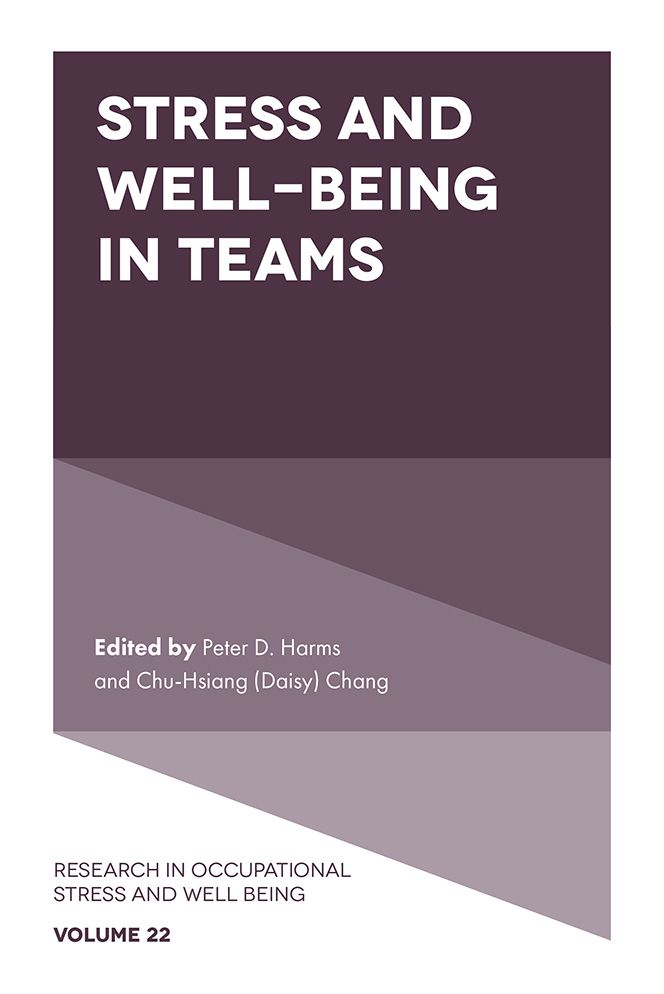

Stress and Well-Being in Teams

This book can be opened with

Note on our eBooks and Audiobooks: you can read our eBooks (ePUB or PDF) and listen to audiobooks on the free Emerald Books app on iOS, Android, and desktop. Or read and listen on Emerald's online reader (ePUB eBooks and audiobooks only). To purchase a digital book you will need to create an account if you don’t already have one. After purchasing you will receive instructions on how to get started.
- Description
- Contents
- About
Stress and Well-Being in Teams is focused on stress and well-being in the context of teams, focused on how inputs of team processes, such as team compositions, leadership, and broader organizational contexts can serve as antecedents of team members’ stress and well-being.
This 22nd volume of the Research in Occupational Stress and Well Being series highlights the importance of team processes and outcomes on the stress and well-being of team members and leaders, and how their stress and well-being may have reciprocal effects on the critical team inputs, processes, and outcomes over time.
Chapters in this volume cover a range of topics including:
- How team inputs such as member composition and task characteristics may influence the stress and well-being of members and leaders.
- How the internal and external contexts in which the teams operate may impact the stress and well-being of both team members and leaders.
- How team processes such as cohesion, coordination, and collaboration may have reciprocal effects with the stress and well-being of team members and leaders.
- How teamwork in extreme contexts may be leveraged to inform teamwork in typical organizational settings and vice versa from both conceptual and empirical perspectives.
- How and when team processes and outcomes related to members’ stress and well-being may relate to other team characteristics and processes over time.
- Methodological issues and considerations for understanding stress and well-being in the team context.
- How and when team processes and outcomes related to members’ stress and well-being may relate to other team characteristics and processes over time.
- Methodological issues and considerations for understanding stress and well-being in the team context.
Chapter 1. Meeting the Challenge of Team Resilience in the Field; Michael A. Rosen, Molly Kilcullen, Sarah Davis, Tiffany Bisbey, and Eduardo Salas
- Chapter 2. The Competitive Conundrum: Exploring Multilevel Competitive Influences on Stress and Well-Being; Tyler N.A. Fezzey and R. Gabrielle Swab
- Chapter 3. Psychological Capital as a Predictor of Health, Well-Being, and Safety Outcomes: Insights for Team-level Psychological Capital; Saeed Loghman and Azita Zahiriharsini
- Chapter 4. Mindfulness in Teams; Gavriella Rubin Rojas, Jennifer Feitosa, and M. Gloria González-Morales
- Chapter 5. A Social Network Perspective of Work Engagement on Teams; Alyssa Birnbaum and M. Gloria González-Morales
- Chapter 6. Can Effective Teamwork Enhance Members’ Well-Being?; Elizabeth Bell, Gabriela Fernández Castillo, Maha Khalid, Gabrielle Rufrano, Allison M. Traylor, and Eduardo Salas
- Chapter 7. From Performance to Well-Being: Broadening the Team Resilience Discourse; Allen Shorey, Lauren H. Moran, Christopher W. Wiese, and C. Shawn Burke
- Chapter 8. Managing Spaceflight Team Stress: Considerations for Multiteam System Research; Laura Bauer, Caton Weinberger, Dorothy R. Carter, and Lauren Blackwell Landon
Peter D. Harms is the Frank Schultz Endowed Professor of Business in the Management Department at the Culverhouse College of Business, University of Alabama, USA.
Chu-Hsiang (Daisy) Chang is a Professor in the Department of Psychology at Michigan State University, USA.