
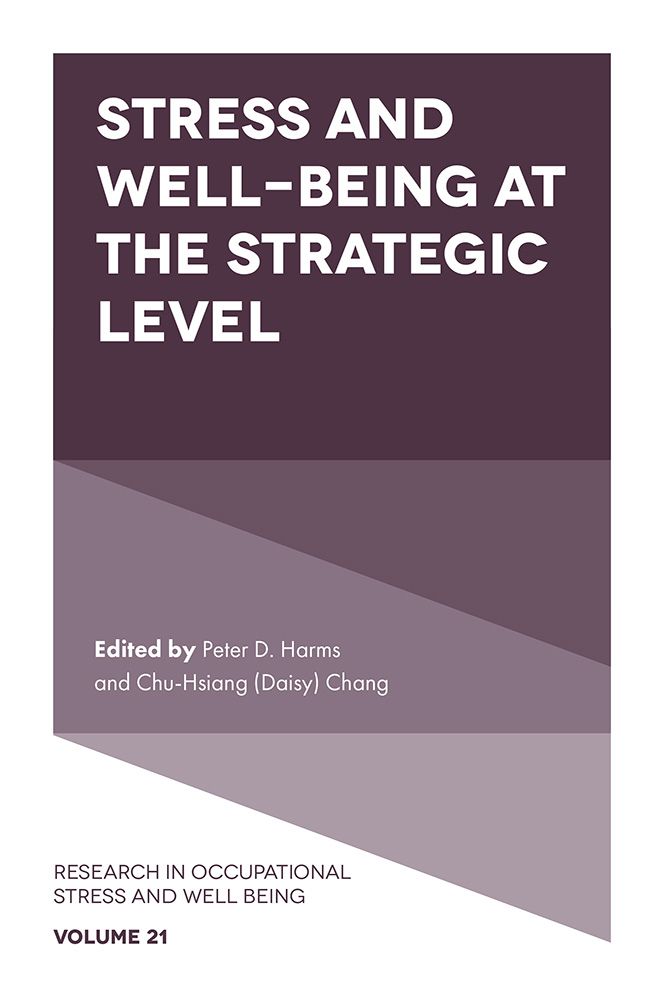

Stress and Well-Being at the Strategic Level

This book can be opened with

Note on our eBooks and Audiobooks: you can read our eBooks (ePUB or PDF) and listen to audiobooks on the free Emerald Books app on iOS, Android, and desktop. Or read and listen on Emerald's online reader (ePUB eBooks and audiobooks only). To purchase a digital book you will need to create an account if you don’t already have one. After purchasing you will receive instructions on how to get started.
- Description
- Contents
- About
Volume 21 of Research in Occupational Stress and Well Being focuses on stress and well-being as it pertains to strategic management and decision-making. In the past few decades, the strategic leadership of firms has been faced with unprecedented challenges in terms of technological changes, economic and political crises, and radical shifts in the workplace owing to health crises. These events have highlighted the need to understand the consequences of stress as a factor impacting strategic decisions. At the same time, firms are increasingly realizing the need to account for the stress and well-being of their employees, their customers, and their communities as factors influencing the ability of their businesses to flourish in a sustainable manner.
Chapters in this volume cover a range of topics including:
- How stress and well-being can influence the decision-making and effectiveness of higher management teams.
- How organizational changes such as mergers/acquisitions or downsizing might impact the stress and well-being of both leaders and followers.
- Strategic initiatives that might directly or indirectly promote the well-being of organizational members or customers.
- CEO mental health and its consequences for strategy and organizational effectiveness.
- Strategic decision-making in times of crisis.
Highlighting how both leader and follower stress and well-being can serve as antecedents and consequences of strategic actions and initiatives, or even be a core concern of strategic plans, Stress and Well-Being at the Strategic Level spotlights the importance of stress and well-being for organizations, their leaders, and the individuals who are impacted by their decisions.
Chapter 1. Firm Stress, Adaptive Responses, and Unpredictable, Resource-Depleting External Shocks: Leveraging Conservation of Resources Theory and Dynamic Capabilities; Erin Bass, Ivana Milosevic, and Sarah E. DeArmond
- Chapter 2. The Reciprocal Relationship between M&A Strategic Decision-making and Well-Being; Kris Irwin and Chris H. Willis
- Chapter 3. Work-Nonwork Policies and Practices: The Strategic Opportunity to Consider Organizational Boundary Management Systems; Haley R. Cobb and Bradley J. Brummel
- Chapter 4. Publicly Invulnerable, Privately Lonely: How the Unique Individual and Structural Characteristics of Their Organizational Role Contribute to CEO Lonelinees; Sarah Wright, Anthony Silard, and Alaric Bourgoin
- Chapter 5. Cracking the CEO's Brain on Risk: Exploring the Interplay between CEO Cognition and Affect Intensity in Organizational Decision-Making and its Outcomes; Steven J. Hyde and Cameron J. Borgholthaus
- Chapter 6. Sentiment Analysis for Organizational Research; Chapman J. Lindgren, Wei Wang, Siddarth K. Upadhyay, and Vladimer B. Kobayashi
- Chapter 7. Leader Energy Driving Personal and Firm-Level Wellness: Lessons from 20 Years of the Leadership Pulse; Theresa M. Welbourne
Peter D. Harms is the Frank Schultz Endowed Professor of Business in the Management Department at the Culverhouse College of Business, University of Alabama, USA.
Chu-Hsiang (Daisy) Chang is a Professor in the Department of Psychology at Michigan State University, USA.