
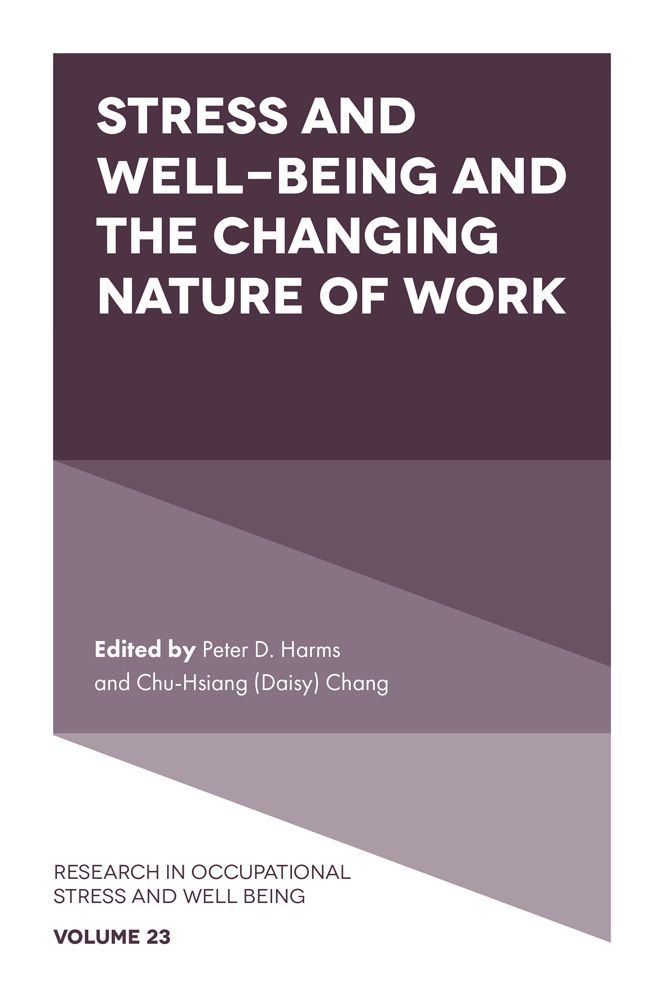
Stress and Well-Being and the Changing Nature of Work

This book can be opened with

Note on our eBooks and Audiobooks: you can read our eBooks (ePUB or PDF) and listen to audiobooks on the free Emerald Books app on iOS, Android, and desktop. Or read and listen on Emerald's online reader (ePUB eBooks and audiobooks only). To purchase a digital book you will need to create an account if you don’t already have one. After purchasing you will receive instructions on how to get started.
- Description
- Contents
- About
Volume 23 of Research in Occupational Stress and Well-Being explores the intricate relationship between stress, well-being, and the evolving nature of work in the 21st century. In light of profound global disruptions—including the COVID-19 pandemic—and the rapid acceleration of technology, the workplace has undergone fundamental transformation. This volume critically examines how these shifts have reshaped the meaning, structure, and experience of work, often resulting in greater precarity, alienation, and psychological strain for workers. Through empirical studies and theoretical commentaries, contributors investigate the psychosocial impact of these changes on individuals and organisations alike.
Topics addressed in this volume span a wide range of contemporary issues, including the rise of remote work and its implications for employee identity and teamwork, the growth of precarious and gig employment, and the resurgence of labour movements and worker activism. Additional chapters examine the role of emerging technologies such as artificial intelligence and robotics in both alleviating and exacerbating workplace stress, as well as organisational responses to crisis and the integration of immigrant and refugee populations into the workforce. Together, these contributions provide a timely and comprehensive analysis of how stress and well-being are being redefined in a world of work that is increasingly fluid, digital, and uncertain.
Chapter 1. What Does “Hybrid Work” Truly Mean? The Conceptualization and Operationalization of Hybrid Work in Occupational Health Research; Eleni Giannakoudi, Anita C. Keller, Susanne Scheibe, and Jessica de Bloom
- Chapter 2. How Remote Work is Redefining Teamwork: A Systematic Literature Review on the Consequences of Remote Work for Team Processes and Team Emergent States; Sabina Hodzic and Bettina Kubicek
- Chapter 3. Gig and Taxi Drivers’ Experiences Working in the United States during COVID-19; Amy M. Schuster, Michael L. Tidwell, Gwendolyn Paige Watson, Noah Britt, Elizabeth A. Mack, and Shelia R. Cotten
- Chapter 4. Exploring the Hidden Connections Between Organizational Environmental Sustainability and Employee Well-Being; Maie Stein, Clara Kühner, and Hannes Zacher
- Chapter 5. Well-being at (anti)work: How antiwork attitudes impact well-being; Seth Butler, Amber Olson, and Elissa Borchert Shults
- Chapter 6. Labour Unions and Mental Health; Diana Serban and E. Kevin Kelloway
- Chapter 7. The health and well-being of migrant workers: A review of the full migration cycle; Fang Li and Yiwen Zhang
- Chapter 8. Job quality in the platform-based food delivery sector in Taiwan from a gender perspective; Bo-Yi Lee
Peter D. Harms is the Frank Schultz Endowed Professor of Business in the Management Department at the University of Alabama’s Culverhouse College of Business. His research focuses on the assessment and development of leadership, personality, and psychological well-being.
Chu-Hsiang (Daisy) Chang is a professor at the Department of Psychology of Michigan State University. Her research interests focus on occupational health and safety, leadership, and motivation.