
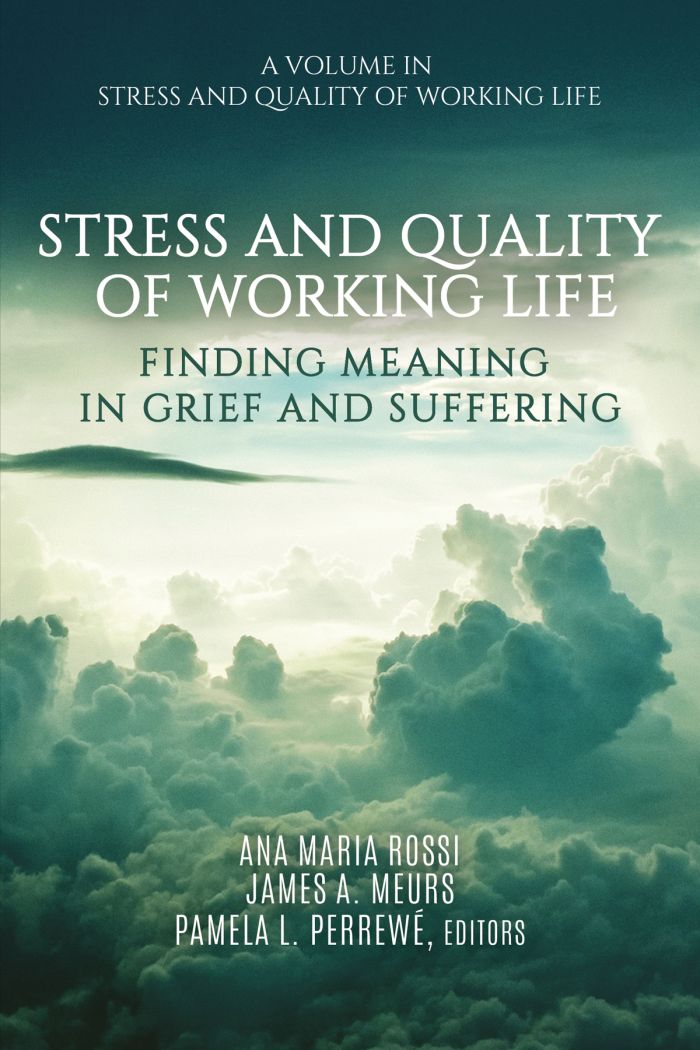

Stress and Quality of Working Life
Finding Meaning in Grief and Suffering

This book can be opened with

Note on our eBooks and Audiobooks: you can read our eBooks (ePUB or PDF) and listen to audiobooks on the free Emerald Books app on iOS, Android, and desktop. Or read and listen on Emerald's online reader (ePUB eBooks and audiobooks only). To purchase a digital book you will need to create an account if you don’t already have one. After purchasing you will receive instructions on how to get started.
- Description
- Contents
According to the American Institute of Stress (AIS), job stress is far and away the primary source of stress for American adults. The relationship between job stress and heart attacks, hypertension, and other disorders is well understood. Further, the cost of job stress in the United States is estimated to be over $300 billion due to outcomes such as accidents, turnover, and lost productivity. Perhaps the most consistent findings connecting job stress to health outcomes confirm that employees who perceive a high level of job demands without the appropriate control over job demands are at an increased risk for cardiovascular disease.
In Brazil, the loss is estimated at 3.5% of the gross domestic product per year. Occupational diseases are related to the activities performed by workers and to working conditions and can trigger new or worsen already existing symptoms. Proper diagnosis and relevant information are essential for managers and workers to become aware of stressors and to take efficient measures to manage stress. Although quality of life is the responsibility of every individual, companies will definitely be able to benefit from the implementation of preventive actions, thus avoiding to pay a high price as a result of absenteeism, sick leaves, and drops in productivity and low work quality.
This book is designed to be an additional tool to provide information and to suggest ways to deal with pressures and work demands, because stress levels are still on the rise. We believe that through information – and here you will be able to find the experience and opinions of recognized professionals in this area – workers will be able to live better and more balanced lives.
Foreword.
- Preface.
- Section I. Grief And Death In The Workplace.
- Chapter 1. Acknowledging Employees' Grief: The Role of Organizational Support; Hadar Freidin, Sharon Toker, and Keren Turgeman-Lupo.
- Chapter 2. Invisible Grief: An Examination of Miscarriage in the Workplace; Kaylee J. Hackney, Cindy Wu, and Joyce E. Nuner.
- Chapter 3. Heroes Need Some Help Too; Jucimara Zacarias Martins, Cristian Zanon, João Paulo Araújo Lessa, and Walkíria Santana Garcia Cristaldo.
- Chapter 4. Mortality Salience in the Workplace: An Integrative Review and Implications for Supervising Jobs With High Exposure to Death; Alexandra Jacobsen and Terry A. Beehr.
- Section II. Surgical And Neurological Stress.
- Chapter 5. Stress and Surgery; Adamastor Humberto Pereira.
- Chapter 6. The Impact of the Environment on the Brain; Priscilla Bencke.
- Section III. Stress And Suffering Of Employees.
- Chapter 7. Do That One More Time and I'll Scream: Self-Regulation and Abusive Supervision in the Workplace; Charn P. McAllister and Jeremy D. Mackey.
- Chapter 8. Manifestations of Occupational Stress in Brazilian Teachers; Luciano Zille Pereira and Flávia Amélia Lopes Nogueira.
- Chapter 9. Bank Jobs and Psychological Suffering in the Flexible Accumulation Paradigm; Odete Cristina Pereira Reis, Anderson de Souza Sant' Anna, and Jaqueline Ferreira.
- Section IV. Emerging Topics In Work Well-being.
- Chapter 10. Mind Wandering at Work: When Employees' Thoughts Drift Away; Einat Yaor and Sharon Toker.
- Chapter 11. Well-Being at Work: The Perception of Public Employees; Luciana Arder S. Medeiros.
- Chapter 12. Illegitimate Tasks as Offense to the Self; Marcus J. Fila, Norbert K. Semmer, and Erin M. Eatough.
- Author Bio.
- Sketches.